Papers by Stephen Lambert
Draft AIO Paper
This is the draft of a paper in preparation for the series Attic Inscriptions Online (AIO) Papers... more This is the draft of a paper in preparation for the series Attic Inscriptions Online (AIO) Papers. In the final version we plan to extend the chronological scope of the chart to 200 BC. In the meantime I should welcome any corrigenda or suggestions for improvements.
A. Makres and P. J. Rhodes (eds.), Grammata Archaia. Studies in Memory of David M. Lewis, 471-81, 2024
This is the corrected proof of a paper, published in 2024, which argues that, with one aborted ex... more This is the corrected proof of a paper, published in 2024, which argues that, with one aborted exception, the Athenian Assembly did not provide for honorific statues to be erected on the Acropolis until after 168 BC.
List of Published Work, 2025
This is my list of published works updated to 10 June 2025.

Athens was a city of the written word. The public bodies of Athens and Attica and individual resi... more Athens was a city of the written word. The public bodies of Athens and Attica and individual residents inscribed more words on stone than the citizens of any other Greek city. There are well over 20,000 Attic inscriptions on stone, and the production is continuous from the archaic period through to the end of antiquity. The sheer quantity of the material endows the epigraphical record with historical potential of a character distinctly different from any other Greek city. Together with the rich literary record — a disproportionate quantity of the literary evidence for ancient Greece, especially of the classical period, was produced by Athenians or Athenian residents — it enables the history of Athens to be written across a span of time and in a depth and detail that is unique in the Greek world and otherwise usually possible only for more modern polities. [A revised version of this chapter was posted on academia.edu on 25 Nov. 2019]

Inscribed Athenian Laws and Decrees in the Age of Demosthenes
Inscribed Athenian Laws and Decrees in the Age of Demosthenes, 2018
This book collects twelve papers which make original contributions to the historical interpretati... more This book collects twelve papers which make original contributions to the historical interpretation of inscribed Athenian laws and decrees, with a core focus on significant historical shapes and patterns implicit in the corpus of the age of Demosthenes. Following a synthetic Introduction, two chapters analyse locations and selectivity of inscribing, four explore the implications of the inscriptions for Athenian policy and for developing attitudes to the past, three for aspects of Athenian democracy. The volume concludes with two studies of specific inscriptions. Some of the papers have appeared elsewhere in conference proceedings and Festschriften, some are published here for the first time. The volume complements the author’s previous collection, Inscribed Athenian Laws and Decrees 352/1-322/1. Epigraphical Essays.
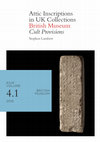
AIUK 4.1 is the first part of our publication of the Attic inscriptions in the British Museum, wh... more AIUK 4.1 is the first part of our publication of the Attic inscriptions in the British Museum, which is designed to supersede E. L. Hicks ed., Ancient Greek Inscriptions in the British Museum. Part I (Attika) (1874), as supplemented by the Attic material included in F. H. Marshall ed. Part IV. Section II (1916). This part contains new editions of three inscriptions of the 5th century BC which make cult provisions, a boustrophedon altar from the City Eleusinion, a sacrificial calendar, and the ordinances of the deme Skambonidai. In addition to updating the editions in the light of the progress of scholarship since 1874, including new fragments, we improve the current published texts of the inscriptions and make original contributions to their interpretation. We also discuss the history of their acquisition by the Museum in the 18th and 19th centuries, and the roles played by Richard Chandler, the Society of Dilettanti and Lord Elgin.
AIO Papers
AIO Papers are academic papers that discuss inscriptions translated on Attic Inscriptions Online.
The Journal of Hellenic Studies, 1982
The purpose of this note is to bring to light a piece of evidence on the ‘Lelantine War’ which ha... more The purpose of this note is to bring to light a piece of evidence on the ‘Lelantine War’ which has hitherto been neglected, and briefly to review the Thucydidean and some of the other evidence in the light of it.
AIO Papers 1, 2014
This paper accompanies the publication on AIO of the inscriptions of the Marathonian Tetrapolis a... more This paper accompanies the publication on AIO of the inscriptions of the Marathonian Tetrapolis and is designed primarily to clarify the texts on which the translations are based. It reviews scholarship on the Tetrapolis’ sacrificial calendar (iv BC), published since my new edition, ZPE 130 (2000), 43-70, and makes some fresh observations. It also reviews the other inscriptions attributable to the Tetrapolis, IG I3 255, IG II2 2933, IG II2 1243, and an unpublished inscription.
This paper accompanies the publication on AIO of the inscriptions of the Marathonian Tetrapolis a... more This paper accompanies the publication on AIO of the inscriptions of the Marathonian Tetrapolis and is designed primarily to clarify the texts on which the translations are based. It reviews scholarship on the Tetrapolis’ sacrificial calendar (iv BC), published since my new edition, ZPE 130 (2000), 43-70, and makes some fresh observations. It also reviews the other inscriptions attributable to the Tetrapolis, IG I3 255, IG II2 2933, IG II2 1243, and an unpublished inscription.
AIO Papers 4, 2014
After exploring features of the history and methodology of Attic epigraphy, this paper surveys th... more After exploring features of the history and methodology of Attic epigraphy, this paper surveys the corpus of 121 Athenian decrees of 229/8-198/7 BC recently published as IG II3 1, 1135-1255 (sections I-II of IG II3 1 fascicule 5). It reviews the decrees by category, discussing some historical aspects and proposing some improvements to the texts. It is designed to be read with the translations of these inscriptions published on AIO.
AIO Papers 5, 2014
This paper treats the accounts of payments from the treasury of Athena in 410-407? BC which are i... more This paper treats the accounts of payments from the treasury of Athena in 410-407? BC which are inscribed on the front and back of the so-called Choiseul marble, in the Louvre in Paris (IG I3 375 and 377). It presents a fresh text of the difficult reverse face of the inscription (377), which prints only those readings on which the three rival texts currently in circulation are in agreement, and discusses the date. It is designed to support the translations of IG I3 375 and 377 published on AIO and includes an annotated table of the payments listed in these accounts.
AIO Papers 6, 2016
This paper reviews the relationship between IG II2 457, the upper part of an Athenian decree of 3... more This paper reviews the relationship between IG II2 457, the upper part of an Athenian decree of 307/6 BC honouring posthumously the orator Lykourgos of Boutadai, and IG II2 3207, the lower part of a stele inscribed with crowns commemorating decrees honouring Lykourgos passed in his lifetime. It finds that 3207 either belonged to the same stele as 457, as the great epigraphist Adolf Wilhlem proposed, or to a separate, but associated stele. In section 2 it investigates the decrees commemorated on 3207, locating them in the context of Lykourgos’ career, his rivalry with Demades and his relations with other politicians of the period.
AIO Papers 7, 2016
This paper presents up-to-date texts, informed by relevant work published since 2000, of the two ... more This paper presents up-to-date texts, informed by relevant work published since 2000, of the two extant sets of fragments of the building accounts of the Erechtheion in Ionic script as a basis for translations of these accounts published simultaneously on AIO. It reviews the date of these accounts, and presents a fresh argument by John Morgan to the effect that, if certain assumptions are made, no. 2 (IG I3 477) is datable to 405/4 BC. That would make it probably the latest extant account. Morgan also finds in this fragment a supporting argument for the position initially aired in AIO Papers 5, p. 3, that the Council's year and the archon's year were not made systematically coterminous in 407 BC, as had previously been thought, but continued to be out of step, probably until ca. 403 BC.
This paper presents up-to-date texts, informed by relevant work published since 2000, of the two ... more This paper presents up-to-date texts, informed by relevant work published since 2000, of the two extant sets of fragments of the building accounts of the Erechtheion in Ionic script as a basis for translations of these accounts published simultaneously on AIO. It reviews the date of these accounts, and presents a fresh argument by John Morgan to the effect that, if certain assumptions are made, no. 2 (IG I3 477) is datable to 405/4 BC. That would make it probably the latest extant account. Morgan also finds in this fragment a supporting argument for the position initially aired in AIO Papers 5, p. 3, that the Council's year and the archon's year were not made systematically coterminous in 407 BC, as had previously been thought, but continued to be out of step, probably until ca. 403 BC.
AIO Papers 8, 2017
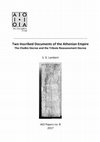
This paper discusses two important inscriptions for the history of the Athenian Empire, the Chalk... more This paper discusses two important inscriptions for the history of the Athenian Empire, the Chalkis decree of 446/5 (or 424/3?) BC (IG I3 40) and the tribute reassessment decree (“Thoudippos’ decree”) of 425/4 BC (IG I3 71). Based on English translations of the most up-to-date and authoritative Greek texts, the paper sets out to explain the inscriptions in historical context, without assuming prior knowledge of ancient Greek or of the history of Athens and the Athenian Empire. To help the reader new to the study of Athenian inscriptions, the Paper includes an introduction to inscribed Athenian decrees of the fifth century BC. This paper will be useful for researchers, teachers and learners of Greek History at University level, but is also designed to help teachers and students in UK 6th forms studying Ancent History A-level (H407, LACTOR4 1.78 and 138).
Note: minor corrections were incorporated on 28 June 2017. Hard copies are available at:
http://www.andromedabooks.gr/product.asp?catid=38457.
AIO Papers 9, 2018
The main purpose of this short paper is to draw attention to the significance of 357/6 BC as the ... more The main purpose of this short paper is to draw attention to the significance of 357/6 BC as the year that dedications by Athenian officials begin to refer to the crowning of officials by the Council and/or People (section 2). It also makes a case for lowering the accepted date at which the Athenians began honouring more than one Council prytany per year from ca. 340 BC to after 307/6 BC (section 3) and proposes consequential changes to the editions of some relevant inscriptions in IG II3 4 fasc. 1, mainly to dates (section 4). The paper concludes with a brief note on historical context (section 5). [Minor corrections were incorporated in August 2018].
The main purpose of this short paper is to draw attention to the significance of 357/6 BC as the ... more The main purpose of this short paper is to draw attention to the significance of 357/6 BC as the year that dedications by Athenian officials begin to refer to the crowning of officials by the Council and/or People (section 2). It also makes a case for lowering the accepted date at which the Athenians began honouring more than one Council prytany per year from ca. 340 BC to after 307/6 BC (section 3) and proposes consequential changes to the editions of some relevant inscriptions in IG II3 4 fasc. 1, mainly to dates (section 4). The paper concludes with a brief note on historical context (section 5).
Attic Inscriptions Online Papers 11, 2019
The Athenian Council and/or Assembly regularly inscribed decrees in the Agora honouring the young... more The Athenian Council and/or Assembly regularly inscribed decrees in the Agora honouring the young men, or ephebes, who had performed national service, from the Chremonidean War (266/5 BC) through to the Augustan period. The last five of these monuments post-date the sack of Athens by Sulla in 86 BC, and a full set of the texts has not been available since 1916 (IG II2), since when the progress of scholarship has made it almost impossible for specialists, let alone non-specialist researchers and students, to obtain an overview of these important documents. This paper accompanies the publication on AIO of new Greek texts, based on autopsy, and annotated English translations, of all five monuments. For ease of future reference it includes complete Greek texts of the two most substantial sets of decrees, IG II2 1039 +, honouring the ephebes of 80/79 BC and their officers, and 1043 +, honouring the ephebes of 38/7 or 37/6 BC and their officers, with textual notes. Though most of the fragments of post-Sullan ephebic decrees are still in Athens, one (IG II2 1042 fr. b) is in the British Museum, and to accompany this paper we are also publishing a short video about this inscription on the AIO Youtube channel.
The Classical Quarterly, 1999
Over twenty years since the influential revisionist studies of Roussel and Bourriot, agreement on... more Over twenty years since the influential revisionist studies of Roussel and Bourriot, agreement on a satisfactory theory of the Attic genos seems as elusive as ever. Although they differed on details, these two scholars were agreed in their rejection of the old monolithic account of the genos as aristocratic family whose institutionalized control over state cults and phratry admissions in the historical period was a relic of a wider political dominance. Roussel and Bourriot instead proposed a tripartite model according to which the formal genos-kome—a more or less localized community similar to the later deme, with hereditary but socio-economically diverse membership, and enjoying, as a tighter community well placed to regulate its own admissions, automatic access to the wider phratry—was distinguishable both from aristocratic families, such as the Peisistratidai or Alkmeonidai, and priestly houses, such as the Kerykes and Eumolpidai of Eleusis. Subsequent discussion has moved in sev...



Uploads
Papers by Stephen Lambert
Note: minor corrections were incorporated on 28 June 2017. Hard copies are available at:
http://www.andromedabooks.gr/product.asp?catid=38457.