

Figure 9 - from "Language as Evolving: Introductory Notes to Some Aspects of Halliday's Systemic Functional Linguistics"
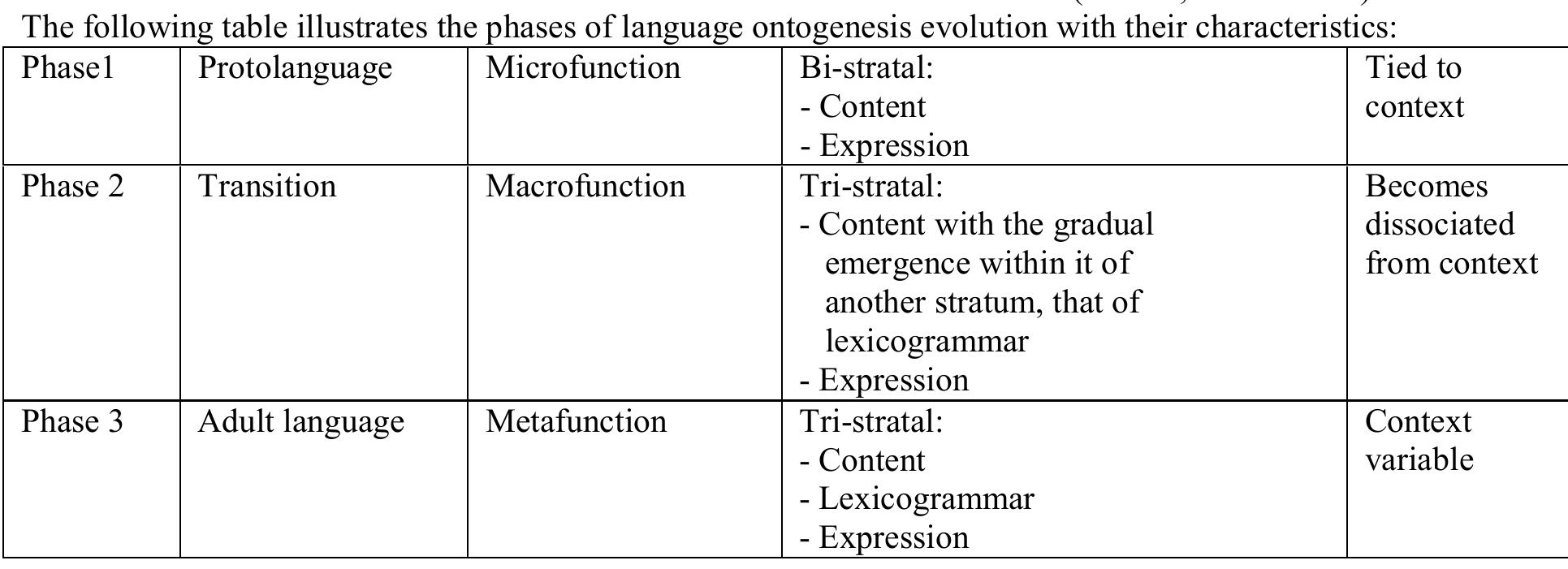
So EICUPTETE SS LUNI UM BG ©, LCUNILENE SS CNET UM GIL LUNI RUM GE UNM LOUTH ig UUUME MANGUM Se. Halliday claims that ‘the ontogenesis of language is at the same time the ontogenesis of learning’ (Halliday 1993:93). Language learning is not a matter of ‘learning sounds and words’ nor ‘learning how to name and refer (Halliday, 1995: 7), but rather a process of ‘learning how to mean’. Whatever socio-cultural environmen children are brought up in, when learning to speak, children are engaged into a three-phase socio-semioti: process. This starts from birth onwards. This leads me to talk about the second major theme related to languag ontogenesis development and the three facets that inhere to it: learning language, learning through language anc learning about language. 6.2.1 Learning Language: Learning language is on-going social semiotic interactive process of construal and construing and in which th child, from birth onwards is actively involved. The SFL theory of Halliday refuses to see the child as an isolatec individual and language as a ready made product to be picked up, ‘a commodity’, to quote Halliday (1979: 8 are roughly matched in the progression of the contexts in which meanings are exchanged... first the home, the neighbourhood, then the primary school, then the secondary school. And this is, of course not a coincidence, because these contexts are the social institutions that have evolved to exploit the development sequence in the child potential to mean. To sum up, one can track the ontogenesis development of language as progressing from a ‘not referring’ proto language to a ‘referential’ language, then almost at once, from ‘proper’ to ‘common’ reference that is from ‘individual’ reference to ‘class’ reference, then from ‘concrete’ to ‘abstract’ reference, and finally from ‘congruent’ to ‘metaphorical’ reference, i.e., from ‘actual’ to ‘virtual’ reference (Halliday, 2010). Thess ontogenesis developmental phases of language
Figure source:




Abstract: The aim of this paper is to give a brief introduction of Systemic Functional Linguistics to people new to this theory of linguistic description by shedding light on some of its aspects, chief among these the insights that this theory gives on language learning and its contribution to the field of education in general and pedagogy in particular. Written in an accessible style, this paper tries, to the utmost, to simplify when possible, the theory by avoiding the use of all the metalanguage and technical jargons that theorists display in their writings. It thus requires no prior knowledge or readings, as it uses no indexical references to other theories of linguistic descriptions or other sources but the ones that they inform this paper. 1. Introduction One alternative way of dealing with language description would be from a functionalist perspective. The concern herein is on how language is organised to achieve the social functions it is meant to serve (Widdowson, 1996). The focus is thus on language as a social phenomenon. MAK Halliday talks about 'language as social semiotics', i.e. as a system of set signs (meanings) socially motivated that are used to express our beliefs, cultures and communion needs. Language, in systemic functional perspective, is regarded as a semiotic tool/resource that interacts with the eco-social environment for making and exchanging meaning. Halliday's systemic functional description is meant to answer the question of how language works. Halliday views language as a meaning –making resource i.e., language as 'meaning-potential'. To learn a language is to learn how to mean (Halliday, 1975). Indeed, we are creatures who mean. Linguistics is then seen as the study of meaning in society. But what is meant, first, by the expression: systemic functional description of language? Functional is used in opposition to formal so far as it considers language as 'a practical means of expressing meaning rather than as an abstract set of relations' (Flowerdew, 2013:11). Grammar, in Systemic Functional Linguistics (henceforth SFL), and lexis are two poles of the same continuum that combine together so that to construe meaning. This combination is referred to as ' lexicogrammar'. In other words, SFL is concerned with how language is used. This functionality, according to Halliday (1985) lies on 'three distinct aspects of its interpretation of: text, system and structure' (ibid: xiii). Language has evolved through time with the evolution of the human species so that to cope with its needs. It is, hence, organized as such. What is of interest is the way language has been fashioned to meet our social needs. The Systemic Functional model of linguistic description should, hence, reflect the essential social nature of language. Its design has to represent the social purposes/ functions language has evolved to fulfil. To serve these functions language is organised around two kinds of meanings: the ideational and the interpersonal. A third metafunctional component, the textual, is said to bestow relevance on the first two. All elements of language are then explained by reference to these functions. I will return to this issue later. This tripartite structure, as Widdowson (2004:26) refers to, and around which the model is built, accounts for how language is intrinsically fashioned so that to mean. Systemic contrasts with systematic and refers to the range of multiple options that the language producer has at his disposal so that to realise meanings. This range of choices is set paradigmatically and concerns the elements that can be substituted for each other in a particular context. A systemic grammar differs from other functional grammars (and from all formal grammars) in that it is paradigmatic: a system is a paradigmatic set of alternative features, of which one must be chosen if the entry condition is satisfied. ((Emphasis in the original) (Halliday, 2003 [1992]: 209) Therefore, choice-from within the semantic system networks-is the primary organizing element of the linguistic resources of the language system. This 'system network formalizes the idea that language is a potential from which choices can be made in particular environments (Taverniers, 2002:30) (Emphasis in the original). A


