Papers by Teotonio R. de Souza
Revista Lusofona De Ciencia Das Religioes, Jul 18, 2014
Instead of reviewing here the predominantly Westbased historiographic efforts and pointing out th... more Instead of reviewing here the predominantly Westbased historiographic efforts and pointing out their relative usefulness or uselessness to analyse the history of expansion of Christianity, I wish rather to raise issues that any Church historiography, worth its salt in today's world context, would need to address. My first blunt question for the self-examination of those engaged in such exercises would be: Are not the prevailing historiographies, consciously or unconsciously tainted by exclusive or quasi-exclusive religious (if not denominational) interest, leaving out or handling only marginally, the cultural, social or economic factors that underlie religious developments? I have yet to see any outstanding examples of research and publication which has paid a systematic attention to all the above mentioned aspects and have not failed to analyse in depth the nexus of Christianity and colonialism, a nexus that has moved to a new phase in the post-colonial era. Any historiography that sidelines or soft-pedals when it comes to exposing the historic realities of a large number of "converted faithful" among the third world citizens is bound to continue to serve the Western strategy of dissimulation through the simulation of impressive historiographic research and scholarship.
Herald (Goa), 2019
In the fast changing world of digital communication and economic globalization the existing forms... more In the fast changing world of digital communication and economic globalization the existing forms of governance, including the democracy, seem to be finding it hard to adapt themselves to new challenges or to respond satisfactorily to the growing unrest of new publics that are made to contribute to governance and public welfare without reaping proportionate benefits or even a share in an effective representation of their needs and woes.
Electoral procedures tend to become a periodic farce and ethically ambiguous with subtle and timely manipulation of electorates. The so-called separation of powers that was thought to ensure the rule of law and justice, is seen to be increasingly eroded by politicization of judicial institutions and by a consequent judicialization of politics and legislative options. As a result, growing numbers of citizens have been losing respect and faith in their politicians and state institutions.
Francis Fukuyama, a management guru turned political analyst, had been quick in 1989 to present the fall of the Berlin Wall as the end of Cold War and a final victory of neo-liberalism over the giant communist rival of the post-World War times. He did not hesitate then to title his book The End of History (1992) to expand his earlier essay with a hurried and provisional analysis.
Francis Fukuyama has very recently revised his understanding of world politics and has presented his updated and a much more balanced picture, a far cry from his earlier euphoric vision, in a new book entitled Identity: The demand for dignity and the politics of resentment (2018). With the risk of over-stepping the limits of this column, I wish to provide a very brief summary of his new analysis and recommendations.
Herald (Goa), 2018
Politics is a science of governance and an art of the possible. It requires good legal training, ... more Politics is a science of governance and an art of the possible. It requires good legal training, a fine tact for negotiation, and the courage for timely concessions. Many a political crisis would not end with violent confrontations if an experienced politician was available. Historians cannot replace politicians. Their role is to safeguard the cultural heritage, stick to the evidence, and prevent its manipulation and misuse. This implies quite an inflexibility of positions and can help to warn mis-adventurous politicians that their future will end into the dust bin of History.
The ideals and reality often differ. Politicians tend to have a relationship of ambivalence with History, implying a mutually beneficial trade-off: politicians need myth-making to win power and to stay in power. Some historians get carried by the political offer of scholarships, chairs and other types of funding.
The ambiguity of the relationship implies a politician’s understanding of historian’s role as myth-making, while professional and critical historians stand for the opposite, namely de-mythifying, or deconstructing stereotypes. Unfortunately, there is no lack of historians who succumb to political allurements and reduce history to political prostitution, replacing the role of an historian from a judge of relevant evidence to an advocate of a political ideology.

Herald (Goa), 2018
Handling humans is probably the most tricky job as compared with handling any other living creatu... more Handling humans is probably the most tricky job as compared with handling any other living creature on the face of this earth. Having said this, it may not be difficult to comprehend why the human evolution has witnessed and will continue to witness ever new ways of governing humans and human societies.
Even the expression “human societies” is ambiguous, because not all individuals feel themselves comfortable in a society they are expected or forced to belong to. There are individuals who even resent having been born from their biological parents or having been born in a particular country. Fortunately, or unfortunately this is part of the “freedom” that characterises the “homo sapiens”, who tends to be at times a most stupid product of the natural evolution.
Seen positively, we may agree with Hegel, the German philosopher who grounded his insights upon dialectic, and explained to us why the evolutionary process is necessarily painful and new forms of life emerge from a spiralling process of thesis and antithesis into a new synthesis, which then becomes a new thesis to face new antithesis and so on. This is not entirely a new discovery, but as old as the biblical saying “unless a grain of wheat dies…” (John 12:24)

Herald , 2018
Contribution to our understanding of how the Gulf countries helped to the betterment of lives of ... more Contribution to our understanding of how the Gulf countries helped to the betterment of lives of the descendants of thousands of Goan households since late 40s of the last century. My own father, Mr. L.C. D’Souza from Moirá was one of the Goans who landed in Kuwait via Karachi in 1949 as an employee of KOC. Without any formal education he became a much appreciated cook of the household of the mother of the ruling Amir Sheik Jabir till his voluntary retirement in mid 70s. His professional companion was THE GOAN COOKS’S GUIDE. With the subtitle GOAN CUZNERACHO SANGAT (399 pp), it was authored by Pedro Damião Dias, who had been cook of several British Indian viceroys. Published in Bombay in 1937 (4th edition) by B.X. Furtado & Sons, it was printed at the Jesuit Mission Press at Anand, Gujarat. It contained 2012 recipes in Konkani, with titles in English. My dad’s three decades in Kuwait brought the shine of the Kuwaiti dinars to change effectively the bleak fortunes of our family.
Unfortunately, many individuals deserving recognition have completed their lives in obscurity without ever getting into limelight. Great majority of Goans had no material or social conditions during the colonial past to merit attention, and quite a few developed their talents and distinguished themselves through diaspora. I wrote in the Preface to Alfredo de Mello’s autobiographical book From Goa to Patagonia (2006) that globalization was a truly a “Goabilization” that empowered many generations of Goans who saw no future for them under the colonial dispensation.
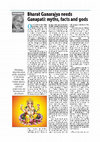
Ganesha, Vinayak, Vignyaneshwar, Gajapati or Ganapati, or whatever his other attributes and deno... more Ganesha, Vinayak, Vignyaneshwar, Gajapati or Ganapati, or whatever his other attributes and denominations, will continue to be relevant in times to come, considering the fact that human progress has never been linear or fast-forward. We need to be thankful to our Indian ancestors from the times of the rock-carvings of Kerala for recording Ganesha as a helpful ally [http://bit.ly/2NJUYbM].
World cultures have thrown up since pre-historic times mythical heroes, gods and mother-goddesses to seek guidance, comfort and protection against the insecurities and threats to human survival. Many of those have been replaced and new ones invented as human skills developed to reduce those insecurities.
Baruch Spinoza, a descendant of the Portuguese Jews who fled to the Netherlands, has left his understanding of this phenomenon, and summed it up by distinguishing two phases of nature, which he called natura naturata and natura naturans. The former represented the natural forces dominated by man, and the latter as the nature that remains uncontrolled by science and continues to instil fear and insecurity.
Rabindranath Tagore was the first Indian and Asian winner of Nobel Prize for Literature. His comp... more Rabindranath Tagore was the first Indian and Asian winner of Nobel Prize for Literature. His composition was chosen for the national anthem of independent India. It conveys a message of internationalism, wherein the whole world is presented as the home of mankind. It is very relevant for today's world plagued with the cruelty towards the refugees.
NAUS, 2018
Resumo: Este artigo procura apontar para os sentimentos e expressões nacionalistas dos missionári... more Resumo: Este artigo procura apontar para os sentimentos e expressões nacionalistas dos missionários que serviram o Padroado português na Ásia. Nota-se que estes sentimentos e comportamentos eram mais notórios entre os missionários portugueses, mais do que entre os missionários de origem italiana, alemã e francesa. O estudo deixa em aberto as conclusões finais por requerem investigação mais aprofundada, mas traz evidência significativa para defender que os missionários portugueses manifestavam fortes sentimentos nacionalistas e defendiam os seus privilégios nacionais. Isto não se limita ao período da unificação das coroas na península ibérica durante 1580-1640, mas precede e contínua até ao fim do colonialismo português na Ásia, confirmando assim que o Padroado sempre foi uma arma da expansão portuguesa na era dos Descobrimentos, e foi um instrumento da sobrevivência do colonialismo português.
Abstract: This article seeks to point out to the nationalist feelings and expressions among the missionaries who served in Asia under the Portuguese Padroado. The cultural nationalism seems to have been stronger among the Portuguese missionaries as compared with the missionaries of Italian, German or French origin. The article leaves the final conclusions open to corroboration by further research, but provides documentary evidence to supports the view that the Portuguese missionaries manifested strong emotional feelings that favoured their national and cultural privileges and characteristics. The article extends the analysis to periods before and beyond the unification of Iberian crowns during 1580-1640, concluding thereby that the Portuguese cultural nationalism was not merely a defensive posture against the loss of its independence in Europe during that brief period. There is documentary evidence to confirm that the Padroado was a tool of Portuguese expansion in the era of Discoveries, and continued to be a tool of the survival of the Portuguese colonialism till its very end.
Trata-se aqui de uma das muitas metáforas que enchem o pensamento e os escritos de Agostinha da S... more Trata-se aqui de uma das muitas metáforas que enchem o pensamento e os escritos de Agostinha da Silva. Não se trata de qualquer viagem física, mas uma conceção de humanidade como vária e una. Mas quando Agostinho da Silva e muitos outros defensores da lusofonia procuram separar os seus ideais da realidade colonial e não só, leva-me a concluir que partilham da mesma espiritualidade cristã da igreja católica que Lutero designara por "casta prostituta".
Trago aqui uma memória pública da presença colonial portuguesa em Goa. É distinta da memória col... more Trago aqui uma memória pública da presença colonial portuguesa em Goa. É distinta da memória coletiva como alguns a entendem e consideram sagrada e inviolável. Fernando Catroga no seu pequeno e excelente estudo sobre " Memória, História e Historiografia " distingue a memória coletiva da memória historiográfica. Enquanto a primeira é anónima e espontânea, uma transmissão predominantemente oral e repetitiva, e com cariz normativo, a segunda é prosaica e ensinável, resultado de uma operação científica que desmistifica a sacralidade assumida pela memória coletiva. A memória pública no título deste ensaio inclui as duas memórias mencionadas, mas com maior ênfase na componente popular de folclore, que para os eruditos tem um sentido pejorativo. É precisamente para questionar esta perceção de superioridade intelectual e devolver ao povo o crédito e o mérito da sua sabedoria que não sabe fingir ou encobrir. Os comentários populares têm pouco de crítica política, mas concentram-se na vida social e económica.
A Pátria, 2018
Despite the Portuguese zeal to enforce Christianity in Asia as a political follow-up of the Tride... more Despite the Portuguese zeal to enforce Christianity in Asia as a political follow-up of the Tridentine policy, the administrative reality forced the Portuguese in India to depend upon the collaboration of the Hindus till the very end of the colonial presence. It sounds like the wrath of Shiva, or the maya of Vishnu.

Fluxos & Riscos, 2017
The “convergent” research has advanced with notable success in the life sciences, physical scienc... more The “convergent” research has advanced with notable success in the life sciences, physical sciences and engineering, as it can be concluded from the joint report of MIT-AAAS, available for online reference at http://news.mit.edu/2011/convergence-0104 containing encomiastic references to “The Third Revolution: The Convergence of the Life Sciences, Physical Sciences and Engineering”.
It is desirable that the realm of the Social Sciences breaks out of its departmental culture which enhances the weaknesses analysed by Thomas S. Kuhn, another north-American and Harvard scholar, in his seminal research published as The Structure of Scientific Revolutions (1962) exposing the subjectivities that blocked the potential for convergence and innovation in Social Sciences.
The “convergence” that is recommended does not require that scholars abandon their specializations, but the emphasis is on a dialogue between scholars of different scientific areas based on mutual respect and curiosity, aimed ultimately at deepening the grasp of one’s own areas of specialization. It is hoped that confrontation and cross-examination of concepts, methods of gathering and analysing data, technical perspectives and application strategies, can result in finding correlations and ways of solving common problems.
The culture of convergence demands individual efforts and institutional efforts, as well as national and international policies. It is viewed as timely to avoid wastage of limited funding in an effective manner. This is clear from the most recent ruling of the Portuguese Foundation for Science and Technologies in preparation for the forthcoming Evaluation and Pluriannual Funding of the R&D units. It recommends to the existing research centres to re-structure themselves into larger units / consortia to maximize human and financial resources, but without losing sight of the academic objectives. The present issue of the journal Fluxes & Risks sought to anticipate this challenge and prepare the CPES to undertake suitable steps in this re-structuring process, ensuring the continuity of its heritage through a culture of convergence.
Ensino Superior e Lusofonia, 2016
É uma apresentação quase auto-biográfica que reflete reações emocionais que possam ainda parecer ... more É uma apresentação quase auto-biográfica que reflete reações emocionais que possam ainda parecer desmedidas. Mas trata-se das experiências pessoais, e não dos outros. São mais emotivas do que emocionais, mas passaram pelo crivo de reflexões críticas e foram objeto de várias conferências em que participei e ensaios que publiquei. Estes ficam registados na bibliografia anexa ao texto e poderão ser consultados para completar o que o tempo e espaço disponíveis aqui não deixam partilhar mais à vontade.
Following the outcome of the elections a couple of weeks ago and the formation of the new Goa gov... more Following the outcome of the elections a couple of weeks ago and the formation of the new Goa government I feel vindicated about my published reflections about "Goenkarponn" adopted by Goa Forward as its election banner. With all due respect to Mr. Timble and his old-age political adventurism, I would not hesitate now to name my fresh reflections on "Goenkarponn simplified" as "Timbleponn", with Vijaiponn as what we call in Goa "faddem", thrown in by the seller for a good measure after a good buy.
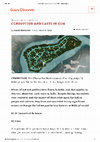
How the Goan clergy and the village communities of Goa were able to turn the State legislation in... more How the Goan clergy and the village communities of Goa were able to turn the State legislation in their favour and save their funds from being diverted to colonial defence budget.
Narratives, routes and intersections in pre-modern Asia, 2017
Rivers of ink and politics have flown in India, and that applies to Goa too, about the caste woe... more Rivers of ink and politics have flown in India, and that applies to Goa too, about the caste woes in India. Despite foreign incursions over centuries and the impact of their rules upon the Indian people and culture they have not succeeded to any significant extent to change the Indian pysche into Koranic or Biblical mould.
The process of conversions has always its limitations. Given time the changes unravel, and the caste hold is reinforced, causing dismay among the foreign and native reformers, who seek to help the "backward" Indians to break out of their cycle of "dharma, karma and sansara" in order to attain the bosom of Abraham, or the heavens of later semitic religions.
Incidentally, the early Jesuits in Goa had problems in translating "heaven" in Konkani for their Goan Hindu converts. Their bhuimvoikuntta for earthly Paradise was tolerable for the Bardeskar Vaishnavas, but in no way acceptable to Sinays (Xennoy) and Shivites from Bamonn Kellxi (Kelossi) , Kushastalli (Kortali) and the rest of Saxtti, for whom their Kailasa deserved continuity. The astute Jesuits then sought a compromisse solution in a more neutral Indra's Svarg.
The Chinese production of steel in 2010 was de 626.7 million tonnes (mt.) showing a anual increa... more The Chinese production of steel in 2010 was de 626.7 million tonnes (mt.) showing a anual increase of 9.3%. It was estimated that in 2012, the total steel output would be 730 mt. Goa supplied about 45 mt of low quality ore (c. 50%). The purchase cost (including transport and insurance) was USD $ 150 to 165 per mt. India is the third largest supplier of iron to China. Goa contributed 60%, which equalled Rs. 1000 crores per year. It was discovered that nearly 20 mt iron ore exported was illegal. The export rose to 33 mt. to meet the Chinese demand in 2008, and to 54 mt.in 2011.
It will be forever relevant to recall the old Aesop’s fable about the wolf and the lamb. Ever sin... more It will be forever relevant to recall the old Aesop’s fable about the wolf and the lamb. Ever since the appearance of life on this planet, the hunger of some has cost some or many others their dear lives. The force and power have generally prevailed, and it continues to be so despite all the inventions to mitigate the law of nature, and the political-religious discourses to hide the reality or wish it would be different.
Farewell poem dedicated to my brother on his death



Uploads
Papers by Teotonio R. de Souza
Electoral procedures tend to become a periodic farce and ethically ambiguous with subtle and timely manipulation of electorates. The so-called separation of powers that was thought to ensure the rule of law and justice, is seen to be increasingly eroded by politicization of judicial institutions and by a consequent judicialization of politics and legislative options. As a result, growing numbers of citizens have been losing respect and faith in their politicians and state institutions.
Francis Fukuyama, a management guru turned political analyst, had been quick in 1989 to present the fall of the Berlin Wall as the end of Cold War and a final victory of neo-liberalism over the giant communist rival of the post-World War times. He did not hesitate then to title his book The End of History (1992) to expand his earlier essay with a hurried and provisional analysis.
Francis Fukuyama has very recently revised his understanding of world politics and has presented his updated and a much more balanced picture, a far cry from his earlier euphoric vision, in a new book entitled Identity: The demand for dignity and the politics of resentment (2018). With the risk of over-stepping the limits of this column, I wish to provide a very brief summary of his new analysis and recommendations.
The ideals and reality often differ. Politicians tend to have a relationship of ambivalence with History, implying a mutually beneficial trade-off: politicians need myth-making to win power and to stay in power. Some historians get carried by the political offer of scholarships, chairs and other types of funding.
The ambiguity of the relationship implies a politician’s understanding of historian’s role as myth-making, while professional and critical historians stand for the opposite, namely de-mythifying, or deconstructing stereotypes. Unfortunately, there is no lack of historians who succumb to political allurements and reduce history to political prostitution, replacing the role of an historian from a judge of relevant evidence to an advocate of a political ideology.
Even the expression “human societies” is ambiguous, because not all individuals feel themselves comfortable in a society they are expected or forced to belong to. There are individuals who even resent having been born from their biological parents or having been born in a particular country. Fortunately, or unfortunately this is part of the “freedom” that characterises the “homo sapiens”, who tends to be at times a most stupid product of the natural evolution.
Seen positively, we may agree with Hegel, the German philosopher who grounded his insights upon dialectic, and explained to us why the evolutionary process is necessarily painful and new forms of life emerge from a spiralling process of thesis and antithesis into a new synthesis, which then becomes a new thesis to face new antithesis and so on. This is not entirely a new discovery, but as old as the biblical saying “unless a grain of wheat dies…” (John 12:24)
Unfortunately, many individuals deserving recognition have completed their lives in obscurity without ever getting into limelight. Great majority of Goans had no material or social conditions during the colonial past to merit attention, and quite a few developed their talents and distinguished themselves through diaspora. I wrote in the Preface to Alfredo de Mello’s autobiographical book From Goa to Patagonia (2006) that globalization was a truly a “Goabilization” that empowered many generations of Goans who saw no future for them under the colonial dispensation.
World cultures have thrown up since pre-historic times mythical heroes, gods and mother-goddesses to seek guidance, comfort and protection against the insecurities and threats to human survival. Many of those have been replaced and new ones invented as human skills developed to reduce those insecurities.
Baruch Spinoza, a descendant of the Portuguese Jews who fled to the Netherlands, has left his understanding of this phenomenon, and summed it up by distinguishing two phases of nature, which he called natura naturata and natura naturans. The former represented the natural forces dominated by man, and the latter as the nature that remains uncontrolled by science and continues to instil fear and insecurity.
Abstract: This article seeks to point out to the nationalist feelings and expressions among the missionaries who served in Asia under the Portuguese Padroado. The cultural nationalism seems to have been stronger among the Portuguese missionaries as compared with the missionaries of Italian, German or French origin. The article leaves the final conclusions open to corroboration by further research, but provides documentary evidence to supports the view that the Portuguese missionaries manifested strong emotional feelings that favoured their national and cultural privileges and characteristics. The article extends the analysis to periods before and beyond the unification of Iberian crowns during 1580-1640, concluding thereby that the Portuguese cultural nationalism was not merely a defensive posture against the loss of its independence in Europe during that brief period. There is documentary evidence to confirm that the Padroado was a tool of Portuguese expansion in the era of Discoveries, and continued to be a tool of the survival of the Portuguese colonialism till its very end.
It is desirable that the realm of the Social Sciences breaks out of its departmental culture which enhances the weaknesses analysed by Thomas S. Kuhn, another north-American and Harvard scholar, in his seminal research published as The Structure of Scientific Revolutions (1962) exposing the subjectivities that blocked the potential for convergence and innovation in Social Sciences.
The “convergence” that is recommended does not require that scholars abandon their specializations, but the emphasis is on a dialogue between scholars of different scientific areas based on mutual respect and curiosity, aimed ultimately at deepening the grasp of one’s own areas of specialization. It is hoped that confrontation and cross-examination of concepts, methods of gathering and analysing data, technical perspectives and application strategies, can result in finding correlations and ways of solving common problems.
The culture of convergence demands individual efforts and institutional efforts, as well as national and international policies. It is viewed as timely to avoid wastage of limited funding in an effective manner. This is clear from the most recent ruling of the Portuguese Foundation for Science and Technologies in preparation for the forthcoming Evaluation and Pluriannual Funding of the R&D units. It recommends to the existing research centres to re-structure themselves into larger units / consortia to maximize human and financial resources, but without losing sight of the academic objectives. The present issue of the journal Fluxes & Risks sought to anticipate this challenge and prepare the CPES to undertake suitable steps in this re-structuring process, ensuring the continuity of its heritage through a culture of convergence.
The process of conversions has always its limitations. Given time the changes unravel, and the caste hold is reinforced, causing dismay among the foreign and native reformers, who seek to help the "backward" Indians to break out of their cycle of "dharma, karma and sansara" in order to attain the bosom of Abraham, or the heavens of later semitic religions.
Incidentally, the early Jesuits in Goa had problems in translating "heaven" in Konkani for their Goan Hindu converts. Their bhuimvoikuntta for earthly Paradise was tolerable for the Bardeskar Vaishnavas, but in no way acceptable to Sinays (Xennoy) and Shivites from Bamonn Kellxi (Kelossi) , Kushastalli (Kortali) and the rest of Saxtti, for whom their Kailasa deserved continuity. The astute Jesuits then sought a compromisse solution in a more neutral Indra's Svarg.