Written in collaboration with Bryanna Hanson, Director of Learning Design
Imagine a classroom where learners are seen for their strengths and their curiosity is nurtured. They feel they belong, they understand their needs, and they learn to self-regulate. Learners in this classroom solve real-world problems that are connected to clear learning outcomes. Feedback is provided throughout the learning process by educators, community members, and classmates, and it is paired with opportunities for self-reflection and self-assessment. Educators provide authentic choices for students and support them in making decisions about their learning, so they receive what they need, when they need it, to reach their goals. This is a learner-centered environment.
Go deeper by downloading “A Learner-Centered Ecosystem” by Dr. Katie Martin
A learner-centered environment is intentionally designed to create experiences for learners to:
- know who they are,
- thrive in the community,
- and actively engage in the world as their best selves.
Central to this approach is creating learning experiences for learners of all ages to develop necessary skills, demonstrate competence at their pace, and work with others to engage in authentic work. At Learner-Centered Collaborative, we identified four aspects supported by the learning sciences that work together to create a learning model: authentic, personalized, competency-based, and learner-centered community.
A learner-centered classroom incorporates these four learning experiences. Each is an important learner-centered entry point and is beneficial when implemented on its own. However, weaving all four together creates a truly learner-centered environment.
Let’s explore each row of the table below in a bit more depth.
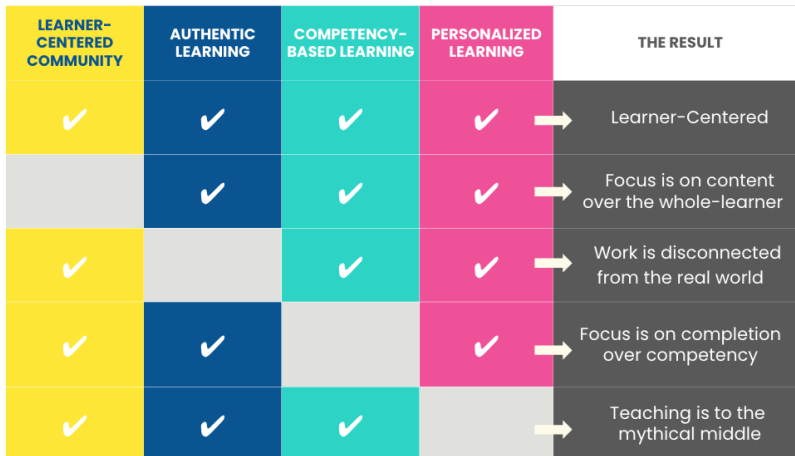
When a Learner-Centered Community is Absent, Focus is on Content Over the Whole Learner
When learning experiences are developed without the lens of the classroom community, pedagogy and resources do not intentionally represent the learners nor highlight diverse perspectives and lived experiences.
Learners in this classroom may experience real-world application of their skills, set goals, reflect on their progress, and have clarity on their performance and next steps in their learning. Yet some learners may not feel a sense of belonging, feel valued for their strengths and talents, or feel like their needs are known and supported. With such a focus on meeting academic needs, this classroom may not foster an inclusive community where individuals learn how to work together, empathize with different perspectives, and get what they need to reach their full potential.
Try this…
- Incorporate more diverse perspectives with choice in books or other texts.
- Use video or multimedia to allow all learners to access content.
- Create opportunities like class meetings to teach learners how to develop and use their social-emotional skills.
When Authentic Learning is Absent, Skills Are Not Relevantly Applied
When learning is not authentic, tasks can focus on narrow skills that lack real-world application and purpose and fail to motivate learners.
Learners may feel that they belong, there is a diverse representation of viewpoints, and learning is personalized, so each learner gets what they need when they need it. Learners know what they are learning, how they are doing, and what they need to do to reach their academic and personal goals. However, they are missing the real-world application of their learning. Learning in this classroom may be very individualized, yet there may also be many worksheets that don’t have a clear goal beyond turning them in to the teacher and that don’t have meaning or connection for the learner.
Try this…
- Connect the discrete skills that students are learning to real-world skills that they need.
- Support students in collaborating to solve real-world problems that matter to them.
- Invite students to identify questions they have or passions they want to explore related to the content or skills you plan to teach.
Learn How to Design Real-World Challenges that Encourage Peer and Community Collaboration.
When Competency-Based Learning is Absent, Assessment Prioritizes Completion Over Competence
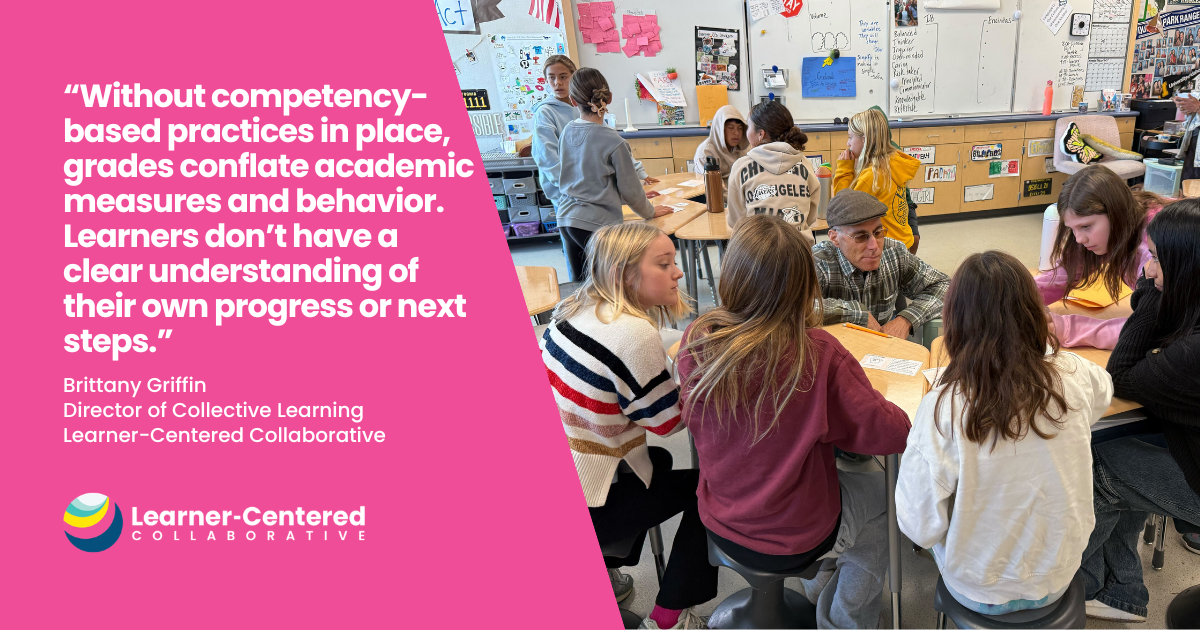
Without competency-based practices in place, grades conflate academic measures and behavior. Learners don’t have a clear understanding of their own progress or next steps.
In this environment, learners engage in personally relevant, real-world projects and feel that they belong and are represented. However, while engaging projects are happening, it isn’t clear to students how they are connected to learning. Students do not receive effective feedback aligned to learning targets, which makes the goal-setting and reflection process difficult. They also do not have clarity on the knowledge and skills they have acquired versus those they’re still developing.
Try this…
- Identify clear learning targets and criteria for success.
- Incorporate formative assessments and cycles of feedback during the learning.
- Have learners set goals, track progress on those goals, and have regular check-ins with each student.
Learn How to Design Meaningful Assessments and Make Learning Visible
When Personalized Learning is Absent, We Teach to the Mythical Middle
Without personalized experiences, students miss opportunities for agency and choice, and everyone has the same learning experience or moves on at the same pace.
Learners in this environment feel they belong and are represented in real-world projects with clear outcomes and feedback. However, learners lack the agency to make personalized choices to navigate their learning path. Projects and lessons in this class may be the same for all learners, regardless of individual needs. Feedback or a grade is given on summative tasks, but there are no personalized next steps for learners.
Try this…
- Help learners connect to their learning through self-reflection and goal-setting.
- Provide choices on how learners learn to gain content knowledge or develop desired skills.
- Provide options for how learners can show what they know and can do.
In the hustle and bustle of daily life in a school, it’s challenging to begin to include all four learning model elements. Focusing on one element at a time can be less overwhelming and provide space and time for educators to deeply build the skills and practices needed to make their classroom more personalized or more authentic. Over time, however, you can evolve your practices to intentionally include each of the four elements to meet the needs of learners.
To enhance your ability to integrate all four elements in your classroom, download our Durable Skills Learning Experience Accelerator App. This tool will support you in designing learner-centered learning experiences.