Synopsis
The Temple of Heaven was where Ming and Qing emperors worshipped Heaven and prayed for harvests. Built in 1420, it is China's largest ancient sacrificial complex. A UNESCO World Cultural Heritage Site since 1998.
Overview
The Temple of Heaven (天坛, Tiantan), located east of Yongdingmen Inner Street in Dongcheng District, Beijing, was the site where emperors of the Ming and Qing Dynasties performed ceremonies to worship Heaven, pray for good harvests, and request rain. Construction began in the 18th year of the Yongle era of the Ming Dynasty (1420), originally named the "Temple of Heaven and Earth." In the 9th year of the Jiajing era (1530), it was renamed the "Temple of Heaven."
The Temple of Heaven is China's largest existing ancient sacrificial architectural complex and the world's largest and best-preserved ancient altar complex for worshipping Heaven. The total area covers approximately 273 hectares (2.73 square kilometers), divided into the Inner Altar and Outer Altar.
In 1998, the Temple of Heaven was inscribed on UNESCO's World Cultural Heritage List.
History
| Period | Event |
|---|---|
| 1420 (18th year of Yongle, Ming) | Temple of Heaven originally built as "Temple of Heaven and Earth" |
| 1530 (9th year of Jiajing, Ming) | Temple of Earth built in the northern suburbs; this site renamed "Temple of Heaven" |
| 1749 (14th year of Qianlong, Qing) | Major reconstruction, forming the current scale |
| 1914 | Republic of China government held a heaven worship ceremony here |
| 1918 | Opened to the public as a park |
| 1998 | Inscribed as UNESCO World Cultural Heritage |
Main Buildings
The main buildings of the Temple of Heaven are concentrated in the Inner Altar, arranged along a north-south axis:
| Building | Features |
|---|---|
| Circular Mound Altar (Huanqiutan) | Open-air three-tiered circular white marble altar where the emperor worshipped Heaven at the Winter Solstice, approximately 23.5m in diameter |
| Imperial Vault of Heaven (Huangqiongyu) | Circular hall north of the Circular Mound Altar, housing spirit tablets — the Echo Wall is located here |
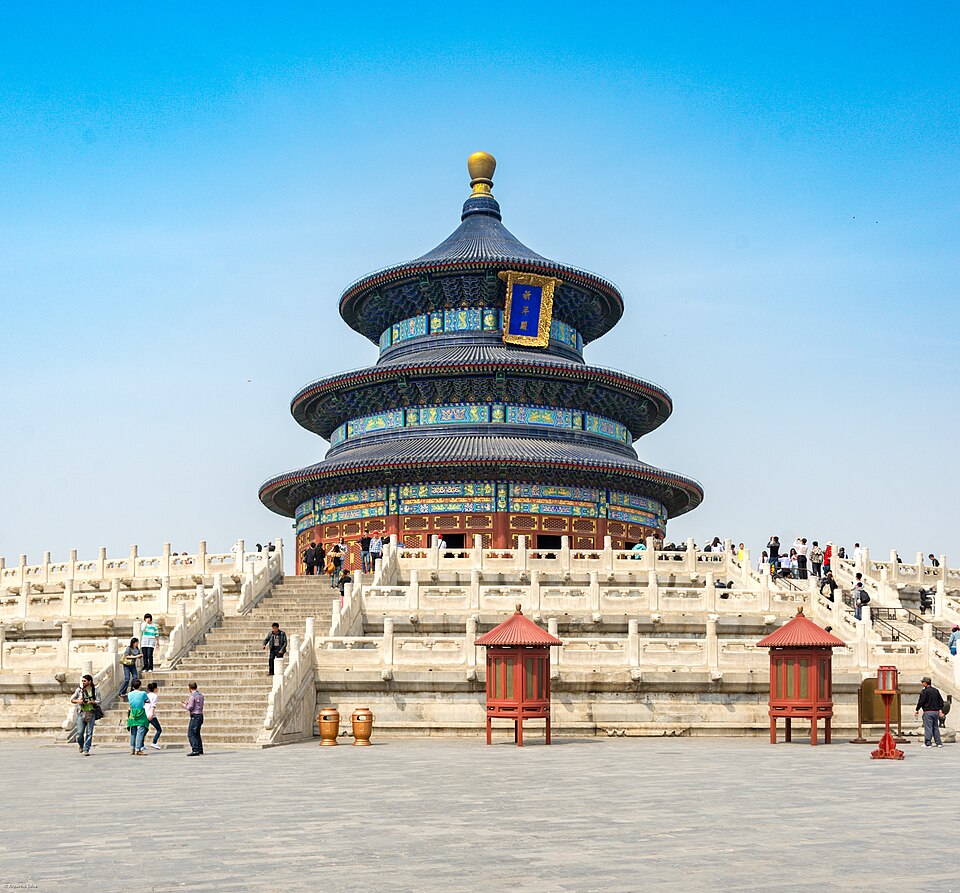
| Hall of Prayer for Good Harvests (Qiniandian) | Iconic building of the Temple of Heaven, a triple-eaved circular hall 38m high and 32.7m in diameter, where the emperor prayed for harvests in spring |
| Danbi Bridge | Pathway connecting the Circular Mound Altar and the Hall of Prayer, 360m long and 30m wide |
| Palace of Abstinence (Zhaigong) | Where the emperor fasted and purified himself before ceremonies — known as the "Little Forbidden City" |
| Echo Wall | Circular wall surrounding the Imperial Vault of Heaven, approximately 65m in diameter, with remarkable acoustic properties |
| Three Sound Stones | Three stone slabs in front of the Imperial Vault where speaking produces multiple echoes |
| Seven Star Stones | Seven giant stones symbolizing the Big Dipper |
Symbolic Meaning in Architecture
The Temple of Heaven's design is rich in symbolic meaning:
- Round Heaven, Square Earth: The Circular Mound Altar and Hall of Prayer are circular, symbolizing "round heaven"; the outer walls are square, symbolizing "square earth"
- Number Nine: The steps and railings of the Circular Mound Altar are all multiples of nine, as nine is the largest yang number, representing Heaven
- Pillars of the Hall of Prayer: 28 nanmu wood pillars — 4 "Dragon Well" pillars represent the four seasons, 12 inner "Gold" pillars represent the twelve months, 12 outer eave pillars represent the twelve two-hour periods, and the inner+outer 24 pillars represent the 24 solar terms
- Blue Glazed Tiles: The Hall of Prayer's roof uses blue glazed tiles, symbolizing the blue sky
Practical Information
| Item | Details |
|---|---|
| Location | Tiantan East Road, Dongcheng District, Beijing |
| Opening Hours | Peak season (Apr-Oct) 6:00-22:00, Off-season (Nov-Mar) 6:30-22:00 |
| Admission | Peak season ~15 RMB, Off-season ~10 RMB; Combined ticket (includes attractions) peak ~34 RMB, off ~28 RMB |
| Suggested Visit Duration | 2-3 hours |
| Transportation | Subway Line 5, Tiantan East Gate Station |
| Best Season | Spring (Apr-May) and Autumn (Sep-Oct) |
World Heritage
In 1998, the Temple of Heaven was inscribed by UNESCO as a World Cultural Heritage Site. UNESCO's evaluation noted:
- The layout and construction of the Temple of Heaven had a profound influence on architecture and planning in the Far East
- The Temple of Heaven is a unique testament to the cosmology and imperial legitimacy in Chinese civilization
- The architectural design of the Temple of Heaven represents the highest achievement of ancient Chinese architectural art
References
- Temple of Heaven Park: https://tiantanpark.cn/
- Wikipedia: https://zh.wikipedia.org/wiki/天坛
- Baidu Baike: https://baike.baidu.com/item/天坛
- UNESCO: https://whc.unesco.org/en/list/881/
Stills & Gallery
Comments (0)