Get Out and TriThank you to Dare2tri for contributing information and photos for this article.
Paratriathlon made its Paralympic competition debut in Rio 2016. The sport, which combines swimming, running and biking into one race, has been rapidly growing in the U.S. and abroad among athletes at all age ranges and ability levels. From 1999 through today, USA Triathlon’s membership has nearly tripled and the number of sanctioned races grew to more than 4,000 last year alone.
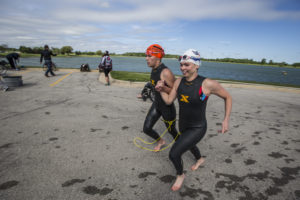 Keri Serota, Executive Director of Dare2tri, a chapter of Disabled Sports USA that focuses solely on paratriathlon, believes that some of the sport’s growth within the adaptive community is the sport’s ability to allow athletes to compete with their peers. “This is truly a community sport,” she said. “One athlete with a disability can race in their own communities with their families and friends without needing to find a team of other athletes like you might with other sports.”
The Four Disciplines
So what exactly is a triathlon? For those that are unfamiliar, a triathlon is a race that starts with a swim, continues with a bike ride and finishes with a run. In between each section of the race is a transition area, where athletes must change their gear and mindset from one sport to the next. The first transition area is where the athlete’s bike, helmet and bike shoes are kept during the swim, and the second area is where the bike is left and any running gear is kept to be utilized for the last let of the race.
Serota recommends that any athlete who wants to become competitive in the sport think of the transition as their ‘fourth discipline’. “Have a specific order for everything you do,” she said. “Do it in the same order every time, even during practice, that way when you get to race day it will be more like second nature.”
I Have to Swim How Far?
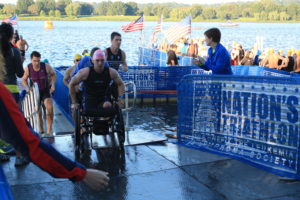 When it comes to selecting your first triathlon, consider your current fitness levels and how long you have to train before race day, then select the distance that is most appropriate. Triathlon comes in a variety of distances to encourage beginners and competitive endurance athletes alike.
Youth (7-10) – 100 meter swim, 5 kilometer bike ride, 1 kilometer run
Youth (11-15) – 200 meter swim, 10 kilometer bike ride, 2 kilometer run
Super Sprint– .25 mile swim, 6.2 mile bike ride, 1.6 mile run
Sprint – .5 mile swim, 12.4 mile bike ride, 3.1 mile run
Olympic – .93 mile swim, 24.8 mile bike ride, 6.2 mile run
Half Ironman – 1.2 mile swim, 56 mile bike ride, 13.1 mile run
Ironman – 2.4 mile swim, 112 mile bike ride, 26.2 mile run
Contrary to the name’s implication, the paratriathlon competitors in Rio did not compete at an Olympic distance. The Sprint distance is the Elite Level distance and is utilized for any Paralympic and Paralympic-qualifying races.