Papers by Wilbert Wong Wei Wen

Winstedt, colonialism and the Malaysian history wars
Indonesia and the Malay world, May 28, 2024
European colonialist thinking continues to influence history writing after national independence ... more European colonialist thinking continues to influence history writing after national independence – even in the construction of national narratives. In the case of Malaysia, the work of the scholar-official, Richard Winstedt, has had a far-reaching impact – and one that is seldom recognised. The 20th century was a crucial period in the political and historical construction of ‘Malay(si)a’ – a time when a colonial state was imagined, and then positioned as a foundation for post-colonial nation-building. Malay(si)a did not exist as a political entity before this time – it had to be carved out of the Indian (or ‘Malay’) Archipelago, an enormous region largely under Dutch authority. The historical construction of Malay(si)a was never a homogenous process, even in colonial narratives. This article examines the strategy Winstedt undertook to develop a state narrative – suggesting how his work moved beyond that of earlier British historians. Although Winstedt’s project was explicitly ‘modern’ in its purpose and style, we also note ways in which he was influenced by pre-modern Malay writers. The final section examines Winstedt’s impact on local Malay(si)an writing, including Malaysia’s standard national narrative. Some local historians, however, resisted Winstedt – and sought to write the Malaysian nation from alternative perspectives. Nation-making in this and other regions of Southeast Asia is all the more interesting because it has been a dialogic rather than merely integrative project.
The Doctor Turned Diplomat: John Crawfurd's Writings on the Malay Peninsula
Indonesia and the Malay World, 2024
European colonialist thinking continues to influence history writing
after national independence... more European colonialist thinking continues to influence history writing
after national independence – even in the construction of national
narratives. In the case of Malaysia, the work of the scholar-official,
Richard Winstedt, has had a far-reaching impact – and one that is
seldom recognised. The 20th century was a crucial period in the
political and historical construction of ‘Malay(si)a’ – a time when a
colonial state was imagined, and then positioned as a foundation
for post-colonial nation-building. Malay(si)a did not exist as a
political entity before this time – it had to be carved out of the
Indian (or ‘Malay’) Archipelago, an enormous region largely under
Dutch authority. The historical construction of Malay(si)a was
never a homogenous process, even in colonial narratives. This
article examines the strategy Winstedt undertook to develop a
state narrative – suggesting how his work moved beyond that of
earlier British historians. Although Winstedt’s project was explicitly
‘modern’ in its purpose and style, we also note ways in which he
was influenced by pre-modern Malay writers. The final section
examines Winstedt’s impact on local Malay(si)an writing, including
Malaysia’s standard national narrative. Some local historians,
however, resisted Winstedt – and sought to write the Malaysian
nation from alternative perspectives. Nation-making in this and
other regions of Southeast Asia is all the more interesting because
it has been a dialogic rather than merely integrative project.
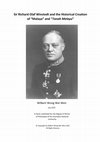
This thesis explores the intellectual career of the prominent scholar-administrator of colonial M... more This thesis explores the intellectual career of the prominent scholar-administrator of colonial Malaya Sir Richard Olaf Winstedt (1878–1966), focusing on the way in which he constructed Malaya as a historical entity politically and culturally in the British territories of the Malay Peninsula during the twentieth century. It argues that his Malay and Melaka-centric historical discourse on Malaya not only shaped the British Empire’s historiography of the region, but provided the base for Malaya’s, and later Malaysia’s nation-state history. Having served in Malaya for about three decades (1902–1935), beginning his career as a Cadet in the Malayan Civil Service, and retiring as the General Adviser of Johor, Winstedt published more than any of his colonial contemporaries and predecessors on a wide range of Malay subjects, except music. Respected even amongst Malay intellectual circles who valued his contributions to knowledge on the Malay language, literature, culture and history, he is acknowledged, although his ideas were not without controversy, to have laid the groundwork for the field of Malay studies through his scholarly contributions — many of which were pioneering and are still cited in contemporary works on history and Malay studies. After R. J. Wilkinson, he was almost the only person who was researching and publishing on the Malays and was nearly without scholarly competition. In addition to his published works, this thesis draws on unexplored primary sources on Winstedt, from private accounts and correspondence shared by those who knew him, to materials discovered in archives in Kuala Lumpur, Singapore and London, which draw together his personal life and his writings.
This thesis also investigates the circumstances that made Winstedt’s histories nation-building pieces in colonial and post-colonial Malaya. Writing at a time when “Malaya” had emerged as a political entity within the British Empire, he ingeniously refined in his histories the idea of a Malaya-based “Malay nation” — a broad concept that could encompass a large part of the Malay Archipelago, especially Indonesia. There were competing interpretations of Malaya’s history during the colonial period, some more plural, while others more Malay-world oriented. Nonetheless, it was Winstedt’s engineered Malay and Malaccan-centric interpretation that triumphed in the end and was strategically suited for post-colonial Malaya’s nation-building goal of creating a national historical identity that was centred on the Malays. Malaya, and later, Malaysia, became the Malay nation that his history engineered — which structure is still followed in Malaysia’s national history. His legacy for Malaysia’s nation-building narratives exemplifies the continuing legacies of colonial discourse in the national historiographies of former colonies.
Colonial Discourse in Perspective the Malay Peninsula in John Crawfurd S Ideas on Ethnology and World History
Singapore National Library Board, 2018
This chapter examines how the Malay Peninsula shaped the ethnological and historical writings of ... more This chapter examines how the Malay Peninsula shaped the ethnological and historical writings of the nineteenth-century British scholar-administrator of Southeast Asia, John Crawfurd (1783-1868), who served as the second British Resident of Singapore (1823-6). By analysing the manner in which he collected his information and made sense of the inhabitants of the region and their history, this paper also offers a closer glimpse on the workings of British, and European, intellectual discourse on foreign places during the colonial period, and invites us to think beyond the simplistic framework of knowledge as a tool of Western imperial domination. This research paper is originally commissioned by the National Library Board, Singapore during the Author's tenure as a Lee Kong Chian Research Fellow attached to the National Library, Singapore during 2016.
John Turnbull Thomson and the Malay Peninsula: The 'Far East' in the Development of His Thoughts and Writings in New Zealand
John Turnbull Thomson was one of the important nineteenth-century figures in New Zealand, Singapo... more John Turnbull Thomson was one of the important nineteenth-century figures in New Zealand, Singapore and Malaysia. A man of many talents, he was a surveyor, engineer, architect, artist, philosopher and writer, and was New Zealand’s first Surveyor General. Thomson spent a total of fifteen years in the Malay Peninsula, serving as an architect, engineer and government surveyor to the East India Company before migrating to New Zealand in 1855. This dissertation argues that his time in the Malay Peninsula was crucial in the development of his thoughts and literary works in New Zealand. The research aims to establish this argument by connecting Thomson’s writings and theories in New Zealand to his experience and observations in Southeast Asia. Thomson has left us with a wide range of writings that is an invaluable source for scholars. It is these writings where this research places the bulk of its focus. The first three chapters cover Thomson’s life in the Malay Archipelago by analysing a selection of his writings on the ‘Far East.’ The fourth chapter ties together the discussions of the previous chapters on his experiences in the Malay Peninsula, and connects them to his literary works in New Zealand. It will be shown that many of the concepts that occupied his writings, from his books to his racial philosophies, were inspired by his sojourn in Southeast Asia.
John Crawfurd’s 1829 pamphlet on free trade and colonisation and his liberal campaign for British imperial reforms in India and Southeast Asia
Liberalism and the British Empire in Southeast Asia, 2018
This paper examines the liberal views of the prominent British scholar administrator, John Crawfu... more This paper examines the liberal views of the prominent British scholar administrator, John Crawfurd (1783-1868), focusing on his 1829 pamphlet on free trade and colonialism in India. Scholars have often overlooked the significance of this pamphlet when discussing Crawfurd's liberal views, yet it is in this pamphlet where he most strongly projected his liberal visions of empire and how these imperial reforms should be implemented. Unlike his other writings, this pamphlet was written specifically to push for liberal reforms of the British Empire in Asia. This paper will also demonstrate that Crawfurd was more than a liberal idealist. He was a reformer as well.
Za'ba Memorial Library, University of Malaya
The Archives of Economic Life in South Asia and Southeast Asia, 2019
My research blog documents my experience as a researcher in Za'ba Memorial Library, located in th... more My research blog documents my experience as a researcher in Za'ba Memorial Library, located in the University of Malaya in Kuala Lumpur. I demonstrate that this is a crucial archive for sources on the Malay scholar and Malaysia's father of the modern Malay language, Zainal Abidin bin Ahmad (Za'ba). I also highlight that this library may provide crucial references not only on Za'ba, but also on the economic life of Malaysia and the surrounding regions during the colonial and post colonial periods. This research blog is part of the Harvard-Cambridge Centre for History and Economics project called "Archives of Economic Life in South Asia." For Link to blog: https://www.histecon.magd.cam.ac.uk/archives-asia/blogs/wong2.html
Arkib Negara Malaysia (The Malaysia National Archives), Kuala Lumpur
The Archives of Economic Life in South and Southeast Asia, 2019
Part of the Harvard-Cambridge Centre for History and Economics project called "Archives of Econom... more Part of the Harvard-Cambridge Centre for History and Economics project called "Archives of Economic Life in South Asia," my research blog documents my experience as a researcher in Arkib Negara Malaysia (The Malaysia National Archives) in Kuala Lumpur. I also discuss how their collections provide crucial references on the economic life of Malaysia and its surrounding regions, from a local and colonial perspective. For link to blog: https://www.histecon.magd.cam.ac.uk/archives-asia/blogs/wong.html
Liberalism and the British Empire in Southeast Asia, edited by Gareth Knapman, Anthony Milner and Mary Quilty, 2018
This paper examines the liberal views of the prominent British scholar administrator, John Crawfu... more This paper examines the liberal views of the prominent British scholar administrator, John Crawfurd (1783-1868), focusing on his 1829 pamphlet on free trade and colonialism in India. Scholars have often overlooked the significance of this pamphlet when discussing Crawfurd's liberal views, yet it is in this pamphlet where he most strongly projected his liberal visions of empire and how these imperial reforms should be implemented. Unlike his other writings, this pamphlet was written specifically to push for liberal reforms of the British Empire in Asia. This paper will also demonstrate that Crawfurd was more than a liberal idealist. He was a reformer as well.
Chapters on Asia: Selected Papers from the Lee Kong Chian Research Fellowship (2014-2016), 2018
This chapter examines how the Malay Peninsula shaped the ethnological and historical writings of ... more This chapter examines how the Malay Peninsula shaped the ethnological and historical writings of the nineteenth-century British scholar-administrator of Southeast Asia, John Crawfurd (1783-1868), who served as the second British Resident of Singapore (1823-6). By analysing the manner in which he collected his information and made sense of the inhabitants of the region and their history, this paper also offers a closer glimpse on the workings of British, and European, intellectual discourse on foreign places during the colonial period, and invites us to think beyond the simplistic framework of knowledge as a tool of Western imperial domination. This research paper is originally commissioned by the National Library Board, Singapore during the Author's tenure as a Lee Kong Chian Research Fellow attached to the National Library, Singapore during 2016.
John Crawfurd, the 19th-century British colonial administrator in Southeast Asia, was known for h... more John Crawfurd, the 19th-century British colonial administrator in Southeast Asia, was known for his insightful writings on ethnology and history in the Malay Peninsula. This article examines the ideas of this visionary scholar and thinker on the Malay Peninsula's inhabitants, and how they fit into his concepts on ethnology and world history
This article was first published in Vol 13 Issue 1 (Apr-Jun 2017) of BiblioAsia, a quarterly journal of the National Library Board. The online edition can be viewed at: http://www.nlb.gov.sg/biblioasia/2017/04/08/the-doctor-turned-diplomat-john-crawfurds-writings-on-the-malay-peninsula/#sthash.OSsvF8fq.lzzJlQSo.dpbs
Abdullah bin Abdul Kadir Munshi (commonly known as Munshi Abdullah), the prolific nineteenth-cent... more Abdullah bin Abdul Kadir Munshi (commonly known as Munshi Abdullah), the prolific nineteenth-century Malay writer and teacher, is hailed today as Malaysia and Singapore’s father of modern Malay literature and reformer. This paper examines how Munshi Abdullah’s autobiography, Hikayat Abdullah, may have influenced the New Zealand writings of John Turnbull Thomson, one of his promising students and an important colonial figure in New Zealand, Singapore and Malaysia.
John Turnbull Thomson was one of the important nineteenth-century figures in New Zealand, Singapo... more John Turnbull Thomson was one of the important nineteenth-century figures in New Zealand, Singapore and Malaysia. A man of many talents, he was a surveyor, engineer, architect, artist, philosopher and writer, and was New Zealand’s first Surveyor General. Thomson spent a total of fifteen years in the Malay Peninsula, serving as an architect, engineer and government surveyor to the East India Company before migrating to New Zealand in 1855. This dissertation argues that his time in the Malay Peninsula was crucial in the development of his thoughts and literary works in New Zealand. The research aims to establish this argument by connecting Thomson’s writings and theories in New Zealand to his experience and observations in Southeast Asia. Thomson has left us with a wide range of writings that is an invaluable source for scholars. It is these writings where this research places the bulk of its focus. The first three chapters cover Thomson’s life in the Malay Archipelago by analysing a selection of his writings on the ‘Far East.’ The fourth chapter ties together the discussions of the previous chapters on his experiences in the Malay Peninsula, and connects them to his literary works in New Zealand. It will be shown that many of the concepts that occupied his writings, from his books to his racial philosophies, were inspired by his sojourn in Southeast Asia.
Book Reviews by Wilbert Wong Wei Wen
Australian Journal of Biography and History, 2020
My review of Phippe Paquet "Simon Leys, Navigator between Worlds" in Australian Journal of Biogra... more My review of Phippe Paquet "Simon Leys, Navigator between Worlds" in Australian Journal of Biography and History: No. 3, 2020, pp. 197-201



Uploads
Papers by Wilbert Wong Wei Wen
after national independence – even in the construction of national
narratives. In the case of Malaysia, the work of the scholar-official,
Richard Winstedt, has had a far-reaching impact – and one that is
seldom recognised. The 20th century was a crucial period in the
political and historical construction of ‘Malay(si)a’ – a time when a
colonial state was imagined, and then positioned as a foundation
for post-colonial nation-building. Malay(si)a did not exist as a
political entity before this time – it had to be carved out of the
Indian (or ‘Malay’) Archipelago, an enormous region largely under
Dutch authority. The historical construction of Malay(si)a was
never a homogenous process, even in colonial narratives. This
article examines the strategy Winstedt undertook to develop a
state narrative – suggesting how his work moved beyond that of
earlier British historians. Although Winstedt’s project was explicitly
‘modern’ in its purpose and style, we also note ways in which he
was influenced by pre-modern Malay writers. The final section
examines Winstedt’s impact on local Malay(si)an writing, including
Malaysia’s standard national narrative. Some local historians,
however, resisted Winstedt – and sought to write the Malaysian
nation from alternative perspectives. Nation-making in this and
other regions of Southeast Asia is all the more interesting because
it has been a dialogic rather than merely integrative project.
This thesis also investigates the circumstances that made Winstedt’s histories nation-building pieces in colonial and post-colonial Malaya. Writing at a time when “Malaya” had emerged as a political entity within the British Empire, he ingeniously refined in his histories the idea of a Malaya-based “Malay nation” — a broad concept that could encompass a large part of the Malay Archipelago, especially Indonesia. There were competing interpretations of Malaya’s history during the colonial period, some more plural, while others more Malay-world oriented. Nonetheless, it was Winstedt’s engineered Malay and Malaccan-centric interpretation that triumphed in the end and was strategically suited for post-colonial Malaya’s nation-building goal of creating a national historical identity that was centred on the Malays. Malaya, and later, Malaysia, became the Malay nation that his history engineered — which structure is still followed in Malaysia’s national history. His legacy for Malaysia’s nation-building narratives exemplifies the continuing legacies of colonial discourse in the national historiographies of former colonies.
This article was first published in Vol 13 Issue 1 (Apr-Jun 2017) of BiblioAsia, a quarterly journal of the National Library Board. The online edition can be viewed at: http://www.nlb.gov.sg/biblioasia/2017/04/08/the-doctor-turned-diplomat-john-crawfurds-writings-on-the-malay-peninsula/#sthash.OSsvF8fq.lzzJlQSo.dpbs
Book Reviews by Wilbert Wong Wei Wen