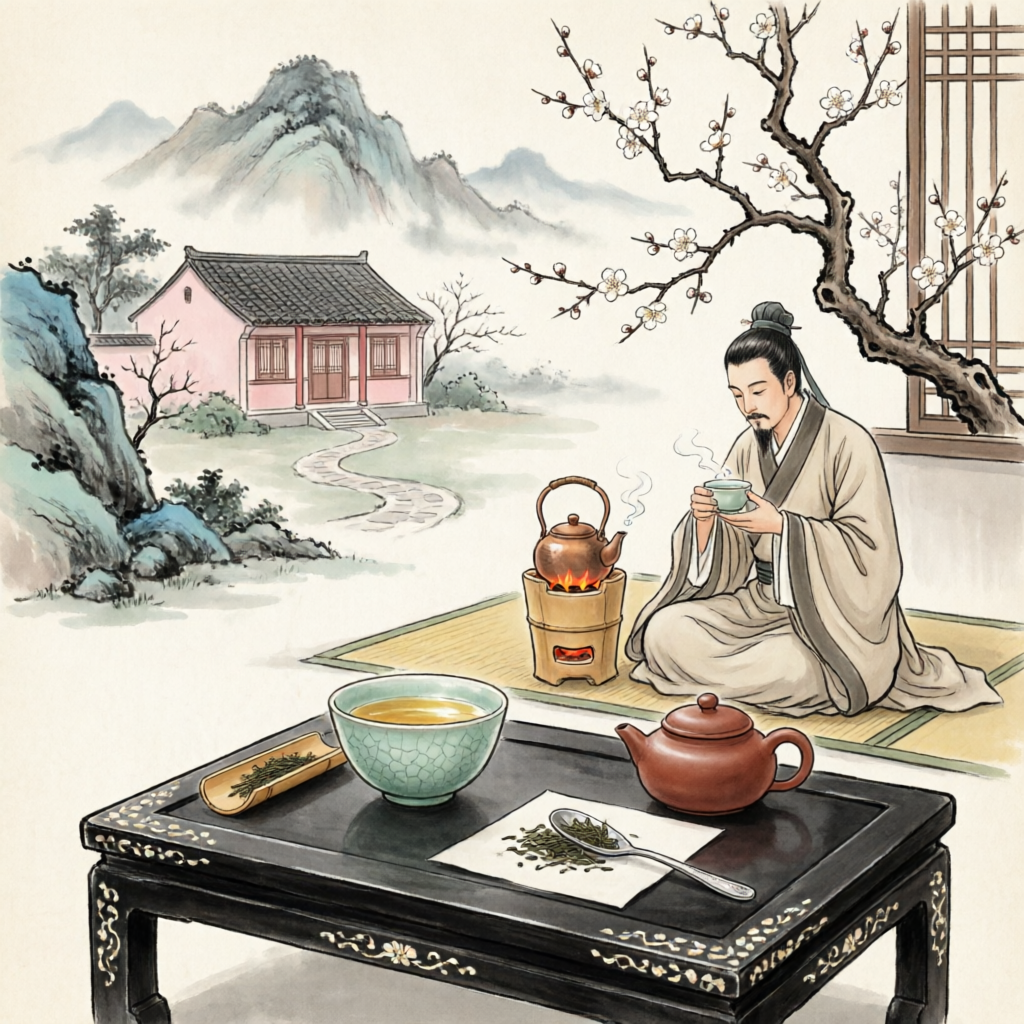
Tea Ceremony
Overview
Tea Ceremony, known as "Chá Dào" (茶道) in Chinese, is a traditional cultural practice centered on the preparation and consumption of tea. It represents more than mere beverage preparation; it encompasses a philosophy, art form, and social ritual that emphasizes harmony, respect, and mindfulness. Originating in China and later developing distinctive forms in Japan and Korea, tea ceremony has evolved into a sophisticated practice that combines aesthetic appreciation with spiritual cultivation. The ceremony varies across cultures but generally follows principles of harmony, respect, purity, and tranquility, reflecting the cultural values of each society.
History
The practice of tea ceremony has ancient roots in China, dating back to the Tang Dynasty (618-907 CE). The earliest known systematic treatment of tea is "The Classic of Tea" (茶经), written by Lu Yu (陆羽) around 760 CE. Lu Yu, often referred to as the "Tea Sage" (茶圣), documented various aspects of tea cultivation, preparation, and consumption, establishing the foundation for Chinese tea culture.
During the Tang Dynasty, tea drinking became increasingly popular among scholars, monks, and aristocrats. Another significant figure from this period was Lu Tong (卢仝), a poet whose "Seven Bowls of Tea" poem profoundly influenced tea culture. Lu Tong, known as the "Tea Immortal" (茶仙), celebrated the spiritual and medicinal qualities of tea in his writings.
Tea culture continued to develop through the Song Dynasty (960-1279 CE), when the practice of whisking powdered tea in bowls became popular. This method, known as "dian cha" (点茶), was later introduced to Japan where it evolved into the Japanese tea ceremony (chanoyu). The Ming Dynasty (1368-1644 CE) saw a shift back to steeping loose-leaf tea, which remains the dominant method in China today.
Key Information
| Aspect | Description |
|---|---|
| Chinese Name | 茶道 (Chá Dào) |
| Alternative Names | Tea Art, The Way of Tea |
| Origin | China (Tang Dynasty) |
| Key Figures | Lu Yu (Tea Sage), Lu Tong (Tea Immortal) |
| Cultural Significance | Philosophical practice, social ritual, artistic expression |
| Core Principles | Harmony, respect, purity, tranquility (varies by culture) |
| Regional Variations | Chinese tea ceremony, Japanese chanoyu, Korean dasan-cha |
Cultural Significance
Tea ceremony holds deep cultural significance across East Asia, embodying philosophical and aesthetic values. In China, tea ceremony reflects the integration of Confucian, Taoist, and Buddhist principles. The Chinese tea spirit, often summarized as "lian, mei, he, jing" (廉、美、和、敬) - meaning purity, beauty, harmony, and respect - emphasizes moral cultivation and social harmony.
Different scholars have proposed various interpretations of Chinese tea ethics:
- Zhang Wanfang proposed "lian, mei, he, jing" (purity, beauty, harmony, respect)
- Cheng Qikun and Yao Guokun suggested "li, jing, qing, rong" (principle, respect, clarity, harmony)
- Fan Zengping advocated "he, jian, jing, jie" (harmony, simplicity, tranquility, purity)
- Lin Jingnan summarized it as "mei, jian, xing, lun" (beauty, health, character, ethics)
These interpretations, though varied, share common themes of harmony, purity, and respect, reflecting the essence of Chinese tea culture.
The theoretical foundation of Chinese tea ceremony includes several key concepts:
Respect for People (尊人)
This principle manifests in the naming of tea utensils and the understanding of tea. For example, a lidded cup with a saucer is called the "Three Treasures Cup" (三才杯), representing heaven (cover), earth (saucer), and humanity (cup). Holding all three together symbolizes the unity of these elements.
Valuing Life (贵生)
This concept incorporates utilitarian perspectives on tea, emphasizing its health benefits and character-cultivating functions. Unlike those who drink tea for fame or profit, true tea appreciation focuses on tea's ability to enhance one's spiritual cultivation and physical well-being.
Sitting in Forgetfulness (坐忘)
Borrowed from Buddhist philosophy, this practice aims to achieve a state of "extreme emptiness and quiet adherence" during tea preparation and consumption. It involves forgetting one's physical self and intellectual concerns to reach a state of spiritual purity.
Selflessness (无己)
This principle advocates a detached, natural approach to life, free from constraints of conventional morality. In tea ceremony, it represents the highest mental state, where the distinction between self and nature dissolves, achieving harmony with the universe.
Following Nature (道法自然)
This concept emphasizes alignment with natural principles at three levels: material (tea as a natural product), behavioral (natural movements and expressions), and spiritual (returning to simplicity and truth). It reflects the Taoist ideal of harmony with natural laws.
Modern Status
Today, tea ceremony continues to be practiced and appreciated worldwide. In China, traditional tea ceremonies are performed in cultural settings, tea houses, and formal ceremonies. The practice has also influenced contemporary design and performance art, as evidenced by innovative presentations like the water stage tea ceremony showcased at the 2025 Maritime Silk Road International Cultural Tourism Festival.
Modern tea culture has seen a revival of interest in traditional practices while adapting to contemporary lifestyles. Tea ceremonies are now conducted in various settings, from traditional tea houses to modern cultural spaces, and have become a means of promoting cultural exchange and understanding.
Educational institutions and cultural organizations offer courses on tea ceremony, preserving traditional knowledge while encouraging innovation. The practice has also gained popularity as a form of stress relief and mindfulness practice in fast-paced modern societies.
References
-
Lu, Y. (760). The Classic of Tea (茶经). Translated by F. Carpenter, 1959. Ecco Press.
-
Sullivan, M. (2019). The Book of Tea: The Classic Work on Eastern Aesthetics, Spirituality, and Philosophy. Tuttle Publishing.
-
Tsai, M. L. (2013). The Art of Tea: The History and Culture of Tea in China. China Intercontinental Press.
-
Hara, Y. (2002). The Japanese Way of Tea: From Its Origins in China to Sen Rikyu. University of Hawai'i Press.
-
Zhang, W. (1990). "A Brief Discussion of Tea Culture" (茶文化浅议). Cultural Exchange, (2).
-
Cheng, Q., & Yao, G. (1990). "Discussing Chinese Tea Ethics from Traditional Tea Customs" (从传统饮茶风俗谈中国茶德). China Tea, (6).