Legalism
Overview
Legalism (法家) was one of the major philosophical schools during the pre-Qin period in ancient China. Unlike Confucianism, which emphasized moral virtue and ritual, Legalism focused on establishing a centralized state through strict laws, administrative methods, and state power. This school of thought played a crucial role in the unification of China under the Qin Dynasty and continued to influence Chinese political thought throughout imperial history.
History
The origins of Legalist thought can be traced back to the Li Guan (理官, "judicial officials") of the Xia and Shang dynasties, as recorded in the Book of Han. During the Spring and Autumn Period, figures such as Guan Zhong of Qi, Guo Yan of Jin, and Zichan of Zheng laid the groundwork for Legalist thought by promulgating laws and penal codes, reforming land tax systems, and promoting the feudalization process.
During the Spring and Autumn and Warring States periods, Chinese society entered a new era characterized by "attention to human affairs," the rise of private schools, and the "Hundred Schools of Thought" debate. Traditional theocratic concepts were challenged by ideas of "virtue" (德) and "benevolence" (仁), while "ritual" (礼) and "law" (法) became important foundations of social ideology. The emergence of the "shi" (士, scholar-official) class, whose activities were not restricted by state boundaries, laid the foundation for the flourishing of thought and culture.
The Warring States Period
The Warring States period was a time of great transformation. The popularization of iron tools greatly increased production efficiency, enabling individual families to become basic production units. Legalist pioneers Li Kui, Wu Qi, Shang Yang, Shen Buhai, Yue Yi, and Ju Xin successively implemented reforms in various states, abolishing hereditary privileges of nobles and allowing commoners to become landowners through land reclamation and military achievements. This gave commoners opportunities to hold official positions, thereby dismantling the hierarchical system of the Zhou Dynasty and fundamentally shaking the aristocratic political system maintained by blood ties.
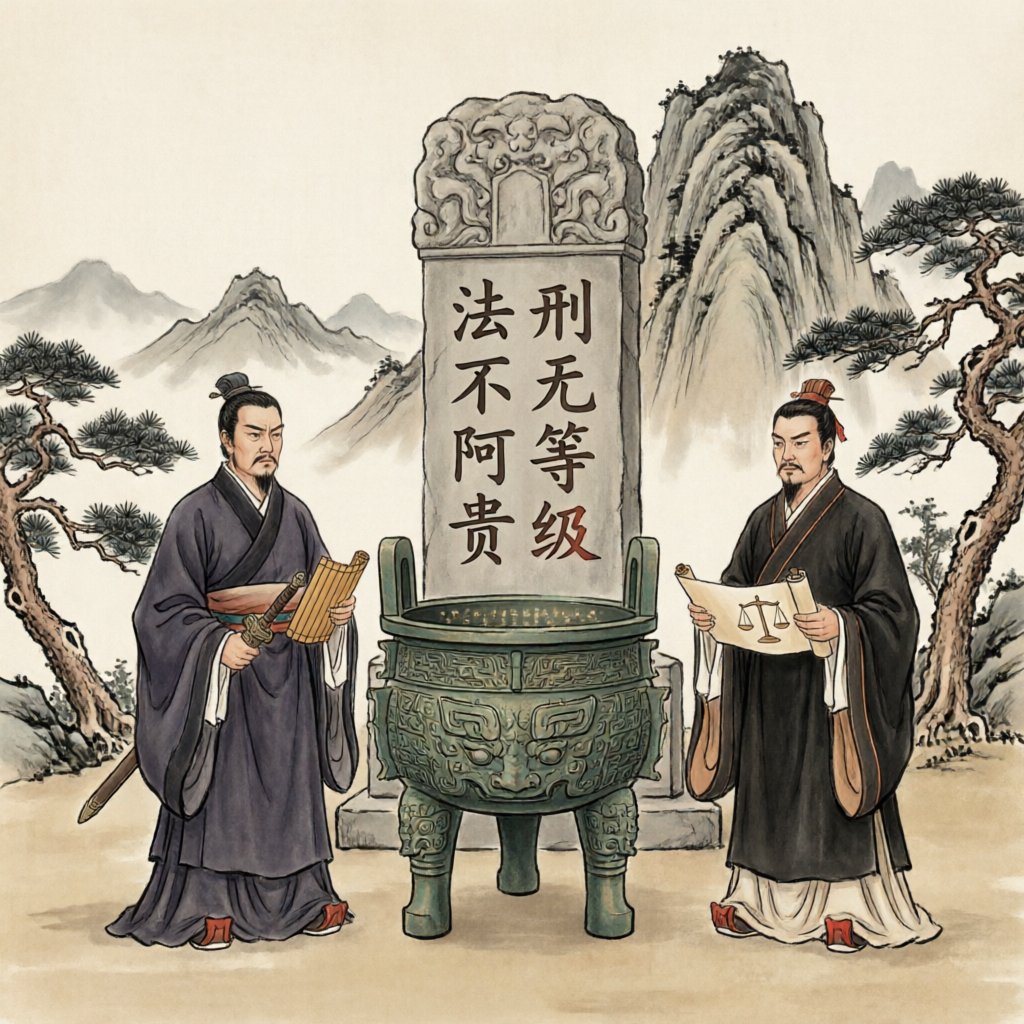
The political advocates for commoners were the Legalists, whose political slogans included "govern according to law" (缘法而治), "distinguishing neither kinship nor status, but judging all by law" (不别亲疏,不殊贵贱,一断于法), and "law does not favor the noble" (法不阿贵).
Development of Legalist Schools
Legalist thought developed into two main schools during the Warring States period: the Qi School of Legalism and the Three Jin School of Legalism.
Qi School of Legalism
The state of Qi's legal thought was unique and is known as the Qi School of Legalism. Qi was the fief of Jiang Ziya, a founding minister of the Western Zhou Dynasty. Jiang Ziya's ancestor, Bo Yi, assisted Emperor Shun in creating rituals and establishing punishments, founding a system that combined ritual and law. After being enfeoffed in Qi, Jiang Ziya simplified rituals according to local customs and established laws, making the combination of ritual and law an enduring governance principle.
Guan Zhong, who assisted Duke Huan of Qi,一方面将礼义廉耻作为维系国家的擎天之柱 (regarded ritual, righteousness, integrity, and shame as the pillars supporting the state), while emphasizing governance according to law. He was the first person in Chinese history to propose governing according to law. During the Warring States period, Qi became the cradle of China's first intellectual liberation movement and the Hundred Schools of Thought. A group of Jixia scholars who inherited and promoted Guan Zhong's ideas formed the Guan Zhong School, whose legal thought that equally valued law and moral instruction became the highest achievement of pre-Qin Legalism.
Three Jin School of Legalism
The Three Jin School of Legalism (comprising the states of Han, Zhao, and Wei) produced many Legalist representatives, including Li Kui, author of China's first systematic legal code; Xun Kuang, who emphasized both "ritual and law" and "punishment and virtue"; Han Fei, who proposed "punishing ministers without regard to their status" and theories of power limitation; as well as Wu Qi, Shang Yang, and Shen Dao. Their legal spirit and thought constituted the essence of Three Jin Legalist culture and made outstanding contributions to the formation and development of the Chinese legal system.
The Three Jin School advocated for "distinguishing neither kinship nor status, but judging all by law," while the Qi School emphasized "governing according to law" with equal importance to law and moral instruction. The Three Jin School held "law" (法), "method" (术), and "power" (势) as supreme principles, while the Qi School valued all four elements.
Key Information
| Aspect | Details |
|---|---|
| Time Period | Pre-Qin period (Spring and Autumn and Warring States periods) |
| Key Figures | Guan Zhong, Li Kui, Shang Yang, Shen Buhai, Han Fei |
| Major Works | Guanzi, Book of Lord Shang, Book of Han Fei, Book of Shenzi |
| Core Principles | Rule by law, centralized state power, administrative methods |
| Historical Impact | Provided theoretical basis for Qin Dynasty's unification of China |
Cultural Significance
Legalist thought had a profound impact on Chinese political culture. Unlike Confucianism, which emphasized moral cultivation and social harmony through ritual, Legalism focused on establishing a powerful state through strict laws and administrative methods. The Qin Dynasty's implementation of Legalist policies led to the unification of China but also resulted in harsh rule that contributed to its rapid downfall.
After the Qin Dynasty, Legalist thought continued to influence Chinese governance in various forms. The Han Dynasty adopted a approach often described as "using Confucianism on the surface and Legalism in substance" (阳儒阴法). Emperors such as Wu of Han and Taizong of Tang successfully combined Legalist methods with Confucian moral principles to create effective governance.
During the Wei, Jin, and Northern and Southern Dynasties, as Confucianism lost its dominant position, Legalist thought experienced a resurgence. Figures like Cao Cao were heavily influenced by pre-Qin Legalist thought, and Northern Wei Emperor Daowu of the Northern Wei Dynasty also promoted Legalist ideas in governance.
Modern Status
In modern times, Legalist thought has experienced various revivals. During the late Qing Dynasty, scholars such as Zhang Taiyan, Liu Shipei, Liang Qichao, and Meng Menghua discovered that, compared to Western legal concepts, modern China also had a tradition of advocating for rule of law through the Legalist school. In the specific historical and academic context of the late Qing, figures like Zhang Taiyan, Liang Qichao, and Shen Jiaben emerged as "Neo-Legalists," who opposed traditional criticisms of Legalism, praised its historical achievements, and interpreted Legalist thought through the lens of "rule of law" or "legalism."
During the Republican period, Chen Qitian made significant contributions to the revival of Legalist thought, comparing Han Feizi to Aristotle of the West and arguing that Han Feizi's contribution to classical Chinese political philosophy was comparable to Aristotle's contribution to Western political philosophy. Chen Qitian also proposed the concept of "Neo-Legalism," stating: "Modern China has entered a new Warring States era of the world, and it seems necessary to produce Neo-Legalism."
In contemporary China, Legalist thought continues to be studied and its principles are sometimes incorporated into modern governance. The Fourth Plenary Session of the 18th Central Committee of the Communist Party of China proposed comprehensively advancing the rule of law, emphasizing the need to carry forward the socialist spirit of rule of law and build a socialist legal culture. Research into the essence of Legalist culture, particularly its emphasis on respecting law and fairness and justice, is incorporated into the construction of socialist legal culture.
References
-
Creel, H.G. (1970). Shen Pu-hai: A Chinese Political Philosopher of the Fourth Century B.C. University of Chicago Press.
-
Puett, M.J. (2001). The Ambivalence of Creation: Debates Concerning Innovation and Artifice in Early China. Stanford University Press.
-
Schwartz, B.I. (1985). The World of Thought in Ancient China. Harvard University Press.
-
Wang, K. (2000). Legalism: A Tradition of Rule-Oriented Thought and Its Contemporary Relevance. Springer.
-
Goldin, P.R. (2012). After Confucius: Studies in Early Chinese Philosophy. Columbia University Press.