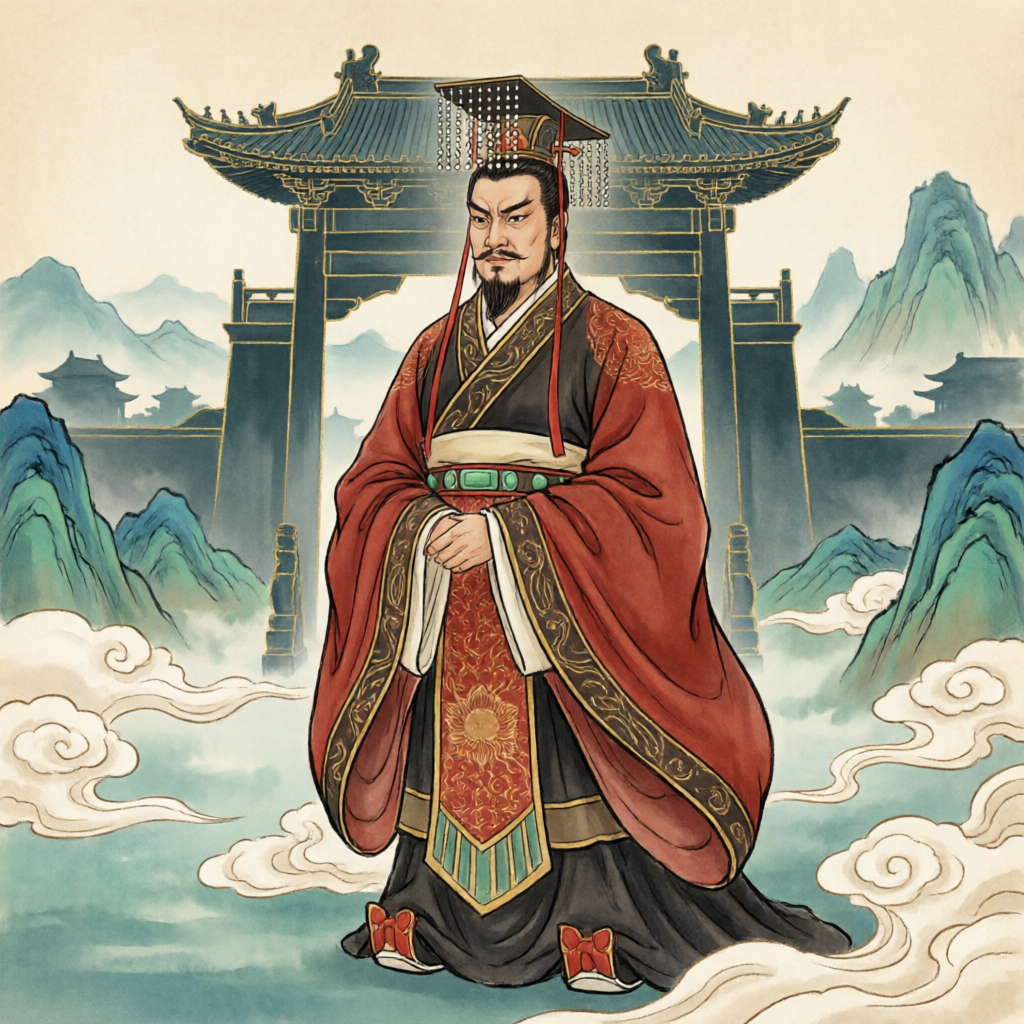
Liu Bang
Overview
Liu Bang (256 BCE–195 BCE), posthumously known as Emperor Gaozu of Han (汉高祖), was the founder and first emperor of the Han Dynasty (206 BCE–220 CE), ruling from 202 BCE until his death. He was one of the most significant emperors in Chinese history, establishing the Han Dynasty which would become one of the golden ages of Chinese civilization. Liu Bang rose from humble origins as a commoner to become a military leader who overthrew the Qin Dynasty and defeated his rival Xiang Yu to establish his rule over China.
History
Early Life
According to historical records, the Liu family traced their ancestry back to the mythical Emperor Yao of the Three Sovereigns and Five Emperors. By the Xia Dynasty, the lineage included Liu Lei, and during the Warring States period, they served as officials in the state of Wei. Liu Bang was born in 256 BCE or 247 BCE in Zhongyang Li, Fengyi County, Pei Commandery (present-day Feng County, Jiangsu Province). He was born on the same day as Lu Wan, and the two families maintained a close friendship.
Liu Bang was described as a generous and kind person who was magnanimous and unrestrained in his character. However, he disliked agricultural work like his family and often reprimanded by his father. In his youth, he frequently brought people to eat at his home, causing conflicts with his sister-in-law. During his youth, Liu Bang was influenced by the cultural atmosphere of the border area between the states of Wei and Chu, becoming familiar with Chu songs and admiring the character of Lord Xinling (Wei Wuxi).
Rise to Power
As an adult, Liu Bang became a minor official known as a Tingzhang (亭长) in Sishui Commandery. During this time, he visited the Qin capital Xianyang and was deeply impressed when he saw Emperor Qin Shi Huang, exclaiming, "That is how a great man should be!"
Liu Bang's marriage to Lü Zhi occurred when he was serving as a Tingzhang. When Lü Gong, the father of Lü Zhi, moved to Pei County to escape enemies, Liu Bang, despite not having money to offer as a gift, wrote "ten thousand coins" on his visiting card. Impressed by his bearing, Lü Gong treated him with respect and eventually married his daughter Lü Zhi to him.
Rebellion against Qin
In 209 BCE, Chen Sheng and Wu Guang launched the Dazexiang Uprising against the Qin Dynasty. The magistrate of Pei County initially planned to join the rebellion but later changed his mind and prepared to execute Xiao He and Cao Shen, who had suggested summoning Liu Bang. Xiao He and Cao Shen escaped and joined Liu Bang, who had already gathered several hundred followers. The people of Pei then killed their magistrate and welcomed Liu Bang back, appointing him as their leader (known as Pei Gong according to Chu customs).
Liu Bang's forces gradually expanded, and he joined the broader rebellion against Qin. He fought against Qin forces in various battles, gaining victories and recruiting more followers. In 208 BCE, Liu Bang joined forces with Xiang Liang, the leader of the Chu rebels, and later participated in the installation of King Huai of Chu (Xin Xin), grandson of the former King Huai of Chu.
Conquest of Qin
After Xiang Liang's death, King Huai of Chu sent Liu Bang on a western campaign to conquer the Guanzhong region (the heartland of Qin). Liu Bang's forces advanced westward, capturing cities and recruiting more soldiers. He defeated several Qin generals and eventually reached the capital region.
In 207 BCE, Liu Bang's army entered Xianyang, the Qin capital. The Qin Ziying (the last Qin ruler) surrendered to Liu Bang, marking the end of the Qin Dynasty. Liu Bang established the "Three-Point Law" in the Guanzhong region, which stipulated: those who kill shall be executed; those who injure or steal shall be punished accordingly; and all other harsh Qin laws shall be abolished. This policy won him popular support among the common people.
Conflict with Xiang Yu
After conquering Xianyang, Liu Bang was forced to contend with Xiang Yu, another rebel leader who had become the most powerful military commander. Despite having entered Xianyang first, Liu Bang was not granted the title of King of Guanzhong as promised by King Huai of Chu. Instead, Xiang Yu proclaimed himself Hegemon-King of Western Chu and granted Liu Bang the title of King of Han with territory in the remote regions of Bashu (modern Sichuan).
The conflict between Liu Bang and Xiang Yu culminated in the famous Hongmen Banquet (鸿门宴), where Xiang Yu's advisor Fan Zeng attempted to have Liu Bang assassinated. However, Liu Bang managed to escape and return to his territory. Over the next few years, Liu Bang gradually consolidated his power and built alliances with other lords to challenge Xiang Yu's dominance.
Establishment of the Han Dynasty
After several years of warfare, Liu Bang eventually defeated Xiang Yu in 202 BCE. Xiang Yu committed suicide after his defeat, and Liu Bang established the Han Dynasty with himself as Emperor Gaozu. He established his capital at Chang'an (modern Xi'an) and implemented policies to restore stability and prosperity after the chaos of the late Qin Dynasty and the Chu-Han Contention.
Key Information
| Aspect | Details |
|---|---|
| Posthumous Name | Emperor Gaozu of Han (汉高帝) |
| Temple Name | Taizu of Han (汉太祖) |
| Era | Late Qin Dynasty / Early Han Dynasty |
| Born | 256 BCE or 247 BCE in Zhongyang Li, Fengyi County, Pei Commandery |
| Died | 195 BCE in Chang'an (modern Xi'an) |
| Predecessor | None (founded the dynasty) |
| Successor | Emperor Hui of Han (Liu Ying) |
| Major Achievements | Founded the Han Dynasty; established imperial system that would last for over 400 years; implemented policies that restored stability and prosperity after the Qin Dynasty |
| Notable Relatives | Father: Liu Taigong (太上皇); Wife: Empress Lü Zhi (吕后); Key Supporters: Xiao He, Cao Shen, Zhang Liang, Fan Kuai |
Cultural Significance
Liu Bang is remembered as a pragmatic ruler who came from humble beginnings and understood the needs of the common people. His rise from a commoner to emperor became a powerful archetype in Chinese culture, symbolizing that talent and virtue could overcome humble origins. The story of his rivalry with Xiang Yu has been immortalized in Chinese literature and opera, with the Hongmen Banquet becoming one of the most famous episodes in Chinese history.
Liu Bang's establishment of the Han Dynasty had profound cultural significance. The Han ethnic group, which constitutes the majority of China's population, derives its name from his dynasty. The Han script, Han clothing, and many other cultural elements trace their origins to this period. Confucianism, which had been suppressed under Qin legalism, was revived and became the state philosophy during the Han Dynasty, influencing Chinese culture and governance for centuries.
Modern Status
Today, Liu Bang is studied as one of the most important emperors in Chinese history. His pragmatic approach to governance, his understanding of the common people's needs, and his ability to defeat more powerful rivals make him a subject of scholarly interest. Archaeological discoveries related to the Han Dynasty, including the Terracotta Army of Emperor Jing and the tombs of Han nobles, continue to provide insights into the period he founded.
The story of Liu Bang's life has been adapted into numerous films, television series, and literary works in modern China. His rise from humble beginnings and eventual triumph over Xiang Yu remains a popular theme in historical dramas. Scholars continue to debate his policies, his relationship with key advisors, and his role in shaping Chinese imperial governance.
References
-
Sima Qian. (1993). Records of the Grand Historian (Shiji). Translated by Burton Watson. Columbia University Press.
-
Loewe, M., & Shaughnessy, E. L. (Eds.). (1999). The Cambridge History of Ancient China: From the Origins of Civilization to 221 B.C. Cambridge University Press.
-
Lewis, M. E. (2007). The Early Chinese Empires: Qin and Han. Belknap Press of Harvard University Press.
-
Bielenstein, H. (1980). The Restoration of the Han Dynasty, Vol. 1: The Earlier Han Dynasty, 202 B.C.–A.D. 9. Museum of Far Eastern Antiquities.
-
Yu, Yingshi. (2010). The Rise of the Chinese Empire: Nation, State, and Imperialism in Early China, 1600 B.C.–A.D. 8. Oxford University Press.