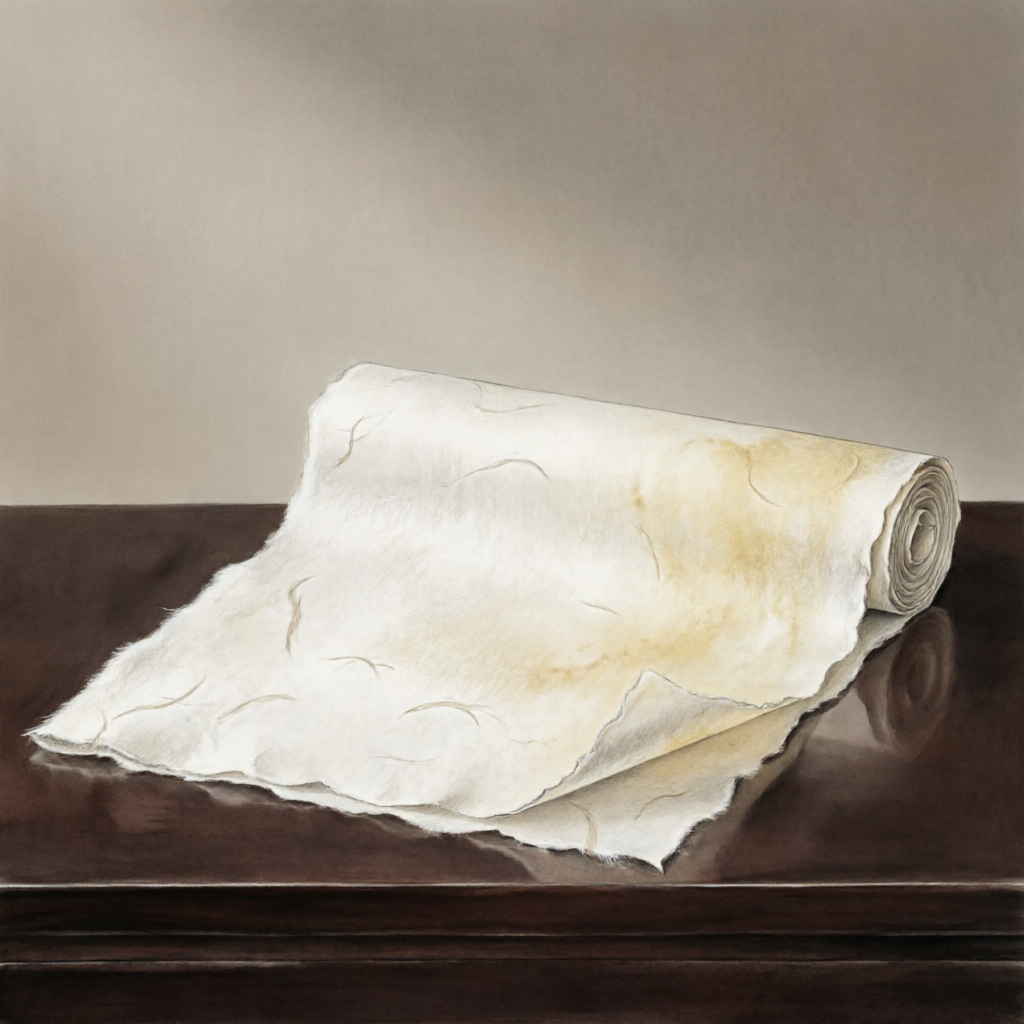
Xuan Paper
Overview
Xuan paper (宣纸), also known as rice paper, is a traditional type of paper originating from Jing County (泾县) in Xuancheng City, Anhui Province, China. Renowned for its exceptional quality, durability, and suitability for calligraphy and painting, Xuan paper has been produced for centuries and is often referred to as the "king of paper" and the "paper that lasts a thousand years." In 2009, the traditional craft of Xuan paper production was inscribed on the UNESCO Representative List of the Intangible Cultural Heritage of Humanity.
History
The history of Xuan paper dates back to the Tang Dynasty (618-907 CE). Historical records indicate that during the Tianbao era (742-756 CE), paper and brushes from Xuancheng County were among the tribute items transported to the imperial capital of Chang'an (modern-day Xi'an). This suggests that paper production was already well-established in the region during this period.
During the Song and Yuan dynasties (960-1368 CE), the Cao family clan migrated to Xiaoling in Jing County, Anhui, where they began systematically producing Xuan paper using the bark of the Qingtan tree (青檀皮, Pteroceltis tatarinowii) as the primary raw material. This marked a significant development in the standardized production of Xuan paper.
The Ming Dynasty (1368-1644 CE) saw further refinement of Xuan paper production. During the Xuande era (1426-1435 CE), imperial workshops began producing Xuan paper under royal supervision, elevating its status and quality. This period established Xuan paper as the preferred medium for imperial calligraphy and painting.
Key Information
Production Characteristics
Xuan paper is distinguished by several unique qualities:
- Excellent ink absorption and diffusion properties
- High durability and resistance to aging
- Resistance to yellowing and discoloration
- Texture that is both tough and absorbent
- Smooth yet not slippery surface
- Pure white color with dense texture
- Clear fiber patterns
- Resistance to folding damage
The paper's ability to create "five shades of ink" (墨分五色) with a single brushstroke—producing varying depths, shades, and textures—makes it particularly valued for traditional Chinese painting and calligraphy.
Specifications and Quality Standards
Xuan paper is classified into three main categories based on raw material composition:
| Category | Primary Materials | Characteristics |
|---|---|---|
| Special Qingpi (特种净皮类) | Higher proportion of Qingtan bark | More durable, better ink absorption |
| Qingpi (净皮类) | Balanced mixture of Qingtan bark and rice straw | Good balance of durability and absorbency |
| Mianliao (棉料类) | Higher proportion of rice straw | Softer texture, more absorbent |
Common Xuan paper sizes and weights:
| Variety | Size (mm) | Weight per Package (kg) | Allowed Weight Variation (g) |
|---|---|---|---|
| Four-foot single | 690×1380 or 700×1380 | 2.40 | ±100 |
| Five-foot single | 840×1530 | 3.20 | ±150 |
| Six-foot single | 970×1800 | 5.00 | ±250 |
| Eight-foot roll | 1242×2484 | 21.00 | ±2100 |
| Twelve-foot | 1449×3675 | 37.50 | ±3750 |
| Sixteen-foot | 1932×5037 | 67.50 | ±4000 to -10000 |
Quality Technical Requirements
Xuan paper must meet specific physical and chemical standards:
| Indicator | Unit | Special Qingpi | Qingpi | Mianliao |
|---|---|---|---|---|
| Density | g/cm³ | 0.35±0.04 | 0.35±0.04 | 0.35±0.04 |
| Brightness (Whiteness) | % | ≥70.0 | ≥70.0 | ≥70.0 |
| Average breaking length | km | ≥2.50 | ≥2.20 | ≥1.70 |
| Average tearing index | mN·m²/g | ≥9.2 | ≥8.2 | ≥8.0 |
| Average wet strength | mN | ≥440 | ≥390 | ≥320 |
| Water absorption (average) | mm | 12-20 | 12-20 | 12-20 |
| Moisture content | % | ≤10.0 | ≤10.0 | ≤10.0 |
Cultural Significance
Xuan paper holds profound cultural significance in Chinese art and literature. Its unique properties have made it the preferred medium for Chinese calligraphy and painting for over a thousand years. The paper's ability to absorb ink while maintaining clarity and allowing for subtle gradations of tone enables artists to create works of exceptional beauty and depth.
In traditional Chinese aesthetics, Xuan paper is valued not merely as a surface for artistic expression but as an integral part of the artwork itself. The interaction between the brush, ink, and paper creates a dynamic relationship that is central to the artistic process. This has led to the development of numerous specialized techniques that take full advantage of Xuan paper's properties.
The production of Xuan paper itself is considered a cultural heritage, involving complex processes that have been passed down through generations. The traditional craft involves harvesting raw materials, processing them through various stages of preparation, and finally forming the sheets using specialized techniques.
Modern Status
As of 2015, Jing County was home to over 300 enterprises producing Xuan paper and calligraphy paper, with 15 companies holding official Xuan paper production certifications. Annual production was approximately 800 tons.
Despite its traditional roots, Xuan paper production continues to evolve. In 2025, the China Academy of Art led a research project titled "Key Technology Research and Development for the Improvement of Traditional Chinese Calligraphy and Painting Paper," aimed at developing new types of paper while preserving traditional techniques.
Xuan paper has received numerous international recognitions:
- 1915: Gold medal at the Panama-Pacific International Exposition
- 2002: Approved as a National Geographical Indication Product
- 2009: Traditional Xuan paper production technique inscribed on UNESCO's Intangible Cultural Heritage list
- 2020: Included in the second list of China-EU Geographical Indications for Protection
The geographical indication for Xuan paper is specifically protected to the administrative area of Jing County in Xuancheng City, Anhui Province. This protection ensures that only paper produced in this region according to traditional methods can be marketed as authentic Xuan paper.
References
-
Li, X. (2010). The Art of Chinese Papermaking. Princeton University Press.
-
Wang, H., & Chen, Y. (2018). "Traditional Xuan Paper Production in Jing County: A Case Study of Intangible Cultural Heritage Preservation." Journal of Material Culture, 23(2), 145-167.
-
Zhang, L. (2020). Chinese Calligraphy and Painting Materials: Tradition and Innovation. Oxford University Press.
-
National Standard of the People's Republic of China. (2008). GB/T 18739-2008: Geographical Indication Product—Xuan Paper. Standards Press of China.