Overview
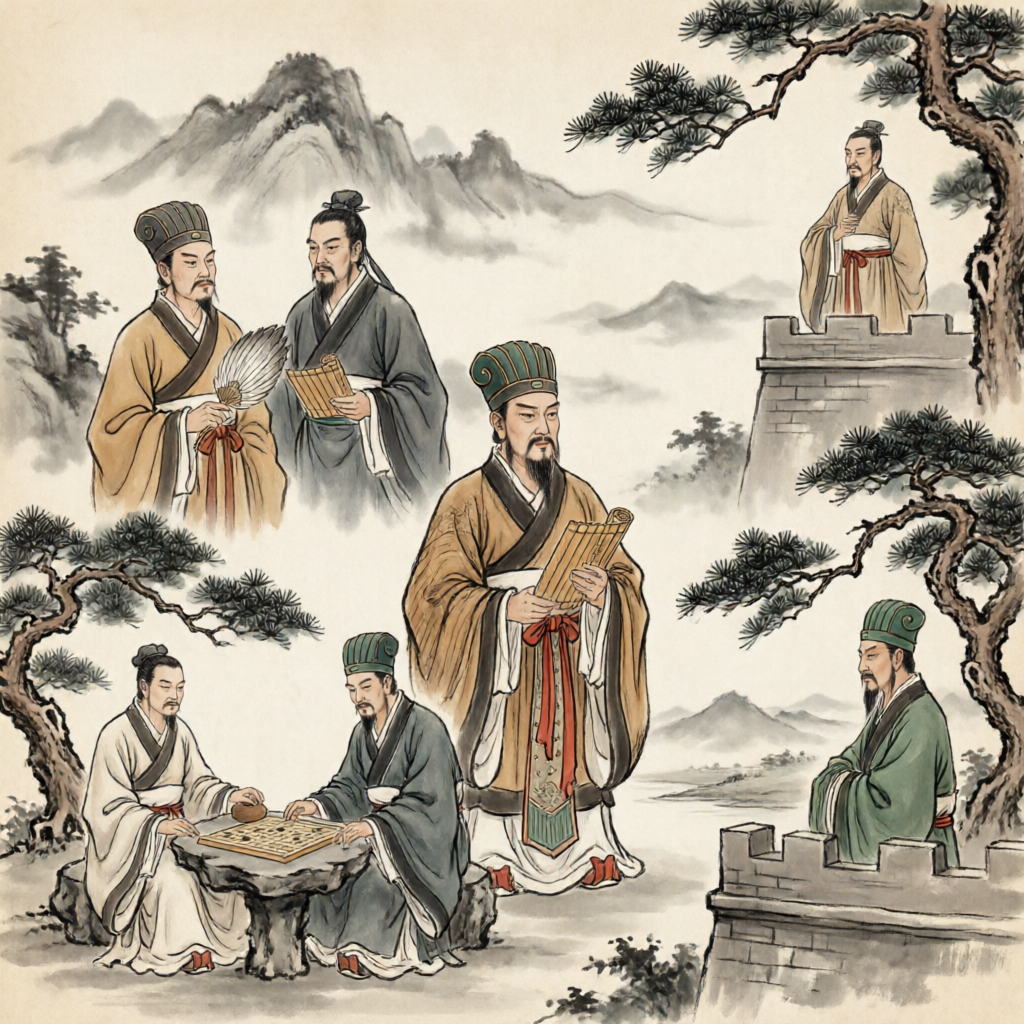
The Zhèng Héng Jiā (纵横家), often translated as "Political Strategists" or "School of Vertical and Horizontal Alliances," were a distinct intellectual and professional group in ancient China who emerged during the late Spring and Autumn and Warring States periods (c. 5th-3rd centuries BCE). These specialists in diplomacy, persuasion, and political strategy developed sophisticated techniques for influencing rulers and manipulating international relations through the formation and dissolution of alliances. Their activities significantly shaped the political landscape of pre-imperial China, particularly during the chaotic transition toward unification under the Qin Dynasty.
History
The origins of the Zhèng Héng Jiā can be traced to earlier diplomatic officials known as "xíng rén" (行人). According to the Book of Han (《汉书·艺文志》), these officials were initially responsible for ceremonial protocol rather than diplomacy: "The Zhèng Héng Jiā probably originated from the officials called xíng rén. Confucius said: 'If one recites the three hundred poems of the Book of Odes but cannot respond appropriately when sent on diplomatic missions, what is the use of knowing so many?'" However, by the Spring and Autumn period, the role of xíng rén had evolved to focus primarily on diplomatic missions between states rather than ceremonial duties.
The Zhèng Héng Jiā emerged as a distinct group during the Warring States period (475-221 BCE), when the international political landscape became increasingly complex. This period witnessed the rise of seven major states (the "Seven Warring States") that constantly vied for dominance, creating fertile ground for diplomatic specialists who could manipulate shifting alliances. The Records of the Grand Historian (《史记》) notes that during this time, "scheming and deceit were employed, and theories of vertical and horizontal alliances arose."
The development of the Zhèng Héng Jiā can be divided into three distinct phases:
First Phase
The early period, following the establishment of the Seven Warring States, was characterized by unstable new regimes focused on internal consolidation. During this stage, the "vertical alliance" (合纵, hézòng) strategy predominated, where multiple weaker states would unite to confront a single powerful state. Key figures of this period included Hui Shi and Gongsun Yan.
Second Phase
As conflicts between major states intensified, the Zhèng Héng Jiā gained greater influence and importance. This period saw the formation of two opposing political blocs centered around the states of Qi and Qin. The "vertical alliance" (uniting against Qin) and "horizontal alliance" (connecting with Qin) strategies alternated as the dominant approach. This era marked the first high point in the development of the Zhèng Héng Jiā, producing numerous influential strategists including Su Qin, Zhang Yi, Chen Zhen, Lou Huan, Guo Wei, Yu Qing, and Gan Mao. The theoretical foundations and distinctive intellectual tradition of the Zhèng Héng Jiā were fully established during this period.
Third Phase
During the final phase, as unification under Qin approached, the "horizontal alliance" strategy (连横, liánhéng) became dominant, particularly under the guidance of strategists like Fan Sui and Cai Ze. Qin's successful implementation of the "befriend distant states while attacking nearby ones" (远交近攻) strategy, largely credited to Fan Sui, ultimately led to Qin's dominance and eventual unification of China. As Liu Xiang noted when compiling the Strategies of the Warring States: "Thus Su Qin, Zhang Yi, Gongsun Yan, Chen Zhen, Su Dai, and Su Lieng generated theories of vertical and horizontal alliances, tilting the balance of power. When Su Qin promoted vertical alliances, Chu became powerful; when Zhang Yi promoted horizontal alliances, Qin became emperor. Where these strategists went, their host state became influential; where they left, their host state became weak."
Key Information
| Aspect | Details |
|---|---|
| Founder | Guiguzi (鬼谷子), a mysterious figure of uncertain origin |
| Period | Late Spring and Autumn to Qin-Han transition (c. 5th-3rd century BCE) |
| Representative Figures | Su Qin, Zhang Yi, Gongsun Yan, Fan Sui, Chen Zhen |
| Major Works | Guiguzi (鬼谷子), Strategies of the Warring States (战国策) |
| Primary Strategy | Vertical alliances (合纵, hézòng): uniting weaker states against a strong one Horizontal alliances (连横, liánhéng): allying with a strong state against others |
Cultural Significance
The Zhèng Héng Jiā represented a pragmatic approach to international relations that emphasized adaptability and effectiveness over moral considerations. Their techniques of psychological manipulation, persuasive rhetoric, and strategic alliance-building represented a sophisticated understanding of human nature and political power. This intellectual tradition contributed significantly to the development of Chinese diplomatic thought and strategic theory.
The Guiguzi, traditionally attributed to the founder of the school, details methods of psychological assessment, persuasive techniques, and strategic positioning that remain influential. The text emphasizes understanding the mindset of one's target and adapting one's approach accordingly: "One can be released or controlled; one can be directed vertically or horizontally." This work, along with the Strategies of the Warring States (which compiled actual diplomatic cases and arguments), formed the theoretical foundation of the Zhèng Héng Jiā tradition.
Modern Status
The influence of the Zhèng Héng Jiā extends beyond ancient diplomatic practice into modern applications. German philosopher Oswald Spengler, in his The Decline of the West (1918), praised the Chinese strategists for their practical relevance to international relations. This work later influenced American diplomacy, with some commentators comparing Henry Kissinger to modern practitioners of these ancient techniques.
Japanese scholar and business executive Takeshi Ohashi applied Guiguzi principles to business management in his book "The Art of War and Guiguzi" (「兵法」と「鬼谷子」), demonstrating the adaptability of these strategies beyond diplomatic contexts. The principles of psychological manipulation, strategic positioning, and adaptive persuasion continue to find applications in modern business negotiations, diplomatic relations, and conflict resolution.
References
-
Crump, Jr., J.I. (1979). Chinese Adaptations of Indian Buddhist Literature. East Asian Research Center, Harvard University.
-
Loewe, M., & Shaughnessy, E.L. (Eds.). (1999). The Cambridge History of Ancient China: From the Origins of Civilization to 221 BC. Cambridge University Press.
-
Puett, M.J. (2001). The To Become a God: Cosmology, Sacrifice, and Self-Divinization in Early China. Harvard University Asia Center.
-
Van Ess, H. (1993). Guanzi. In M. Loewe & E.L. Shaughnessy (Eds.), The Cambridge History of Ancient China (pp. 260-294). Cambridge University Press.
-
Yates, R.D.S. (1997). The Guiguzzi. In M. Loewe & E.L. Shaughnessy (Eds.), The Cambridge History of Ancient China (pp. 274-284). Cambridge University Press.