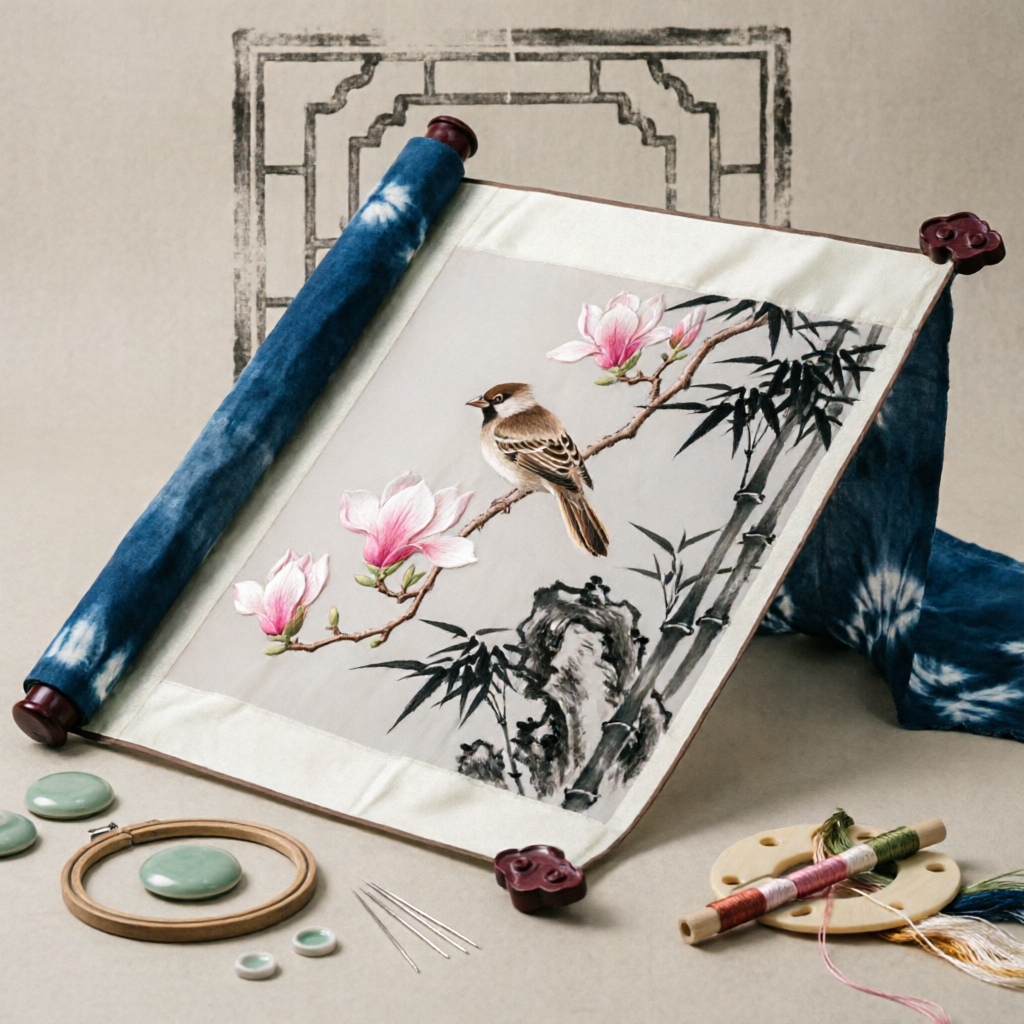
Overview
Suzhou Embroidery (苏绣), also known as Su embroidery, is a renowned traditional Chinese embroidery art originating from Suzhou in Jiangsu province. With a history spanning over 2,000 years, it is one of the most famous embroidery styles in China and is recognized as a National Intangible Cultural Heritage of China. Suzhou Embroidery is celebrated for its exquisite craftsmanship, delicate techniques, and artistic expression, earning it a prestigious place among China's "Four Famous Embroideries" alongside Yue embroidery, Xiang embroidery, and Shu embroidery.
History
The origins of Suzhou Embroidery can be traced back over 2,000 years to the Spring and Autumn Period (770-476 BCE). Legend attributes its invention to "Nü Hong," the granddaughter of Zhongyong, who is said to have been inspired by a drop of blood falling on fabric while she was sewing, leading her to create embroidered patterns as an alternative to tattooing. The term "nü hong" (女红) continues to refer to women's textile, sewing, and embroidery activities in Chinese culture.
During the Three Kingdoms period (220-280 CE), there are recorded instances of sophisticated embroidery production in the Wu Kingdom. According to historical records, Sun Quan, the king of Wu, commissioned Zhao Da's sister to embroider "The Map of All Nations" on silk fabric, depicting mountains, rivers, cities, and military formations in exquisite detail.
The foundation of Suzhou Embroidery's distinctive style was established during the Sui and Tang dynasties (581-907 CE), with its basic techniques and characteristics gradually forming during the Song and Yuan dynasties (960-1368 CE). By the Ming and Qing dynasties, Suzhou Embroidery had reached artistic maturity.
The Ming Dynasty (1368-1644 CE) saw Suzhou Embroidery become a widespread folk craft, with "every household raising silkworms and everyone practicing embroidery." The region emerged as a center for silk handcrafts, and the development of the Wu School of painting, represented by artists like Tang Yin (Tang Bohu) and Shen Zhou, significantly influenced embroidery design and technique. Embroidery artists began recreating paintings with needle and thread, achieving lifelike effects that were praised as "painting with needles" and "surpassing natural workmanship."
The Qing Dynasty (1644-1911 CE) marked the golden age of Suzhou Embroidery, which became renowned for its "exquisite fineness and elegant purity." Suzhou earned the reputation of being the "Embroidery City" of China. During the mid-to-late Qing period, the technique of "double-sided embroidery" emerged, showcasing the extraordinary skill of Suzhou artisans.
In the late Qing and early Republican era, Suzhou Embroidery began to incorporate Western artistic influences. Notably, the embroidery master Shen Shou (formerly Shen Yunzhi) developed "realistic embroidery" by integrating Western painting techniques. Her works, including portraits of Italy's Queen Elena and Jesus Christ, received international acclaim and awards at expositions in Italy and the United States.
After the founding of the People's Republic of China in 1949, Suzhou Embroidery experienced further revitalization. The Suzhou Embroidery Research Institute was established in 1950, and embroidery training classes were organized. The number of embroidery techniques expanded from 18 to over 40. In the 1930s, Yang Shouyu created "random needle embroidery," while Ren Hexian developed "virtual-real random needle embroidery" in 1958, further enriching the artistic expression of Suzhou Embroidery.
Key Information
| Aspect | Details |
|---|---|
| Chinese Name | 苏绣 (Suzhou Embroidery) |
| Recognition | National Intangible Cultural Heritage (since May 20, 2006) |
| Heritage Category | Traditional Fine Arts |
| Heritage Number | Ⅶ-18 |
| Origin Region | Suzhou City, Jiangsu Province |
| Historical Period | Over 2,000 years (Spring and Autumn Period to present) |
| Key Features | Exquisite fineness, elegant purity, double-sided embroidery |
| Major Techniques | Over 40 different embroidery techniques |
| Notable Masters | Shen Shou, Yang Shouyu, Ren Hexian |
Cultural Significance
Suzhou Embroidery holds profound cultural significance in Chinese art and history. It represents the pinnacle of Chinese embroidery artistry and embodies the aesthetic values of Jiangnan culture. The craft has been deeply influenced by the literati painting traditions of the Wu School, resulting in works that often feature classical themes, poetic imagery, and refined artistic sensibilities.
In traditional Chinese society, embroidery served both practical and symbolic purposes. Suzhou Embroidery items were used in various aspects of life, from clothing and accessories to decorative screens and wall hangings. Many designs incorporated auspicious symbols representing happiness, longevity, and good fortune, reflecting cultural values and aspirations.
The craft also played a significant role in women's education and social status in traditional China. For centuries, embroidery skills were considered essential accomplishments for women of good families, and proficiency in the art could enhance one's social standing. The distinction between "folk embroidery," "boudoir embroidery" (闺阁绣), and "court embroidery" reflects the different social contexts in which the craft was practiced.
Modern Status
Today, Suzhou Embroidery continues to thrive as both an art form and a cultural industry. The craft has adapted to contemporary tastes and market demands while preserving its traditional techniques and artistic essence. Modern innovations include the development of new embroidery styles, applications in interior design, and customization services that allow personal artistic expression.
Institutions such as the Suzhou Embroidery Research Institute and the China Suzhou Embroidery Museum (established in 1986) play crucial roles in preserving, researching, and developing the craft. These organizations train new generations of artisans, document traditional techniques, and promote Suzhou Embroidery both domestically and internationally.
Contemporary Suzhou Embroidery artists continue to push the boundaries of the art form while respecting its heritage. Notable contemporary artists include Yao Jianping, whose works have gained widespread recognition for their technical excellence and artistic innovation. The craft has also found new markets in the form of luxury gifts, home décor items, and art collectibles.
Despite modernization challenges, Suzhou Embroidery maintains its cultural significance and artistic value. It represents not only a remarkable technical achievement but also a living cultural tradition that continues to evolve while honoring its rich historical legacy.
References
-
Gowing, L. (1997). Embroideries and Needlepoints from China. Thames & Hudson.
-
Laing, E. (2004). Chinese Silk: A Cultural History. Oxford University Press.
-
Wang, S. (2010). Traditional Chinese Embroidery: History, Techniques, and Conservation. National Museum of China Press.
-
Jiangsu Provincial Department of Culture. (2006). Suzhou Embroidery: Intangible Cultural Heritage Documentation. Jiangsu People's Publishing House.
-
Chen, X., & Li, Y. (2015). The Art of Chinese Embroidery: Suzhou Tradition and Innovation. Cambridge Scholars Publishing.