Overview
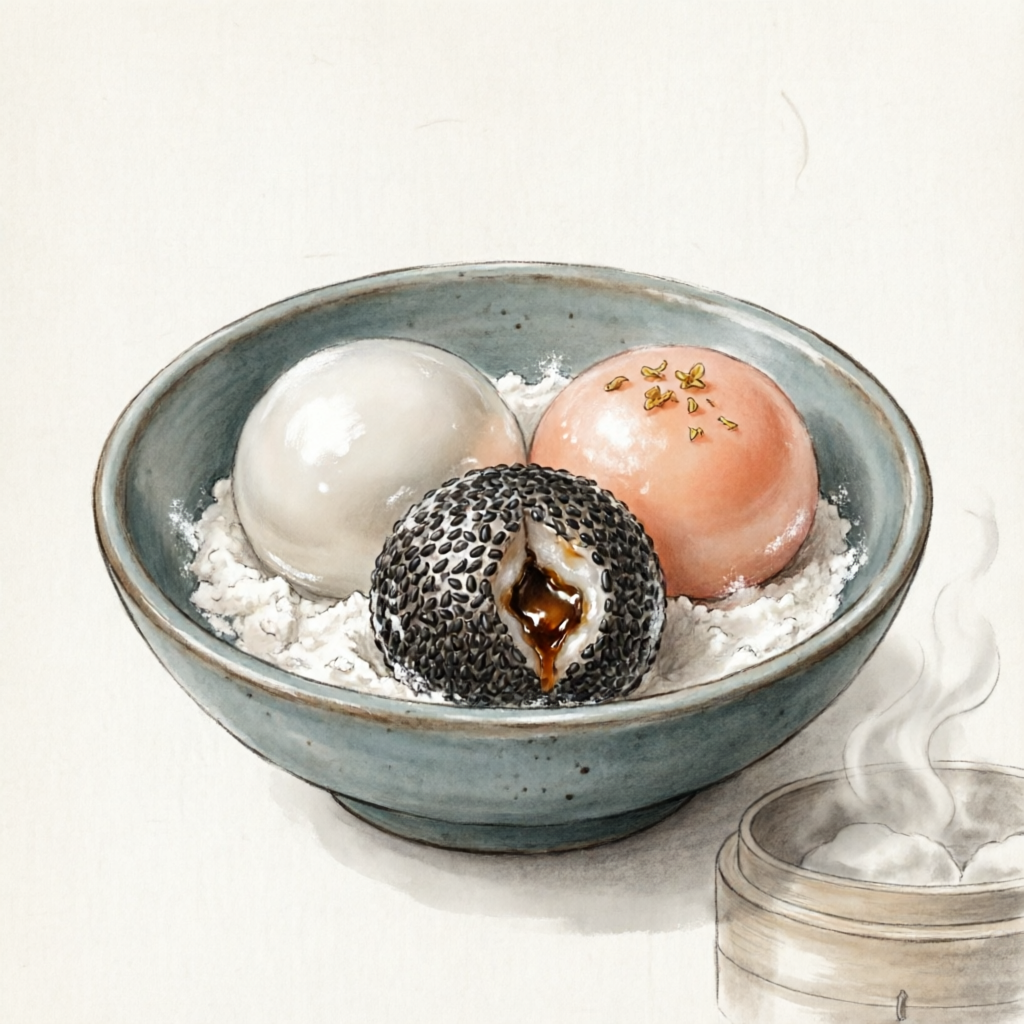
Tangyuan (汤圆) are traditional Chinese food made from glutinous rice flour, typically served in hot water or sweet broth. They are round, symbolizing completeness and reunion in Chinese culture, and are particularly popular during the Lantern Festival and other celebrations. The name "tangyuan" refers to the fact that these dumplings are served in soup, while "yuanxiao" is a common alternative name, especially in northern China. These dumplings come in various fillings, both sweet and savory, and have evolved significantly throughout Chinese history, with regional variations developed across different parts of the country.
History
Origin Legends
The history of tangyuan can be traced back to ancient times with multiple origin legends. The most widely known story relates to a palace maid named "Yuanxiao" during Emperor Wu of Han's reign. According to legend, Yuanxiao wept daily for her family. To help her reunite with her family, the scholar Dongfang Shu told Emperor Wu that the Fire God would burn Chang'an on the 15th day of the first lunar month unless the entire city prepared Yuanxiao's favorite tangyuan as offerings. The emperor agreed, allowing Yuanxiao to make tangyuan for everyone, which eventually enabled her to reunite with her family. Another legend connects tangyuan to King Zhao of Chu during the late Spring and Autumn period. When returning to his restored kingdom, King Zhao saw sweet white-red floating objects on the river. Confucius called them "floating apple fruits" and predicted that whoever obtained them would have signs of revival. The king then ordered his men to imitate these objects using flour with hawthorn filling, creating red tangyuan to commemorate the occasion.
Song Dynasty
During the Song Dynasty, eating tangyuan became widely popular and became an important symbol of the Lantern Festival. In Mingzhou (present-day Ningbo, Zhejiang), a new type of tangyuan emerged, made from black sesame seeds, lard, and white sugar. The black sesame was ground into powder, mixed with lard and sugar to form the filling, then wrapped in glutinous rice flour into round shapes. These were first called "fuyuanzi" and later "yuanxiao," with businesspeople calling them "yuanbao" (gold ingots) for auspicious reasons. Historical records such as "Pingyuan Xugao," "Shiguang Ji," and "Daming Yitong Fu" indicate that tangyuan became a seasonal food for celebrating the Lantern Festival during the Song Dynasty.
In the Northern Song, "Dongjing Menghua Lu" and in the Southern Song, "Wulin Shishi" both documented people eating "yuanzi" or "shatuan" during the Lantern Festival. According to these texts, there were various types of tangyuan, including those made with Chinese yam and kumquat. The "rutang yuanzi" made with black sesame, lard, and white sugar was most similar to today's Ningbo sesame tangyuan. The famous Southern Song poetess Zhu Shuzhen wrote a poem praising the sweet, soft tangyuan as tastier than chicken or crab. By the Southern Song Dynasty, tangyuan preparation techniques had become quite sophisticated, with detailed recipes recorded in texts like "Zhongfei Lu."
Ming and Qing Dynasties
After the Ming Dynasty, the "yuanzi" class of foods from the Song Dynasty became known as tangyuan or yuanxiao. The name "yuanxiao" was mainly popular in northern regions, while "tangyuan" was more common in the south. Historical texts from this period, such as "Xihu Youlan Zhiyu" and "Zhuozhong Zhi," mention "fentuan" (powder balls) which likely refers to tangyuan. During the Ming Dynasty, eating tangyuan on the 15th day of the first lunar month became customary, often consumed after ancestral worship with family and fellow townspeople.
In the Qing Dynasty, eating tangyuan during the Lantern Festival became even more popular. Various regional specialties emerged, such as Lai tangyuan in Chengdu, Ling tangyuan in Chongqing, Leisha tangyuan in Shanghai, Wuse tangyuan in Suzhou, Sixi tangyuan in Guangdong, and cairou tangyuan in Taiwan. The chef Yuan Mei and his team in the Qing Dynasty experimented with both sweet and savory fillings, creating innovative varieties like radish tangyuan and water powder tangyuan. Yuan Mei documented these recipes in his famous work "Suiyuan Shidan" ("The Foodie's Manual").
Republican Era
After the Xinhai Revolution in 1911, Yuan Shikai became the provisional president and reportedly disliked the name "yuanxiao" because it sounded similar to "yuan xiao" (Yuan disappears). In 1913, he ordered the name to be changed to "tangyuan" to avoid this association.
Key Information
| Category | Description |
|---|---|
| Chinese Name | 汤圆 (Tangyuan) |
| Alternative Names | 元宵 (Yuanxiao), 浮元子 (Fuyuanzi), 团子 (Tuanzi) |
| Main Ingredients | Glutinous rice flour, various fillings |
| Types | Filled and unfilled (solid) |
| Flavors | Sweet and savory |
| Cultural Significance | Symbol of family reunion and completeness |
| Main Festival | Lantern Festival (15th day of first lunar month) |
| Regional Variations | Ningbo, Chongqing, Sichuan, Guangdong, and other regional styles |
Cultural Significance
Tangyuan hold significant cultural meaning in Chinese tradition, primarily symbolizing family reunion and completeness. The round shape of tangyuan represents reunion (团圆, tuányuán) and perfection in Chinese culture. They are traditionally eaten during the Lantern Festival (Yuan Xiao Festival), which falls on the 15th day of the first lunar month, marking the first full moon of the new year. This festival symbolizes the coming together of family after the New Year celebrations.
The preparation and sharing of tangyuan also carry social significance. In many families, making tangyuan is a communal activity that brings family members together. The process of kneading the glutinous rice flour and filling the tangyuan is often seen as a metaphor for strengthening family bonds. Additionally, tangyuan are often exchanged as gifts between families during festivals, symbolizing good wishes and harmonious relationships.
Modern Status
In modern times, tangyuan have evolved significantly in terms of production methods, fillings, and consumption patterns. The invention of frozen tangyuan by Chen Zemin in 1992 revolutionized the industry, enabling year-round availability and industrial production. This innovation created a multi-billion yuan frozen food industry in China.
Contemporary tangyuan come in a wide variety of fillings beyond traditional options, including chocolate, durian, fruit, and even innovative flavors inspired by popular drinks and desserts. There has also been a trend toward healthier options, such as low-sugar, zero-sucrose, and whole-grain varieties, as well as "medicinal and food homology" products incorporating traditional Chinese medicinal ingredients.
In recent years, tangyuan have become increasingly creative in appearance, with 3D shapes, zodiac themes, and collaborations with popular intellectual properties (IPs). For example, in 2023,思念食品 (Si Siang Food) featured a rabbit IP形象 (IP image) for their "yellow millet tangyuan," while in 2025, various brands introduced fish-shaped "koi tangyuan" and "apple tangyuan" with auspicious meanings.
Cultural preservation efforts have also increased, with traditional tangyuan-making techniques being recognized as intangible cultural heritage in various regions. For instance, Liuzhou dew tangyuan making技艺 (craftsmanship) was listed as Liuzhou's intangible cultural heritage in 2018, and Bijie tangyuan making技艺 was added to Guizhou's provincial intangible cultural heritage list in 2024.
References
- Wang, L. (2019). Chinese Food Culture: History and Traditions. Beijing University Press.
- Zhang, Y. (2020). The Evolution of Traditional Chinese Snacks: From Regional Specialties to National Foods. Shanghai People's Publishing House.
- Li, H. (2018). "Symbolism and Social Function of Food in Chinese Festivals." Journal of Chinese Cultural Studies, 35(2), 112-135.
- Chen, Z. (2021). The Story of Frozen Foods: Innovation and Tradition in Modern Chinese Cuisine. China Light Industry Press.
- Liu, M. (2017). Regional Cuisines of China: Diversity and Cultural Significance. Oxford University Press.