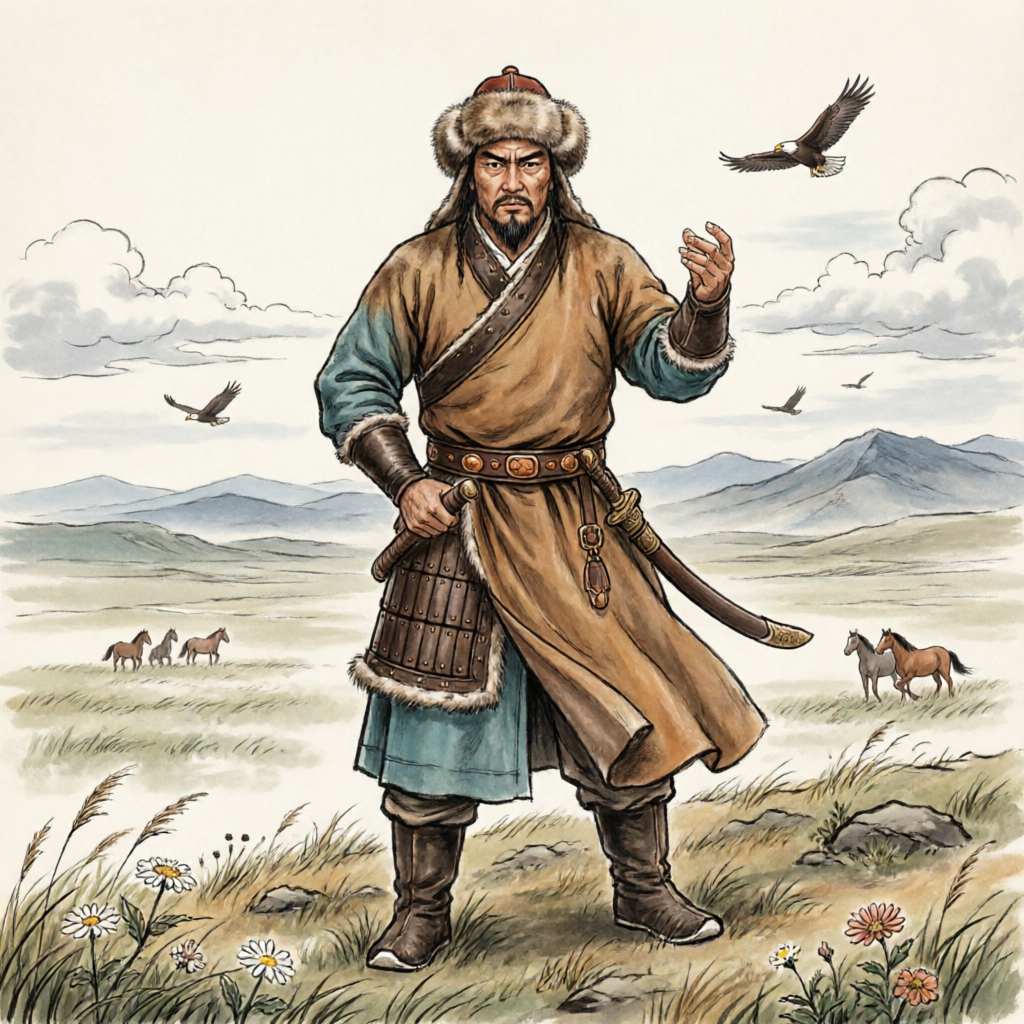
Temüjin
Overview
Temüjin (1162-1227), later known as Genghis Khan, was the founder of the Mongol Empire and one of history's most significant military leaders. Born into the Borjigin clan of the Mongol tribe, he unified the nomadic tribes of Northeast Asia and established the largest contiguous empire in history, stretching from Eastern Europe to the Sea of Japan. His military innovations, administrative reforms, and diplomatic strategies laid the foundation for the Mongol Empire's expansion and influence across Eurasia.
History
Early Life
Temüjin was born on May 31, 1162, near the Onon River in present-day Mongolia. His father, Yesugei, was the chief of the Khamag Mongol confederation, and his mother, Hö'elün, was abducted from the Merkit tribe according to the "bride-stealing" customs of the time. Legend holds that Temüjin was born with a blood clot in his hand, which was interpreted as a sign that he was destined to be a great leader.
Tragedy struck when Temüjin was nine years old. His father was poisoned by the Tatars, leaving the family vulnerable. The subsequent abandonment by their clan forced Temüjin, his mother, and his siblings into a life of extreme hardship. They survived by foraging for food and fishing in the Onon River. This difficult upbringing fostered Temüjin's resilience and determination.
Rise to Power
Temüjin's early adulthood was marked by a series of strategic alliances and betrayals. He sought protection from his father's anda (sworn brother), Toghrul of the Kerait tribe, who became his patron. Temüjin also formed a close bond with Jamukha, who would later become both his ally and rival.
In 1184, Temüjin married Börte, from the Konkirat tribe, only to have her abducted by the Merkits. With the help of Toghrul and Jamukha, Temüjin rescued Börte, an event that strengthened his reputation as a leader and warrior. This victory marked the beginning of Temüjin's consolidation of power.
Unification of the Mongol Tribes
By the late 12th century, Temüjin had emerged as a prominent leader among the Mongol tribes. His military genius and ability to forge alliances allowed him to defeat rival chieftains, including Jamukha at the Battle of the Thirteen Wings (1190) and the Tatars at the Battle of Ulan Butung (1196). These victories significantly increased his influence.
The decisive turning point came in 1204 when Temüjin defeated the powerful Naiman tribe at the Battle of the Irtysh River. This victory eliminated the last major obstacle to his unification of the Mongol tribes.
Coronation as Genghis Khan
In 1206, Temüjin convened a kurultai (a political and military council) on the banks of the Onon River, where he was proclaimed "Genghis Khan" (meaning "universal ruler" or "oceanic ruler"). He established the Great Mongol State (Yeke Mongghol Ulus) and implemented sweeping administrative and military reforms, including the decimal-based organization of the army and the codification of the Yassa (a legal code).
Key Information
| Aspect | Details |
|---|---|
| Full Name | Temüjin (孛儿只斤·铁木真) |
| Posthumous Title | Genghis Khan (成吉思汗) |
| Birth Date | May 31, 1162 |
| Birth Place | Onon River region, Mongolia (斡难河) |
| Death Date | August 25, 1227 |
| Death Place | Liupan Mountains, China (六盘山) |
| Burial Location | Unknown (possibly in Burkhan Khaldun, Mongolia) |
| Reign | 1206-1227 |
| Major Achievements | Unification of Mongol tribes, establishment of the Mongol Empire, creation of the Yassa legal code, implementation of decimal military organization |
| Successors | Ögedei Khan (son) |
Cultural Significance
Genghis Khan's legacy is complex and multifaceted. In Mongolian culture, he is revered as a national hero and the father of the Mongol nation. The "Darkhad" people of Mongolia maintain a sacred site believed to be his burial place, and numerous monuments and museums commemorate his life and achievements.
In the broader context of world history, Genghis Khan is remembered for both his military conquests and his administrative innovations. The Pax Mongolica (Mongol Peace) that followed his reign facilitated unprecedented trade and cultural exchange along the Silk Road, connecting Europe and Asia.
The Mongol Empire's tolerance of different religions and its promotion of merit-based governance were revolutionary for their time. Genghis Khan's policy of incorporating conquered peoples into his administration rather than exterminating them was instrumental in maintaining control over such a vast territory.
Modern Status
Today, Genghis Khan remains a symbol of national identity for Mongolians and continues to be studied by historians, military strategists, and anthropologists. Recent genetic studies have suggested that a significant portion of the population in Asia may be descended from him and his close male relatives, earning him the nickname "the father of a billion people."
In popular culture, Genghis Khan has been portrayed in numerous books, films, and television shows, often emphasizing his military prowess while sometimes overlooking his administrative achievements. Modern scholarship has increasingly focused on his role as a statesman and lawgiver rather than merely a conqueror.
The Mongol Empire's impact on world history continues to be studied, with historians examining its influence on trade routes, cultural exchange, and the development of modern governance systems. Genghis Khan's military tactics, particularly his innovative use of psychological warfare and mobility, continue to be studied by military academies worldwide.
References
-
Weatherford, J. (2004). Genghis Khan and the Making of the Modern World. Crown Publishers.
-
Ratchnevsky, P. (1991). Genghis Khan: His Life and Legacy. Blackwell Publishers.
-
Morgan, D. (1986). The Mongols. Blackwell Publishing.
-
Jack Weatherford (2010). The Secret History of the Mongol Queens: How the Daughters of Genghis Khan Resolved the Empire's Succession for Centuries. Crown Publishers.
-
Rossabi, M. (2012). Genghis Khan and the Mongol Empire. University of California Press.