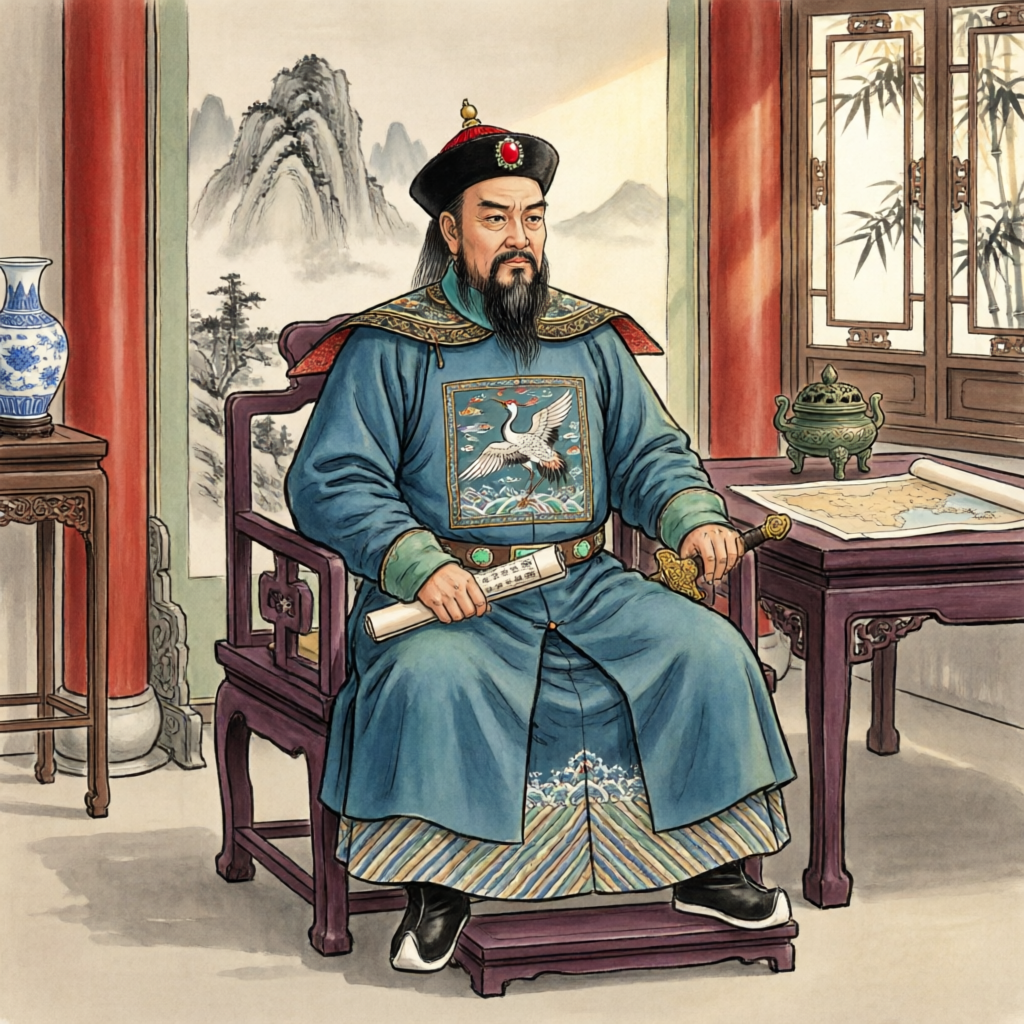
Zuo Zongtang
Overview
Zuo Zongtang (1812-1885) was a prominent statesman, military general, and governor of the late Qing Dynasty. He played a crucial role in suppressing several major rebellions, including the Taiping Rebellion and the Dungan Revolt, and is best known for leading the military campaign that recovered Xinjiang from foreign occupation. Zuo's administrative reforms, military strategies, and vision for modernization left a lasting impact on Chinese history during a period of internal strife and external threats.
History
Early Life and Education
Zuo Zongtang was born on November 10, 1812, in Xiangyin County, Hunan Province. From an early age, he displayed exceptional intelligence and ambition. In 1816, he accompanied his father, Zuo Guanlan, to Changsha to pursue his studies. In 1827, he placed second in the Changsha prefectural examination but abandoned further examination due to his mother's illness, who subsequently passed away.
During the mourning period, beginning in 1829, Zuo immersed himself in practical studies of statecraft (jingshi zhongyong), studying classics on Chinese history, geography, military affairs, economics, and water conservancy. He particularly valued works like "Imperial Compilation of Statecraft" (Huangchao Jingshi Wenbian), "Book on the Advantages and Disadvantages of All Prefectures and Commanderies" (Tianxia Junuo Libing Shu), "Geographical Study of Reading History" (Dushi Fangyao Ji Yao), and "Outline of Waterways" (Shuidu Tigang), which later proved invaluable in his military and administrative career.
In 1830, Zuo's father passed away. During the mourning period, he visited the renowned pragmatic official and scholar of statecraft, He Changling, who treated him with exceptional respect. In 1831, Zuo entered Chengnan Academy in Changsha, where He Changling's brother, He Xiling, became his teacher. He Xiling greatly admired Zuo's abilities, describing him as "outstandingly self-reliant" and possessing "solid knowledge." Their relationship grew so close that they eventually arranged a marriage between their children.
Entry into Official Service
In 1832, Zuo passed the provincial examination (xiangshi) and earned the title of "Juren" (Recommended Person). However, he failed the metropolitan examinations (huishi) on three subsequent occasions. Despite this setback, Zuo's talent and vision gained recognition from many prominent officials and scholars, including the He brothers.
In 1833, during his first attempt at the metropolitan examination in Beijing, Zuo befriended Hu Linyi. He also wrote a collection of poems titled "Miscellaneous Feelings on the Yan Terrace" (Yantai Gan Zhi), addressing the situation in Xinjiang. In 1835, Zuo once again participated in the metropolitan examination, placing fifteenth among Hunan candidates, but was removed due to exceeding the quota and only appointed as a "transcriber" (Tenglu). Unwilling to accept this position, he returned home with his wife Zhou's assistance, focusing on geographical studies.
In 1836, while teaching at Lujiang Academy in Liling, Hunan, Zuo met Tao Shu, the Governor-General of Liangjiang. In 1838, after failing the examination again, Zuo met Tao Shu in Nanjing during his journey home. Tao Shu proposed an engagement between his only son Tao Fang and Zuo's eldest daughter. Shortly after, Tao Shu passed away, and Zuo remained with the Tao family in Anhua from 1840 to 1847, teaching their children and managing their affairs. During this time, he extensively read the Tao family's library, managed Liuzhuang, studied agriculture and geography, and developed strategies for responding to the First Opium War.
Military Career and Suppression of Rebellions
In 1852, when the Taiping Rebellion threatened Changsha, Zuo was persuaded by Guo Songtao and others to accept an invitation from Governor Zhang Liangji to join the effort to defend the Qing Dynasty. Zuo entered the besieged city under cover of darkness and was entrusted with all military affairs. He organized supplies, managed documents, and planned defenses, successfully defending Changsha for three months until the Taiping forces withdrew. This marked the beginning of Zuo's military career.
In 1853, Zuo followed Zhang Liangji to the Governor-General's yamen in Huguang but returned to Xiangyin when Zhang was transferred to Shandong as governor. In 1854, at the invitation of Governor Luo Bingzhang, Zuo joined his yamen for a second time, serving for six years. During this period, he assisted Luo in "pacifying the interior and supporting five provinces," while also reforming policies, increasing revenue, stabilizing currency, and preparing military supplies. Luo trusted Zuo completely, often approving his proposals without review.
In 1855, Censor Zong Jichen recommended Zuo for promotion. In 1856, for his assistance in supplying funds to Zeng Guofan's troops, the imperial court appointed Zuo as a "Commissioner of the Ministry of War" with peacock feathers. In 1858, on Luo's recommendation, Zuo was granted the rank of "Fourth-rank Minister" (Sipin Qing). However, in 1859, the Fan Xie lawsuit forced Zuo to leave Luo's yamen. Despite this setback, his reputation grew, with the saying emerging that "the world cannot go a day without Hunan, and Hunan cannot go a day without Zuo Zongtang."
Campaign in Fujian and Zhejiang
In 1860, after the Taiping forces captured the Jiangnan Great Camp, Zuo, as a "Fourth-rank Capital Official waiting for assignment," accompanied Imperial Commissioner and Governor-General Zeng Guofan to assist with military affairs. He recruited 5,000 men from Hunan to form the "Chu Army," which fought against the Taiping forces in Jiangxi and Anhui.
In 1861, Zeng Guofan recommended Zuo for the position of Governor of Zhejiang. After the Taiping forces captured Hangzhou, the imperial court formally appointed Zuo as Governor of Zhejiang in January 1862, with responsibility for military affairs. In 1862, Zuo advanced into Zhejiang and, with the assistance of the Franco-Chinese "Changjie Army" and the Anglo-Chinese "Chang'an Army," successively captured Jinhua, Shaoxing, and other areas. In 1863, he was promoted to Governor-General of Fujian and Zhejiang.
In March 1864, Zuo captured Hangzhou, was granted the title of "Junior Guardian of the Crown Prince," and awarded the Yellow Jacket. He implemented various measures to restore the economy in Zhejiang and captured Huzhou, gaining control of the entire province. For his achievements, he was ennobled as "First-rank Kejing Earl." He was then ordered to lead troops into Jiangxi and Fujian to pursue Taiping forces led by Li Shixian and Wang Haiyang, finally defeating them in February 1866 in Jiaying Prefecture (present-day Meizhou).
Campaign in Shaanxi and Gansu
In 1862, Hui Muslims in Shaanxi took advantage of the Taiping Rebellion and Nian Rebellion to launch an uprising. The initial leaders included Hu Mingtang, Ma Shengyan, Ma Zhenhe, and Bai Yanhu. At the same time, a widespread Hui uprising occurred in Ningxia, led by Ma Zhao yuan and Ma Hualong. Due to these rebellions, the situation in Shaanxi and Gansu became nearly uncontrollable, and Governor-General Yang Yuebin could not effectively manage the crisis. In September 1866, the imperial court ordered Zuo Zongtang to proceed to Shaanxi and Gansu.
At the end of 1866, Zuo set out to suppress the Hui rebellions. However, due to the invasion of the Western Nian Army into Shaanxi and Zuo's assessment that the Nian forces were stronger than the Hui forces, he first focused on suppressing the Nian Army. In 1867, as Imperial Commissioner commanding troops (with the Governor-General of Shaanxi and Gansu temporarily held by Mutushan), Zuo repeatedly defeated the Nian Army but struggled to achieve complete victory due to Hui army distractions and the Nian Army's mobility. Yan chuan and Suide were also captured by Hui forces multiple times.
By the end of 1867, the Nian Army moved from Shaanxi to Shanxi, then to Henan and Zhili, causing alarm in the capital. Zuo, along with Li Hongzhang, Li Henian, and Guan Wen, were all dismissed from their positions. Zuo pursued the army and provided strategic advice, ultimately assisting Li Hongzhang in eliminating the Western Nian Army in 1868. When he visited the capital, Zuo stated that pacifying Shaanxi and Gansu would still take five years.
At the end of 1868, Zuo advanced to Yan'an, Suide, and Yulin in northern Shaanxi. By early 1869, he had successively persuaded the rebel leaders Hu Zhang and Dong Fuxiang to surrender. He then advanced to Dongzhi Plateau, decisively defeating the Hui forces stationed there and capturing the area in April, clearing Qingyang and Jingzhou. During this period, mutinies occurred in the forces of Liu Songshan and Gao Liansheng, with Gao being killed. Zuo was furious and severely punished the mutinous soldiers. He also promoted the "Daitian Method" and "Qutian Method" to restore production and allocated funds to relieve famine victims and surrendered rebels.
Zuo identified Ma Hualong in Jinjibao as one of the principal instigators of the Hui uprising and ordered Liu Songshan to attack Ma's position. In the same year, Zuo moved from Jingzhou to Pingliang and assumed the seal of Governor-General of Shaanxi and Gansu.
Campaign in Xinjiang
In 1864, influenced by the Taiping Rebellion and the Shaanxi-Gansu Hui uprising, local strongmen in Xinjiang took advantage of the chaos to establish separate regimes. The Islamic White Mountain Sect leader Mamat A and the Kyrgyz tribal leader Sidik both wrote to the Kokand Khanate in Central Asia, inviting its military leader Yakub Beg. In 1867, Yakub Beg established the "Khanate of Khoqand" and occupied Xinjiang. Russia took advantage of the situation and occupied Ili in July 1871.
The occupation of Ili drew the attention of the Qing court. The court ordered Jing Lian and Cheng Lu to lead troops out of the pass and instructed Zuo to send troops to suppress the rebels. However, due to the ongoing Hui rebellion in Shaanxi and Gansu, Zuo believed that "launching a distant expedition at this time is not a stable approach." Nevertheless, in January 1872, he ordered Xu Zhanbiao to advance to Suzhou.
In March 1873, Zuo wrote to the Zongli Yamen (Office of Foreign Affairs), stating that "to recover Ili, we must first capture Urumqi." Once Urumqi was captured, "our prestige will be established." Then, large-scale reclamation could be undertaken to ensure long-term logistical support, and various ethnic groups in Xinjiang could be encouraged to resume their normal farming and herding activities. "Even if we do not immediately demand Ili, it will be firmly secured." If diplomatic efforts failed and military confrontation with Russia became necessary, the Qing army could still achieve victory. In this way, Zuo proposed a policy of first pacifying the Hui regions of Xinjiang before preparing to recover Ili.
In 1874, Japan invaded Taiwan, leading to a debate within the Qing court between advocates of "coastal defense" (haifang) and "frontier defense" (saifang). Li Hongzhang and others advocated for coastal defense, prioritizing Japan as the main hypothetical enemy and suggesting abandoning frontier defense to reallocate funds. Hunan Governor Wang Wenshao advocated for frontier defense. Zuo argued for equal importance to both, stating that failing to recover Xinjiang would tie up Shaanxi and Gansu troops for an extended period, not only preventing the reduction of military expenditures that could benefit coastal defense but also "retreating an inch while the enemy advances a foot," especially inviting British and Russian infiltration.
The Grand Council minister Wen Xiang supported Zuo's view and provided full backing. Meanwhile, Zuo impeached Jing Lian and Cheng Lu, who had been ordered to recover Xinjiang but had hesitated to advance. Cheng Lu was dismissed, and Jing Lian was transferred. Consequently, in May 1875, the imperial court issued an edict appointing Zuo Zongtang as Imperial Commissioner with full authority over military affairs in Xinjiang, with General Jin Shun as his deputy.
In terms of military strategy, Zuo proposed "north first, then south" and "slow advance, quick battle":
-
"North first, then south": First pacify northern Xinjiang (without immediately attacking Ili), then advance to southern Xinjiang. This was because the main focus was to defeat Yakub Beg, whose forces were concentrated in Daban, Toksun, and Turpan, with weaker influence in the north. Additionally, Urumqi in northern Xinjiang had important political significance, and recapturing it would create necessary conditions for recovering Ili.
-
"Slow advance, quick battle": "Slow advance" referred to thorough military preparation. Zuo spent eighteen months raising military funds, accumulating supplies, reorganizing troops, reducing redundancy, and enhancing combat effectiveness. Even his main force, the Xiang Army, was streamlined by eliminating empty positions and keeping only the strong. He stipulated that any soldiers unwilling to march west to Xinjiang would be given funds and sent home without compulsion. When setting out, Zuo's Western Expedition Army consisted of Liu Jintang's Xiang Army (25 battalions, later increased to 32), Zhang Yao's Songwu Army (14 battalions), Xu Zhanbiao's Shu Army (5 battalions), Jin Shun's reorganized 40 battalions, plus other Qing troops for defense, totaling over 150 battalions with approximately 70,000-80,000 troops. However, only about 50 battalions, numbering over 20,000 men, were actually deployed to the front lines.
"Quick battle" referred to the need for rapid victory due to the imperial treasury's emptiness and the difficulties of transportation, sparse population, and barren land in Northwest China. To minimize military expenditures, once the army marched out, it had to achieve victory quickly, aiming for complete success in about eighteen months.
In 1876, Zuo officially launched the campaign. He stationed himself in Suzhou and ordered Liu Jintang and Jin Shun to lead troops out of the pass separately. Considering water supply difficulties, he divided the army into units of a thousand men, with each unit departing every other day. Liu took the northern route, and Jin took the southern route, meeting in Hami.
Liu's main force entered Xinjiang from Suzhou to Hami, a journey of about 1,700 li, and successfully reached Hami. After the battalions arrived in Hami, they transported grain from Suzhou and other areas to Hami, then transferred it over the dangerous eastern Tianshan Mountains to Barkol and Gucheng.
Liu's vanguard soon occupied Jimusa (present-day Jimusar County), less than 300 li from Urumqi. In August, Liu and Jin's forces jointly captured Gumudi after fierce fighting. Bai Yanhu and Ma Rende, Yakub Beg's accomplices, abandoned Urumqi and fled. Liu's army then recaptured Urumqi without bloodshed (August 18). Subsequently, Jin occupied Changji, and Rong Quan captured Manas with Liu's assistance. Thus, the northern route was pacified.
Daban, Toksun, and Turpan were the gateways to southern Xinjiang, significantly affecting the war situation. Zuo warned Liu not to advance too quickly and deployed a three-pronged advance plan, keeping Jin in Urumqi while making Liu the frontline commander.
In April 1877, Liu launched his troops and quickly recaptured Daban (April 20) and Toksun (April 26). Xu Zhanbiao and Zhang Yao met at Yanchi and captured the Turpan gate of Qiketengmu (April 21). Yakub Beg fled to Yanqi, leaving his young son in Korla as a rear guard. Soon, Liu, Zhang, and Xu's forces combined and recaptured Turpan (April 26). Seeing the gateway to the south open, Yakub Beg knew the situation was hopeless and committed suicide (or was poisoned). Yakub Beg's eldest son, Bukh Khuli, killed his younger brother in a power struggle and led the remaining forces to flee to Kashgar. Bai Yanhu led his remaining forces to escape to the Kaidu River area.
During the campaign to recover Xinjiang, British minister Thomas Wade repeatedly threatened the Qing court to stop the advance and suggested recognizing Yakub Beg's forces as a vassal state. The coastal defense faction also lobbied the court, which asked Zuo to "plan the overall situation" and present his views. Zuo submitted a memorial arguing forcefully for Xinjiang's strategic significance and the current favorable situation, proposing the implementation of provincial administration in Xinjiang. Ultimately, the campaign to recover Xinjiang continued.
In August 1877, Russia and Turkey were engaged in the Russo-Turkish War. Jin Shun suggested taking advantage of the situation to attack Ili, which was occupied by Russia. Zuo believed such an attack would be unjustified and would invite criticism, so he left it untouched. In August, the main army advanced westward, first recapturing the eastern four cities of southern Xinjiang (Korla, Kucha, Aksu, and Wushi), then the western four cities (Kashgar, Yengisar, Yarkant, and Hotan). Bukh Khuli and Bai Yanhu fled to Russia. On January 2, 1878 (still in the third year of the Guangxu reign), Hotan was recaptured. Thus, the Yakub Beg rebellion, supported by Britain and Russia, was suppressed. Seeing this, fourteen tribes of the Brus (present-day Kyrgyz) in the mountains vied to submit to Qing rule.
In just over a year, Zuo's Western Expedition Army had recovered all of Xinjiang except Ili. The Qing court commended his achievements and ennobled him as "Second-rank Kejing Marquis." Localities throughout Xinjiang also established "Zuo Gong Temples" in towns and villages for worship.
Final Years
In 1874, Zuo promoted the separation of provincial examinations and educational administration in Gansu and Shaanxi to spare Gansu candidates the difficulty of traveling to Shaanxi for examinations. He also implemented tea trade reforms in the northwest and suppressed the rebellion of Min Dianchen. In August 1874, Zuo was appointed Grand Secretary and later Grand Secretary of the Eastern Cabinet.
In 1875, Zuo was appointed Imperial Commissioner to negotiate with Russia regarding Ili. Through firm diplomatic negotiations and military pressure, he achieved the Treaty of Saint Petersburg in 1881, in which Russia agreed to return most of Ili to China while retaining some territories.
Zuo Zongtang passed away on September 5, 1885, in Fuzhou. He was posthumously granted the title of "Wenxiang" (Cultured and Accomplished) and buried in Xiangyin County, Hunan Province.
Key Information
| Aspect | Details |
|---|---|
| Full Name | Zuo Zongtang (左宗棠) |
| Courtesy Name | Zuo Pucon (左朴存) |
| Style Name | Laoliang (老亮) |
| Posthumous Name | Wenxiang (文襄) |
| Birth Date | November 10, 1812 (Qing Jiaqing era) |
| Birth Place | Xiangyin County, Hunan Province |
| Death Date | September 5, 1885 (Qing Guangxu era) |
| Death Place | Fuzhou, Fujian Province |
| Major Achievements | Suppression of Taiping Rebellion, Dungan Revolt; Recovery of Xinjiang; Modernization efforts including naval shipbuilding |
| Key Positions | Governor of Zhejiang, Governor-General of Fujian-Zhejiang, Shaanxi-Gansu, and Liangjiang; Grand Secretary |
| Military Strategy | "Slow advance, quick battle" (缓进急战); "North first, then south" (先北后南) |
Cultural Significance
Zuo Zongtang remains a significant historical figure in China, particularly remembered for his role in recovering Xinjiang. His military campaigns and administrative reforms during a turbulent period in Chinese history have been extensively studied and debated. In Xinjiang, he is revered as a hero who protected Chinese territory, with numerous temples and monuments dedicated to him. His approach to governance, emphasizing both military strength and economic development, has influenced subsequent Chinese administrators.
Modern historians have offered varied assessments of Zuo's legacy. Some praise his strategic vision and administrative capabilities, particularly in the Xinjiang campaign, while others criticize the brutal suppression of rebellions and the loss of life during his campaigns. His role in the early modernization efforts, including the establishment of shipyards and arsenals, is generally acknowledged as forward-thinking for the time.
In popular culture, Zuo has been portrayed in various novels, television series, and films, often as a complex figure combining Confucian scholar ideals with military prowess. His famous saying, "Never let the world go without Hunan, never let Hunan go without Zuo Zongtang," has become a cultural reference to his perceived indispensability during his time.
Modern Status
Today, Zuo Zongtang is studied in Chinese schools as a key figure of the late Qing Dynasty. His tomb in Xiangyin County and several historical sites associated with his life, including his former residence in Liuzhuang, have been preserved as cultural heritage sites. The Zuo Gong Temple in Urumqi and other monuments in Xinjiang continue to serve as symbols of his historical significance in the region.
Academic research on Zuo has expanded beyond traditional military and political history to include studies of his economic policies, technological innovations, and ethnic relations in the northwest. His approach to frontier defense and modernization continues to inform discussions about China's historical relationship with its border regions and the challenges of governance in multiethnic areas.
In contemporary China, Zuo is often invoked in discussions of national sovereignty and territorial integrity, particularly regarding Xinjiang. His successful campaign to recover the region from foreign occupation is frequently cited as a precedent for China's historical claims to the territory. At the same time, historians increasingly examine the complexities of his rule, including the impact of military campaigns on local populations and the long-term consequences of his policies.
References
-
Wright, Mary C. The Last Stand of Chinese Conservatism: The T'ung-chih Restoration, 1862-1874. Stanford University Press, 1957.
-
Spence, Jonathan D. The Search for Modern China. W.W. Norton & Company, 1990.
-
Hummel, Arthur W., ed. Eminent Chinese of the Ch'ing Period (1644-1912). United States Government Printing Office, 1943.
-
Zeng, Yifen. Zuo Zongtang Nianpu (Chronological Biography of Zuo Zongtang). Zhonghua Shuju, 1997.
-
Perdue, Peter C. China Marches West: The Qing Conquest of Central Eurasia. Harvard University Press, 2005.