Chinese Characters
Overview
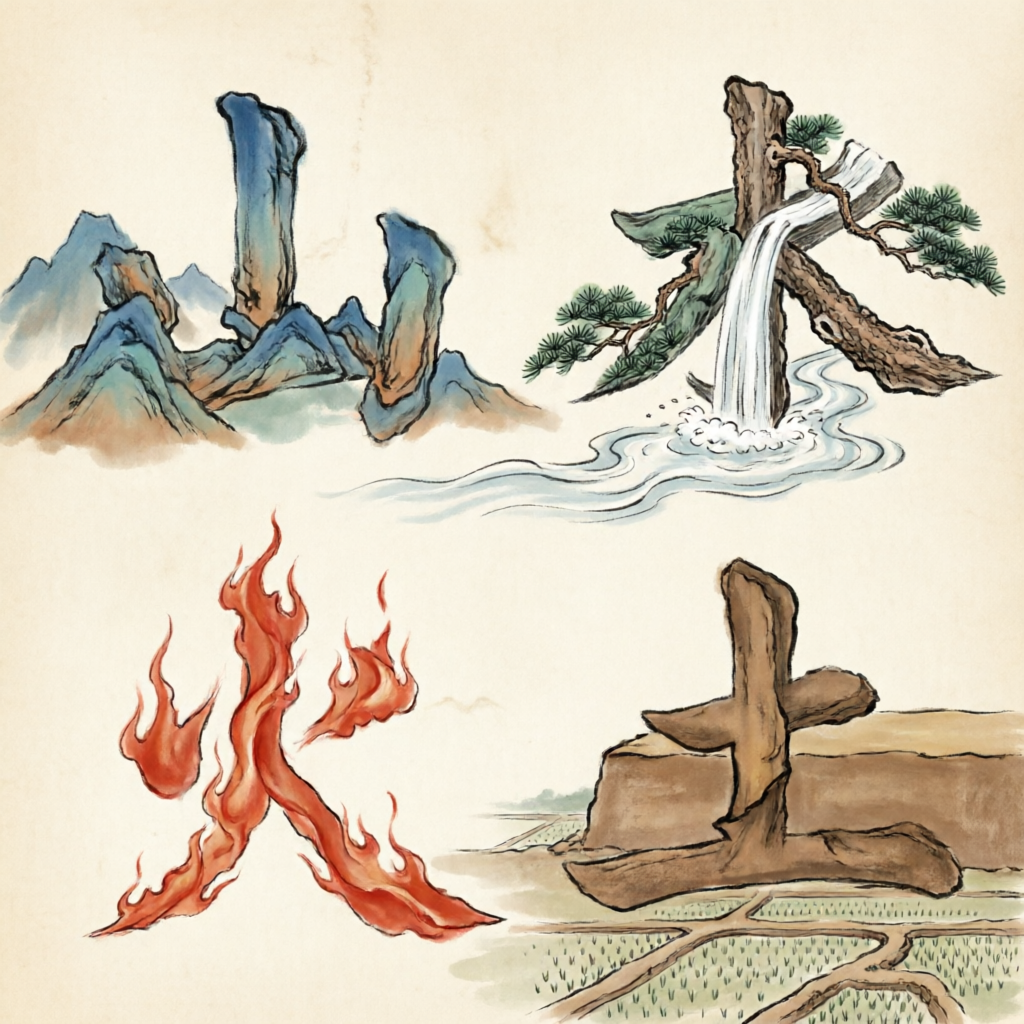
Chinese characters (汉字/漢字, hàn zì) are the writing system used to write Chinese and historically influenced many East Asian languages. As one of the world's oldest continuously used writing systems, Chinese characters are logograms, meaning each character typically represents a semantic unit rather than a pure sound. The system features characters that are mostly monosyllabic and represent single morphemes in the language. These characters are typically composed of strokes arranged in two-dimensional combinations, primarily following left-right or top-bottom structures.
History
Origins of Chinese Characters
The origins of Chinese characters have been debated throughout Chinese history, with several competing theories attempting to explain their emergence:
-
Knot-tying Theory (结绳说): Before writing, ancient people used knotted ropes to record events. The Book of Changes states: "In high antiquity, governance was conducted through knotted ropes; later sages replaced them with written documents." This theory suggests that knots may have influenced the development of writing systems.
-
Bagua Theory (八卦说): The Book of Changes also describes how the mythical emperor Fuxi created the eight trigrams (bagua) by observing natural phenomena. Some scholars believe these trigrams may have influenced the development of early Chinese characters.
-
Cangjie Creation Theory (仓颉造字说): Legend attributes the creation of Chinese characters to Cangjie, a historian of the Yellow Emperor's era. According to this account, Cangjie developed characters by observing bird and animal tracks. Modern scholars suggest that if Cangjie was a real historical figure, he was likely a compiler or standardizer of existing rather than the sole creator of characters.
-
Inscription Theory (刻契说): This theory posits that early characters evolved from notches made on wooden or bamboo strips used for recording numbers and transactions. Some of these notches resemble early numerical characters like "one, two, three, four, five."
-
Carving Theory (刻划说): Based on comparisons between pottery symbols from the Banpo site and Shang dynasty oracle bones, scholar Guo Moro proposed that early characters developed from a carving system that preceded pictographic representations.
-
Pictograph Theory (图画说): Many scholars believe Chinese characters originated from pictographs used to record events. Archaeological findings from Dawenkou and Liangzhu cultures show more regularized graphic markings that may represent early pictographic characters.
Evolution of Chinese Characters
Chinese characters have undergone significant evolution over thousands of years, developing through several major stages:
-
Oracle Bone Script (甲骨文): The earliest systematic Chinese writing, dating from the Shang dynasty (14th-11th centuries BCE), found on turtle shells and animal bones used for divination. Approximately 150,000 fragments have been discovered, containing over 4,500 distinct characters, with about 1,500 identified. Oracle bones demonstrate a mature writing system with various character formation methods.
-
Bronze Script (金文): Characters cast on bronze vessels during the Shang and Zhou dynasties. Also known as "bell and tripod script" (钟鼎文), these inscriptions primarily recorded ancestral achievements and significant historical events.
-
Great Seal Script (大篆): A script style from the late Western Zhou to the Qin dynasty, characterized by overlapping forms. The Stone Drum Script is considered a representative example.
-
Small Seal Script (小篆): The standardized script created during the Qin dynasty under the direction of Li Shi. It featured elongated, rounded forms and remained in use until the Western Han dynasty when it was gradually replaced by clerical script.
-
Clerical Script (隶书): Developed during the late Qin dynasty, this script transformed the rounded strokes of seal script into angular forms, significantly improving writing efficiency. It represents a major turning point in Chinese script evolution, becoming the foundation for later script styles.
-
Regular Script (楷书): Also known as standard script, it emerged in the Eastern Han dynasty and reached its peak during the Tang dynasty. Characterized by square forms and straight strokes, it became the standard script for printing and formal writing.
-
Cursive Script (草书): Developed for faster writing, beginning with clerical cursive in the early Han dynasty and evolving into various forms including cursive (今草) and wild cursive (狂草).
-
Running Script (行书): A semi-cursive style that emerged in the late Eastern Han, balancing the clarity of regular script with the speed of cursive script.
Archaeological Discoveries
Archaeological findings have provided important clues about the origins of Chinese characters:
- Jiahu carved symbols (approx. 7,762 years old)
- Shuangdian symbols (7,000 years old)
- Banpo pottery symbols (6,000 years old)
- Qingdun site inscriptions (5,000 years old)
- Zhuangqiaofen site with connected characters
- Dawenkou pottery symbols
- Taosi site inscriptions from the Yao-Shun era
These early symbols show increasing regularity and may represent the nascent stages of Chinese writing.
Key Information
| Characteristic | Description |
|---|---|
| Chinese Name | 汉字/漢字 (hàn zì) |
| Type | Logographic writing system with morphemic representation |
| Structure | Primarily left-right or top-bottom two-dimensional combinations |
| Pronunciation | Mostly monosyllabic, one character per syllable |
| Earliest Form | Oracle Bone Script (Shang dynasty, 14th-11th century BCE) |
| Major Evolutionary Stages | Oracle Bone → Bronze → Seal → Clerical → Regular → Cursive → Running scripts |
| Total Characters | Approximately 80,000-100,000 in existence, with about 3,000-6,000 in common use |
| Unicode Coverage | Over 90,000 characters in the latest Unicode standard |
Cultural Significance
Chinese characters hold profound cultural significance in East Asia and beyond. As one of the world's few ancient writing systems still in use today, they serve as a vital link to China's 3,000-year recorded history. The structure and evolution of characters reflect Chinese philosophical concepts, particularly the relationship between form and meaning.
Historically, Chinese characters played a crucial role in cultural unification across China's vast territory. During the Zhou dynasty, the "feudal relatives" system led to the widespread dissemination of Chinese characters throughout different regions. Following the unification of China under the Qin dynasty, the "standardization of script" policy (书同文) further solidified the role of Chinese characters as a unifying cultural force.
The aesthetic dimension of Chinese characters, known as calligraphy (书法), developed into a major art form in East Asia, valued for its visual beauty and spiritual expression. Different calligraphic styles reflect various cultural and historical periods, with masters like Wang Xizhi (Tang dynasty) and Yan Zhenqing (Tang dynasty) achieving legendary status.
Modern Status
Today, Chinese characters remain the primary writing system for Chinese and are used in various forms throughout the Chinese-speaking world. The traditional form (繁体字) is used in Taiwan, Hong Kong, and Macau, while the simplified form (简体字) is used in mainland China, Singapore, and Malaysia.
In terms of character usage, approximately 3,000 characters cover 99% of modern Chinese text. The Chinese government's "General Standard Chinese Character Table" (2013) includes 8,105 characters divided into three levels: 3,500 common characters, 3,000 less common characters, and 1,605 characters for specialized use.
Digital technology has presented both challenges and opportunities for Chinese characters. Early computer systems struggled with character encoding, but modern standards like Unicode now support over 90,000 Chinese characters. Input methods have evolved from complex keyboard layouts to advanced pinyin and handwriting recognition systems.
Despite challenges from digital communication and romanization systems, Chinese characters continue to thrive as a vital part of Chinese cultural identity and a major world writing system.
References
-
Qiu, Xigui. (2000). Chinese Writing. Translated by Gilbert L. Mattos and Jerry Norman. Society for the Study of Early China and The Institute of East Asian Studies, University of California.
-
Boltz, W. G. (1994). The Origin and Early Development of the Chinese Writing System. American Oriental Society.
-
Tsu, Jing-Li. (2010). Written and Unwritten: A New History of Chinese Script Through Calligraphy. University of Washington Press.
-
DeFrancis, John. (1984). The Chinese Language: Fact and Fantasy. University of Hawaii Press.