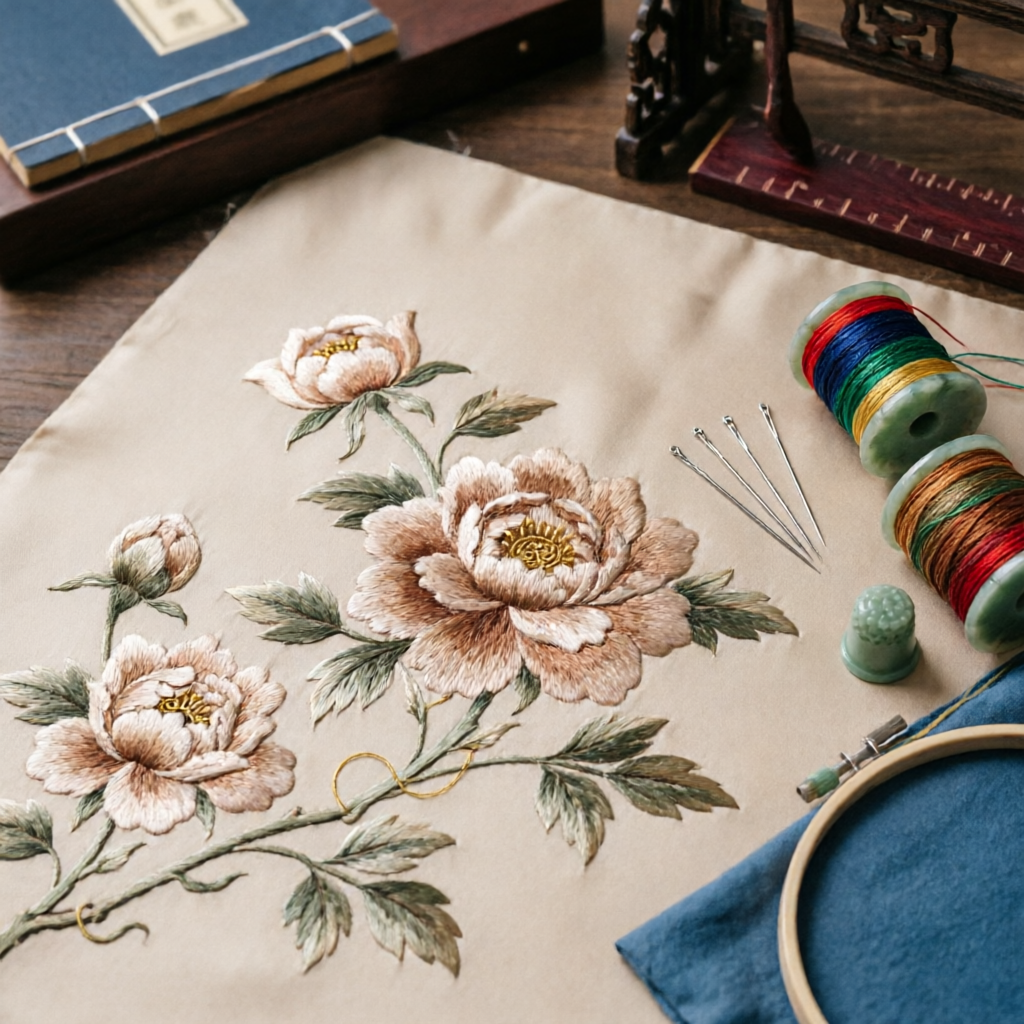
Embroidery
Overview
Embroidery, known as "刺绣" (cì xiù) in Chinese, is a traditional handicraft that involves creating decorative patterns on textiles using needles and colored threads. This ancient art form, which dates back over 2,000 years in China, has evolved into a sophisticated craft with numerous regional styles and techniques. Embroidery serves both practical and aesthetic purposes, adorning everything from clothing and household items to artistic works of high cultural value.
History
Embroidery in China has a rich and storied history, with archaeological evidence suggesting its existence as early as the Neolithic period. According to historical records, the "章服制度" (zhangfu zhidu) of the Xia Dynasty (c. 2070-1600 BCE) already prescribed "衣画而裳绣" (clothes painted and skirts embroidered). By the Zhou Dynasty (1046-256 BCE), embroidery had become specialized enough to have dedicated officials overseeing its production.
The earliest surviving embroidered artifacts discovered in China date from the Warring States period (475-221 BCE). Excavated from tombs in Changsha, Hunan, these pieces showcase advanced techniques with patterns of dragons, phoenixes, and tigers, executed using the "辫子股针法" (bianzigu zhenfa), or lock stitch technique.
During the Han Dynasty (206 BCE-220 CE), embroidery flourished alongside the development of silk production. The Mawangdui tomb in Changsha yielded numerous exquisite embroidered items demonstrating sophisticated craftsmanship and diverse patterns. The Tang Dynasty (618-907 CE) saw further refinement, with embroidery increasingly used for religious purposes, particularly in creating Buddhist sutras and images.
The Song Dynasty (960-1279 CE) marked a golden age for embroidery, with the establishment of specialized embroidery workshops and the emergence of "绣画" (xiuhua), or embroidered paintings that emulated famous artworks. This period saw the development of numerous needle techniques and a focus on achieving lifelike representations.
Key Information
| Aspect | Details |
|---|---|
| Chinese Name | 刺绣 (cì xiù) |
| Alternative Names | 针绣 (zhēn xiù) |
| Origin | China (over 2,000 years ago) |
| Major Regional Styles | Su embroidery (苏绣), Xiang embroidery (湘绣), Yue embroidery (粤绣), Shu embroidery (蜀绣) |
| Key Techniques | Lock stitch, flat stitch, seed stitch, gold thread embroidery |
| Cultural Significance | Important part of "女红" (nǔ hóng), traditional women's needlework |
| UNESCO Status | Various regional embroidery styles recognized as intangible cultural heritage |
Cultural Significance
Embroidery holds deep cultural significance in Chinese tradition and is considered an essential part of "女红" (nǔ hóng), the traditional domain of women's needlework skills. Beyond its practical applications, embroidery has long been valued for its artistic expression and cultural symbolism.
Different embroidered motifs carry specific meanings: dragons symbolize imperial power and good fortune, phoenixes represent virtue and grace, and lotus flowers signify purity and enlightenment. These symbolic elements are often combined in complex compositions that reflect Chinese philosophical and aesthetic values.
The art of embroidery also reflects social hierarchies and cultural exchange. Historically, imperial workshops produced the finest embroidered works for the court, while regional styles developed distinct characteristics influenced by local culture, materials, and preferences.
Modern Status
Today, Chinese embroidery continues to thrive both as a traditional art form and a contemporary creative medium. The "四大名绣" (Sì Dà Míng Xiù), or Four Great Embroideries—Su (Suzhou), Xiang (Hunan), Yue (Guangdong), and Shu (Sichuan)—are particularly renowned for their distinctive styles and techniques.
In recent decades, embroidery has gained recognition as an important element of China's intangible cultural heritage. Various regional embroidery styles have been protected and promoted through government initiatives, educational programs, and cultural exhibitions. Notable artists like Shen Shou (沈寿, 1874-1921) have contributed to the evolution of embroidery by incorporating Western artistic techniques while maintaining traditional craftsmanship.
The contemporary embroidery scene embraces innovation while preserving traditional methods. Artists experiment with new materials, techniques, and subject matters, creating works that resonate with modern sensibilities while honoring historical roots. Embroidery has also found new applications in fashion design, interior decoration, and contemporary art.
References
-
James, C. Y. (2016). Chinese Embroidery: Traditional Techniques. Thames & Hudson.
-
Gittinger, M. (1972). Masterpieces of Chinese Embroidery from the People's Republic of China. Textile Museum.
-
Laing, E. (2013). Chinese Silk: A Cultural History. Oxford University Press.
-
Zhao, F. (2008). The History of Chinese Embroidery. National Museum of China Publishing House.
-
Wang, X. (2015). Traditional Chinese Embroidery Techniques and Patterns. Beijing: Tsinghua University Press.