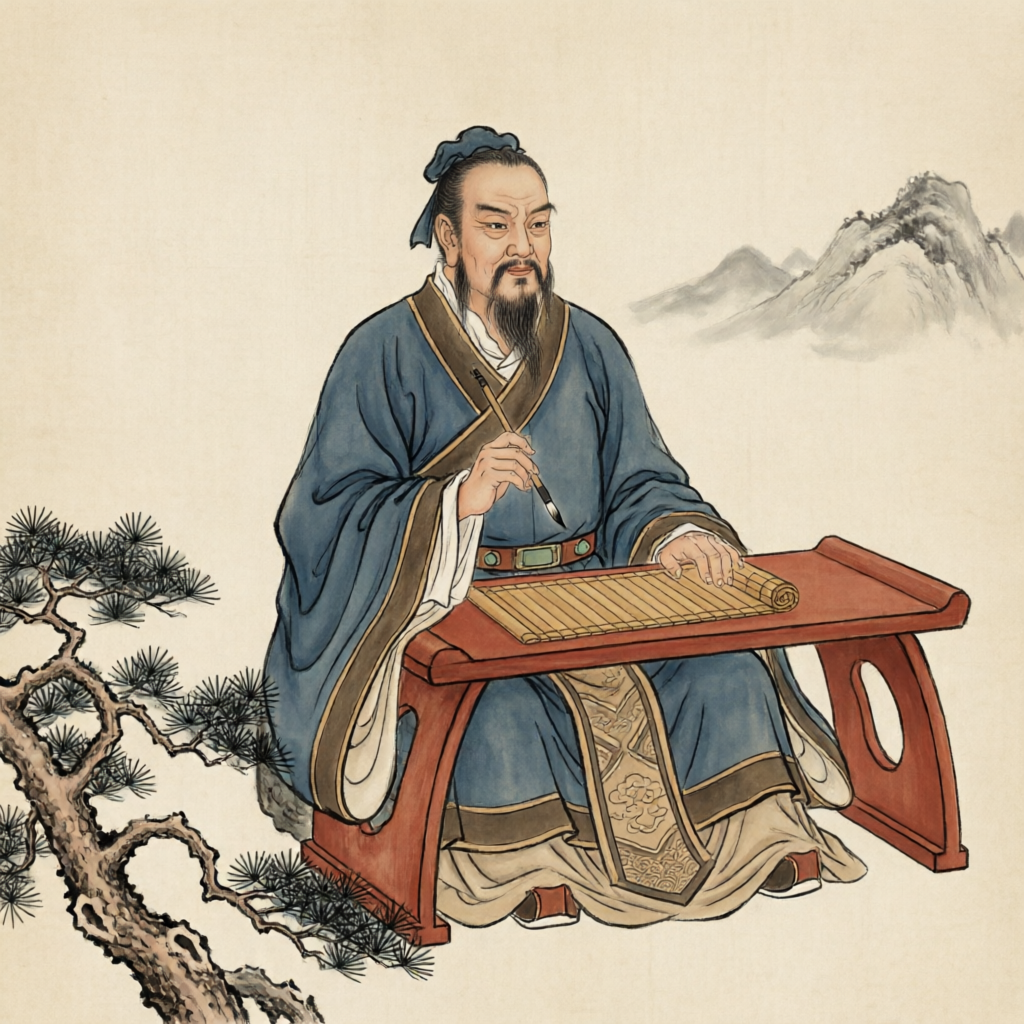
Han Yu
Overview
Han Yu (768-824 CE), courtesy name Tuizhi, was a renowned writer, poet, and philosopher of the mid-Tang Dynasty in China. He is widely regarded as a leading figure of the Classical Prose Movement (古文运动), which sought to revitalize literary expression by returning to the concise, straightforward style of pre-Han and Han dynasty texts. Han Yu's works exerted profound influence on later Chinese literature, earning him recognition as the first of the "Eight Great Prose Masters of the Tang and Song" (唐宋八大家). His literary achievements were complemented by his career as a government official, during which he demonstrated unwavering principles and remarkable courage in the face of political adversity.
History
Early Life and Hardships
Han Yu was born in 768 CE during the Dali era of Emperor Daizong of Tang. His family background was scholarly, with ancestors who had served in both imperial and local government positions. His father, Han Zhongqing, held the position of Secretary in the Imperial Library. However, tragedy struck early in Han Yu's life—his father passed away when he was just three years old. He was subsequently raised by his elder brother, Han Hui.
In 777 CE, Han Hui fell victim to political intrigue when he was implicated in a case involving the powerful chancellor Yuan Zai. He was demoted to Prefect of Shaozhou, where he died shortly after assuming his post. Following this tragedy, Han Yu, accompanied by his sister-in-law Lady Zheng (whom he respectfully referred to as "Sixth Sister"), first returned to their ancestral home in Heyang to bury his brother. Unable to remain there permanently, they moved to Xuanzhou to live in obscurity. This period of Han Yu's youth was marked by hardship and instability.
The Path to Scholarly Recognition
Despite these difficulties, Han Yu demonstrated exceptional diligence in his studies from a young age, requiring no external encouragement. In 786 CE, he left Xuancheng alone for the capital, Chang'an, to pursue his scholarly ambitions. He first sought out his kinsman Han Yan in Hezhong Prefecture (modern-day Yongji, Shanxi), hoping to gain a recommendation from the military governor Hun Jian. However, this effort proved fruitless.
In the autumn of 787 CE, Han Yu qualified as a provincial candidate and returned to Chang'an, only to fail the metropolitan examination that year. Around this time, he received the devastating news of Han Yan's untimely death. Toward the end of 787 CE, through a fortuitous encounter, Han Yu gained an audience with the Prince of Beiping, Ma Sui, who provided him with crucial assistance. In gratitude, Han Yu later wrote "The Cat Nurturing Kittens" (猫相乳) to acknowledge Ma Sui's kindness.
Between 787 and 789 CE, Han Yu attempted the imperial examinations three times without success. In 789 CE, he returned to Xuancheng. His perseverance paid off in 792 CE when he finally passed the jinshi examination at his fourth attempt. The following year, however, he failed the special examination for erudite and accomplished scholars (博学宏词科) administered by the Ministry of Personnel. In 794 CE, he attempted this examination again but failed once more. During this period, he also submitted memorials to the chancellor three times without receiving any response.
Service in Military Administrations
In July 796 CE, Han Yu was recommended by Dong Jin, the military governor of Xuanwu, and appointed as an Observational Aide in the secretariat. During his three years in this position, he mentored young scholars like Li Ao and Zhang Ji while promoting his vision for prose reform.
In February 799 CE, Dong Jin passed away. Han Yu accompanied Dong Jin's coffin out of the region. Remarkably, just four days after his departure, a mutiny broke out in the Xuanwu Army, with the deputy commander Lu Changyuan and others being killed. Han Yu's timely departure spared him from this turmoil. He traveled with Dong Jin's coffin to Luoyang, then proceeded to Xuzhou by the end of February. In the autumn of that year, he accepted an appointment as an aide to Zhang Jianfeng, the military governor of Xu-Si-Hao. During the winter, Zhang Jianfeng sent Han Yu to Chang'an to present New Year's greetings to the emperor.
In the spring of 800 CE, Han Yu returned to Xuzhou. Shortly after, Zhang Jianfeng passed away, and Han Yu left for Luoyang. In the winter of 800 CE, he traveled to Chang'an for his fourth attempt at the Ministry of Personnel examination.
Repeated Exile and Political Challenges
In 801 CE, Han Yu finally passed the selection examination. In the spring of 802 CE, he was appointed as an Erudite of the Four Gates School (国子监四门博士). He took leave to visit Mount Hua in Luoyang.
In 803 CE, Han Yu was promoted to Censor (监察御史). At that time, the Guanzhong region was suffering a severe drought. Han Yu discovered that displaced victims were wandering and begging for food, while corpses lay scattered throughout the region. Deeply moved by the disaster, Han Yu wrote "Memorial on the Drought and Famine in the Capital" (御史台上论天旱人饥状), which reported the true extent of the suffering. However, the capital prefect Li Shi had concealed the severity of the situation and falsely reported abundant harvests and contentment among the populace. In response to Han Yu's memorial, Li Shi and his allies slandered him, resulting in Han Yu's demotion in December 803 CE to the position of County Magistrate of Yangshan in Lianzhou.
In the spring of 804 CE, Han Yu arrived in Yangshan to assume his post. In the spring of 805 CE, he was pardoned and left Yangshan between summer and autumn. In August, he was appointed as a Judicial Aide in Jiangling.
In June 806 CE, Han Yu was recalled to Chang'an and granted provisional appointment as Erudite of the National University. In 808 CE, he formally became Erudite of the National University. On June 10, 809 CE, he was transferred to Assistant Gentleman of the Ministry of Personnel, serving concurrently in the Eastern Capital and overseeing the Bureau of Sacrifices.
In 810 CE, Han Yu was demoted to County Magistrate of Henan. At that time, the four military governors of Wei, Yun, You, and Zhen secretly maintained private armies and harbored fugitives, plotting rebellion. Han Yu exposed their illegal activities by deploying officials to sever their connections with the populace, which frightened the local officials into ceasing their unlawful practices.
In 811 CE, Han Yu served as Assistant Gentleman of the Bureau of Military Affairs and returned to Chang'an. In February 812 CE, he resumed his position as Erudite of the National University.
In 813 CE, believing his talents were unrecognized despite his repeated demotions, Han Yu wrote "Explanation of Advancing in Learning" (进学解) as a metaphor for his own situation. The chancellor, sympathetic to Han Yu's plight and recognizing his historical knowledge, transferred him to Gentleman of the Bureau of Comparisons and Historian of the Historiography Institute. He was also tasked with compiling the "Veritable Records of Emperor Shunzong" (《顺宗实录》).
In October 814 CE, Han Yu was appointed as Gentleman of the Bureau of Evaluation, while continuing his role as Historian of the Historiography Institute. In December of the same year, he was promoted to Drafting Gentleman (知制诰).
In January 815 CE, Han Yu was elevated to Gentleman of the Central Secretariat and granted the right to wear purple robes and carry a fish-shaped token. Soon after, his detractors claimed that during his service in Jiangling, he had been hosted lavishly by Pei Jun, the military governor of Jingnan. They pointed out that Han Yu had addressed Pei Jun's mediocre son Pei E by his courtesy name in a farewell preface, causing considerable controversy. As a result, Han Yu was transferred to the position of Junior Guardian of the Crown Prince.
Campaign Against Huaixi
In August 817 CE, Chancellor Pei Du was appointed as Pacification Commissioner and Military Governor of Zhenyi to suppress the rebellion of Wu Yuanji in Huaixi. Han Yu was invited to serve as Military Commissioner, granted the right to wear purple robes and carry a fish-shaped token. Han Yu suggested that Pei Du dispatch a thousand elite soldiers via a secret route to capture Wu Yuanji in Caizhou. Before this plan could be implemented, however, Li Su, the military governor of Tang-Deng, had already led his troops in a snowstorm raid on Caizhou and successfully captured Wu Yuanji. Military strategists lamented that Han Yu's suggestion had not been adopted earlier.
Han Yu then told Pei Du: "With the momentum of our victory in Huaixi, Wang Chengzong of Zhenzhou can be persuaded through diplomacy rather than military force." He found Bai Qi, dictated a letter to Wang Chengzong, and sent him to Zhenzhou to deliver the message. Faced with the imperial military might, Wang Chengzong surrendered De and Di prefectures and pledged allegiance to the court.
After the pacification of Huaixi in December 817 CE, Han Yu returned to the capital with Pei Du and was appointed Vice Minister of Justice for his contributions. Emperor Xianzong ordered him to write the "Stele of the Pacification of Huaixi" (平淮西碑), which largely described Pei Du's achievements. Li Su, who had captured Wu Yuanji and thus contributed the most to the victory, was angered by the text's emphasis on Pei Du. Li Su's wife presented a case to the palace, arguing that the stele's account did not match the facts. Emperor Xianzong then ordered the erasure of Han Yu's text and commissioned the Hanlin Academician Duan Wencheng to rewrite and carve a new stele.
In April 818 CE, Han Yu was appointed as Deputy Commissioner to Zheng Yuqing, the Left Vice Director of the Department of State Affairs, to revise court rituals and the five ceremonial systems.
Opposition to the Buddha Bone Relic
In January 819 CE, Emperor Xianzong sent an envoy to Fengxiang to retrieve a Buddha bone relic, causing a Buddhist fervor to sweep through Chang'an. Despite the personal danger involved, Han Yu submitted the "Memorial on the Buddha Bone" (论佛骨表), strongly arguing that venerating the bone was absurd and should be destroyed to prevent its misleading influence on the populace. Emperor Xianzong was enraged by the memorial and wanted to execute Han Yu. Only after strenuous efforts by Pei Du, Cui Qun, and others, coupled with appeals from imperial relatives, was Han Yu spared but demoted to Prefect of Chaozhou.
After arriving in Chaozhou, Han Yu submitted a memorial defending his actions. Emperor Xianzong later told the chancellor: "Yesterday I received Han Yu's memorial from Chaozhou, which reminded me of his opposition to the Buddha bone. He truly cares for me, don't I know that? But as a subject, he shouldn't have said that the emperor's veneration of Buddhism would shorten his life. That's why I find him reckless." The emperor intended to reinstate Han Yu and mentioned this to gauge the chancellor's reaction. However, Chancellor Huang Fu Bo, who resented Han Yu's straightforwardness, quickly responded: "Han Yu is ultimately too arrogant and careless. Perhaps he could be transferred to another command." Amid a general amnesty, Emperor Xianzong moved Han Yu to Prefect of Yuanzhou (modern-day Yichun, Jiangxi) in October of the same year.
In the spring of 820 CE, Han Yu arrived in Yuanzhou. According to local custom, when commoner daughters were pledged as servants and the redemption period expired without payment, they were reduced to slavery. Han Yu arranged to redeem those who had been enslaved and returned them to their parents. He then prohibited this practice, forbidding the purchase of humans as slaves.
In September 820 CE, Emperor Muzong summoned Han Yu to the capital to serve as Chancellor of the National University. Han Yu returned to Chang'an that winter.
Mission to Zhenzhou
In July 821 CE, Han Yu was transferred to Vice Minister of War. At that time, a mutiny broke out in Zhenzhou, where the newly appointed military governor Tian Hongzheng was killed. The Commander of the Army, Wang Tingcou, declared himself acting military governor and demanded imperial recognition.
In February 822 CE, the imperial court pardoned Wang Tingcou and the soldiers of Zhenzhou, appointing Han Yu as Pacification Commissioner to Zhenzhou. Before departing, officials expressed concern for Han Yu's safety. The poet Yuan Zhen remarked: "What a pity for Han Yu." Emperor Muzong also regretted the decision and instructed Han Yu to observe the situation near Zhenzhou before entering, to prevent any mishaps. Han Yu replied: "Your Majesty's order to delay my entry is an act of benevolence and concern for my personal safety; however, fearlessly carrying out the sovereign's command is the duty of a subject." He then proceeded alone to Zhenzhou.
Upon arrival, Wang Tingcou's soldiers greeted Han Yu with drawn swords and bows. After Han Yu entered his quarters, soldiers continued to surround the courtyard with weapons. Wang Tingcou explained: "This rude display is the doing of these soldiers, not my intention." Han Yu retorted sternly: "The emperor appointed you as military governor because of your military talents, yet you cannot control these soldiers!"
A soldier stepped forward and said: "Our late Grand Marshal (referring to Wang Wuju) repelled Zhu Tao for the state, and his blood-stained uniform is still here. What have we done to offend the court that we are being treated as rebels?" Han Yu replied: "It's good that you remember your late Grand Marshal. He initially rebelled but later submitted to the court, receiving promotions and honors. If rebels can achieve such fortune, is it too late for you to do the same? From An Lushan and Shi Siming to Wu Yuanji and Li Shidao—have any of their descendants survived and held official positions?" The soldiers replied: "No."
Han Yu continued: "Tian Hongzhong surrendered Weibo to the court, and his young children were all given high positions. Wang Chengyuan surrendered Chengde and was appointed military governor before reaching adulthood. Liu Wu and Li You, who initially followed Li Shidong and Wu Yuanji in rebellion, later surrendered to the court and are now both military governors. Have you not heard of these cases?" The soldiers replied: "We heard that Tian Hongzhong was harsh, which is why our army was restless."
Han Yu countered: "But you killed Lord Tian and massacred his family—how does that make sense?" The soldiers all agreed. Wang Tingcou, fearing his troops' morale would collapse, ordered them to leave. He then asked Han Yu: "What do you want me to do on this visit to Chengde?" Han Yu replied: "Among the commanders of the Divine Strategy Army, there are many like Niu Yuanyi, but the court, considering the overall situation, cannot abandon them. Why do you still surround Shenzhou and not let him leave?" Wang Tingcou said: "I will release him immediately." He then feasted with Han Yu. Coincidentally, Niu Yuanyi escaped during the feast, and Wang Tingcou did not pursue him.
Later Life
In September 822 CE, Han Yu was transferred to Vice Minister of Personnel. The following June, he was promoted to Prefect of Jingzhao and Censor-in-Chief. When the soldiers of the Divine Strategy Army heard of Han Yu's appointment, they dared not break the law, warning one another: "If he dared to burn the Buddha bone, how dare we break the law?"
Han Yu served briefly before being impeached by Censor-in-Chief Li Shen for not paying respects to the eunuchs. Han Yu defended his actions, claiming he had received Emperor Muzong's permission. Their dispute continued, and Chancellor Li Fengji took the opportunity to report their discord to the court. As a result, Li Shen was transferred to Observer of Xizhe, and Han Yu was reassigned to Vice Minister of War. When Emperor Muzong later learned the truth, he reinstated Han Yu as Vice Minister of Personnel.
Death
In August 824 CE, Han Yu took sick leave. On December 2 of the same year (December 25, 824 CE), Han Yu died at his home in Jing'an Li, Chang'an, at the age of 57. He was posthumously granted the title of Minister of Rites and the posthumous name "Wen" (文). In March 825 CE, he was buried in Heyang.
In 1078 CE, Emperor Shenzong of the Song Dynasty posthumously honored Han Yu as the Earl of Changli and permitted his worship in the Confucian Temple, recognizing his enduring cultural significance.
Key Information
| Aspect | Details |
|---|---|
| Full Name | Han Yu (韩愈) |
| Courtesy Name | Tuizhi (退之) |
| Posthumous Name | Wen (文) |
| Era | Mid Tang Dynasty (768-824 CE) |
| Major Literary Contributions | Classical Prose Movement leader, "Eight Great Prose Masters" ranking |
| Notable Works | "Memorial on the Buddha Bone," "Explanation of Advancing in Learning," "On the Teacher" (师说) |
| Political Positions | Censor, Vice Minister of Personnel, Prefect of Jingzhao |
| Significant Events | Opposition to Buddha bone relic, mission to Zhenzhou during mutiny |
| Historical Recognition | First of "Eight Great Prose Masters," "revival of prose after eight generations of decline" (苏轼) |
Cultural Significance
Han Yu's literary and philosophical contributions have had a profound and lasting impact on Chinese culture. As a leader of the Classical Prose Movement, he successfully challenged the ornate, parallel-prose style (骈文) that had dominated Chinese literature since the Six Dynasties. His advocacy for a return to the simpler, more expressive prose of the pre-Han and Han dynasties revitalized Chinese literary expression and influenced generations of writers.
Han Yu's influence extends beyond literature into philosophy and intellectual history. He positioned himself as a transmitter of the Confucian orthodoxy (道统), emphasizing the importance of classical learning and moral cultivation. This stance laid important groundwork for Neo-Confucianism (理学), which would flourish in the Song Dynasty. His essays on Confucian principles, such as "On the Dao" (原道) and "On Human Nature" (原性), became foundational texts in this intellectual tradition.
In the realm of education, Han Yu's essay "On the Teacher" (师说) challenged contemporary attitudes toward learning and teaching. At a time when formal teacher-student relationships were rare, Han Yu argued that learning could occur between any individuals regardless of age or social status, with the teacher defined by knowledge rather than position. This progressive view of education has continued to influence Chinese educational thought.
Han Yu's fearless commitment to principle, exemplified by his opposition to the imperial veneration of the Buddha bone relic, has made him a cultural symbol of intellectual integrity. His willingness to risk his career and even his life for what he believed to be right has inspired generations of Chinese intellectuals and officials.
Modern Status
Today, Han Yu is celebrated as one of China's most important literary and philosophical figures. His works remain central to the Chinese literary canon, studied extensively in schools and universities throughout the Chinese-speaking world. The Classical Prose Movement he led continues to be regarded as a pivotal moment in Chinese literary history.
In contemporary scholarship, Han Yu is studied from multiple perspectives. Literary scholars analyze his prose style and its revolutionary impact on Chinese expression. Philosophers examine his Confucian revival and its influence on later Chinese thought. Historians investigate his career as a government official and its relationship with his literary output.
Han Yu's legacy extends beyond academic circles. His name and image appear in various cultural contexts, from literature and education to popular media. The "Eight Great Prose Masters" designation, which places Han Yu first, continues to influence how Chinese literature is taught and evaluated.
Modern adaptations of Han Yu's works include new translations, critical editions, and digital humanities projects that make his writings more accessible to contemporary audiences. His essays on education, ethics, and governance continue to resonate in discussions about traditional Chinese values and their relevance to modern society.
In 2017, the Chinese government established the Han Yu Culture Festival in Changsha, Hunan Province, to honor his contributions to Chinese literature and culture. This annual event includes academic symposia, literary competitions, and public performances inspired by Han Yu's works.
References
-
Ch'en, Shou-yi. Chinese Literature: A Historical Introduction. Ronald Press Co., 1961.
-
Egan, Ronald. Word, Image, and Deed in the Life of Su Shi. Harvard University Asia Center, 1994.
-
Hartman, Charles. Han Yu's Letters: A Study in Literary Conventions. Yale University Press, 1975.
-
Knechtges, David R., and Taiping Chang, eds. Ancient and Early Medieval Chinese Literature: A Reference Guide. Brill, 2014.
-
Owen, Stephen. An Anthology of Chinese Literature: Beginnings to 1911. W.W. Norton & Company, 1996.