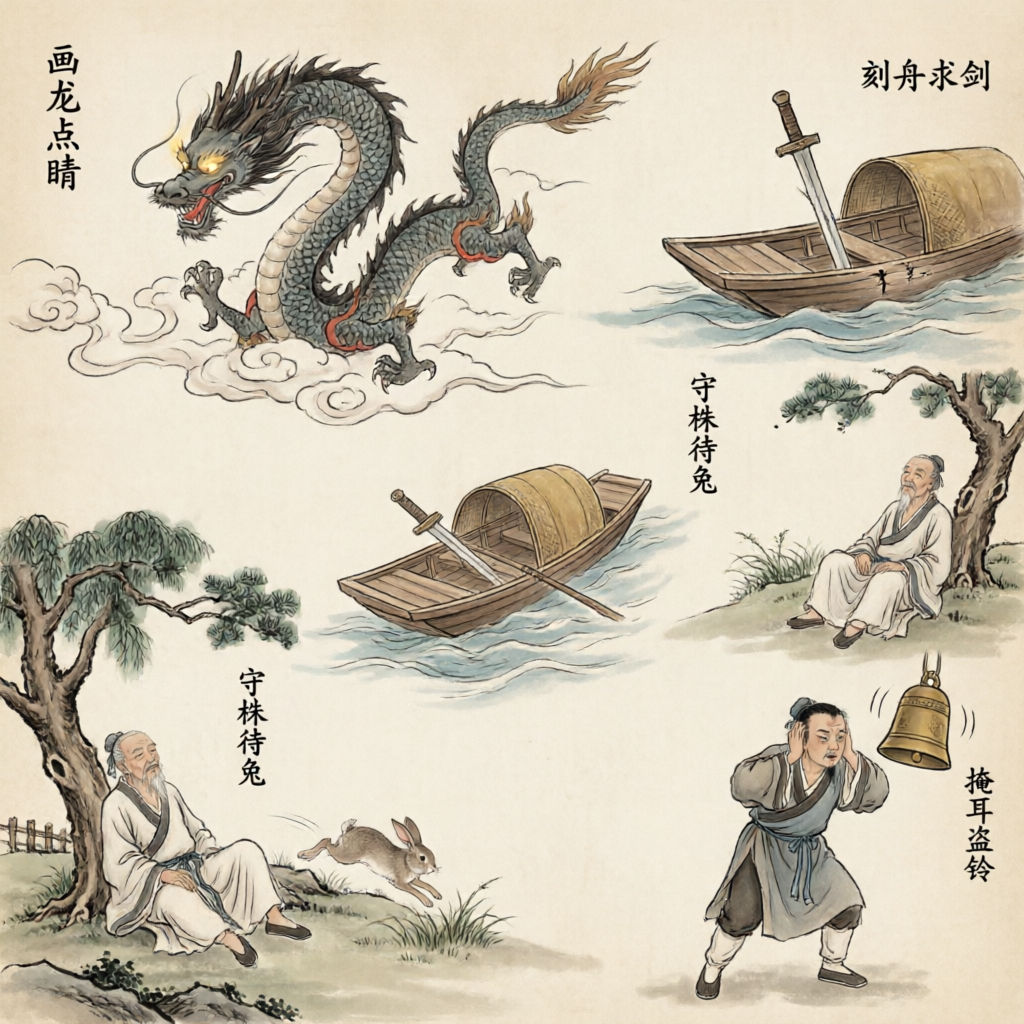
Chengyu (Chinese Idioms)
Overview
Chengyu (成语, chéng yǔ) are fixed expressions in the Chinese language that have been passed down through generations. These idioms, most commonly consisting of four characters, are derived from ancient literature, historical events, folk tales, and classical texts. Chengyu are characterized by their concise yet profound meanings, often encapsulating complex concepts or moral lessons in just a few characters. They serve as important carriers of Chinese cultural heritage and wisdom, frequently used in both written and spoken language to enhance expression with historical depth and literary elegance.
History
The use of chengyu dates back to ancient China, with many idioms originating from classical texts such as the I Ching (Book of Changes), Zuo Zhuan (Commentary of Zuo), and historical records like the Shiji (Records of the Grand Historian). During the pre-Qin period (before 221 BCE), many four-character phrases began to appear in philosophical texts and historical records. The Han Dynasty (206 BCE-220 CE) saw further development, as idioms were increasingly recorded and preserved in literature.
The Tang (618-907) and Song (960-1279) dynasties marked a golden age for chengyu, with numerous idioms being created and documented in poetry, prose, and historical works. By the Ming (1368-1644) and Qing (1644-1912) dynasties, chengyu had become an integral part of the Chinese language, with comprehensive collections being compiled and studied.
Key Information
| Feature | Description |
|---|---|
| Name | 成语 (chéng yǔ) |
| Romanization | Chengyu (Chinese idiom) |
| Character Count | Primarily 4 characters, but also 3, 5, 6, and more |
| Grammatical Function | Can function as subject, object, or other components in sentences |
| Origin | Classical literature, historical events, folk tales, philosophical texts |
| Cultural Significance | Carriers of traditional Chinese values, wisdom, and historical knowledge |
| Usage | Common in formal writing, speeches, and daily conversation |
Cultural Significance
Chengyu hold significant cultural importance in Chinese society as they encapsulate historical events, philosophical concepts, moral lessons, and cultural values. Many chengyu are derived from historical stories, such as "完璧归赵" (returning the jade disc intact to Zhao), which recounts the story of Lin Xiangru's clever diplomacy during the Warring States period. Others come from classical literature, like "画蛇添足" (drawing a snake and adding feet), which originates from a story in the Strategies of the Warring States.
These idioms often carry implicit moral teachings and cultural wisdom that have been transmitted through generations. For example, "愚公移山" (the foolish old man who moved mountains) illustrates perseverance and determination, while "狐假虎威" (the fox borrowing the tiger's might) warns against abusing borrowed power.
In traditional Chinese education, learning chengyu has always been an essential part of literacy. Mastery of these idioms demonstrates one's knowledge of classical literature and cultural heritage. Even today, proficiency in chengyu is considered a mark of education and cultural refinement.
Modern Status
In contemporary China, chengyu continue to play a vital role in language and culture. They are widely used in formal writing, speeches, education, and media. Modern Chinese dictionaries often include extensive sections dedicated to chengyu, with explanations of their origins, meanings, and usage examples.
The digital age has brought new life to chengyu through social media, online dictionaries, and educational apps. Many young people use chengyu in their online communication, blending traditional expressions with modern contexts. There has also been a trend of creating new chengyu or adapting traditional ones to contemporary situations, though these are generally not considered "authentic" chengyu in the traditional sense.
Educational institutions in China and abroad continue to emphasize the learning of chengyu as part of Chinese language education. Foreign learners of Chinese often find chengyu challenging but fascinating, as they provide insights into Chinese culture and思维方式 (thinking patterns). International Chinese language tests like HSK (Hanyu Shuiping Kaoshi) include chengyu as part of advanced-level vocabulary requirements.
References
-
Chen, Ping. (2016). Chinese Idioms: Origins and Usage. Beijing: Foreign Language Teaching and Research Press.
-
Yip, Po-ching. (2010). The Chinese Lexicon: A Comprehensive Inventory. London: Routledge.
-
Li, Charles N. & Sandra A. Thompson. (1989). Mandarin Chinese: A Functional Reference Grammar. Berkeley: University of California Press.
"Chengyu are not merely linguistic curiosities but cultural artifacts that carry the weight of centuries of Chinese civilization." — Chen, 2016, p. 45