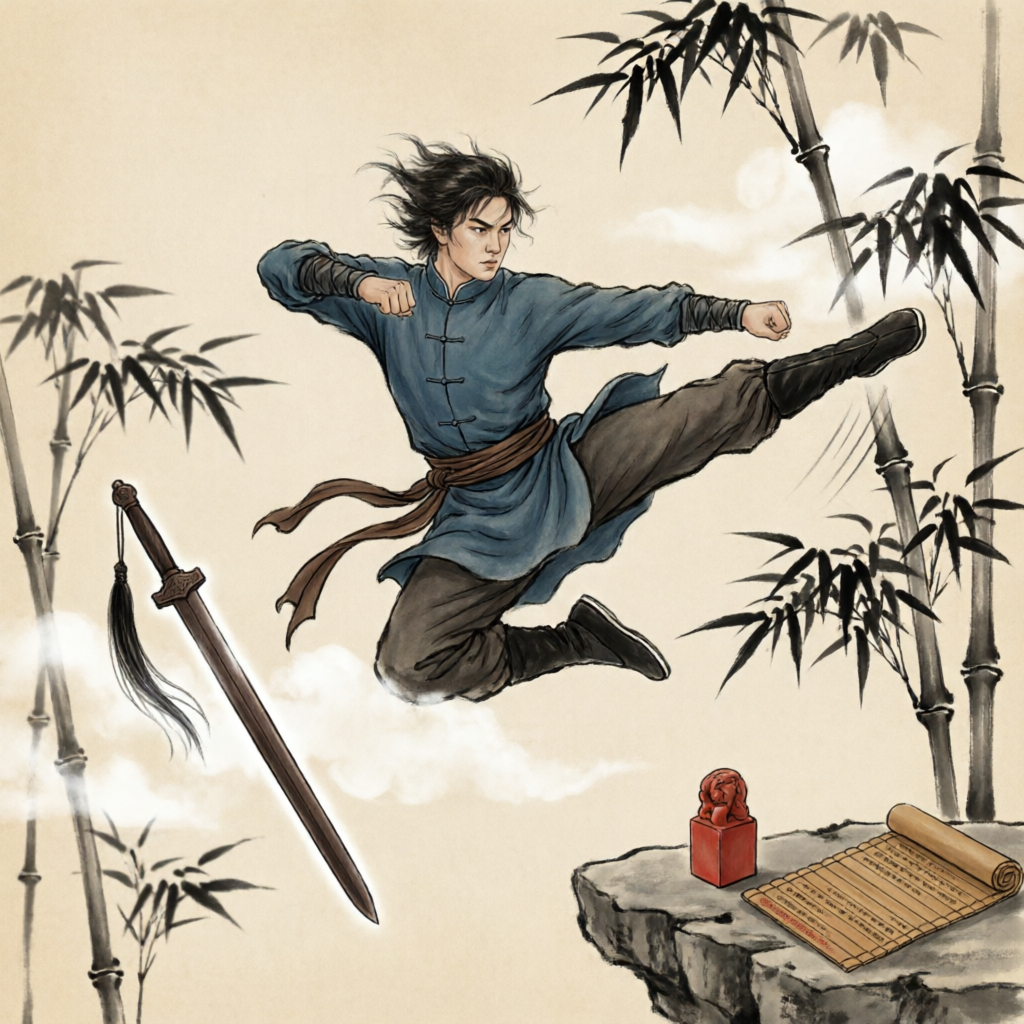
Kung Fu
Overview
Kung Fu, literally translated as "skill achieved through hard work and practice," refers to the personal application and mastery of martial arts in Chinese culture. The term originated during the late Qing Dynasty as an alternative name for "martial arts" (武术), emphasizing individual achievement and proficiency in combat techniques. While often associated with physical combat, Kung Fu represents a comprehensive system that integrates physical training, mental discipline, and philosophical principles.
History
The evolution of Chinese martial arts spans over 4,000 years, with different periods developing distinct terminology and practices:
| Dynasty/Era | Terms Used for Martial Arts |
|---|---|
| Xia, Shang, Zhou | 拳勇 (fist bravery), 手搏 (hand fighting), 角力 (wrestling), 斗勇 (bravery combat) |
| Spring and Autumn, Warring States | 技击 (techniques), 相搏 (mutual combat), 手战 (hand battle) |
| Qin, Han, Three Kingdoms | 武艺 (martial arts), 角抵 (horn butting), 手格 (hand combat) |
| Jin, Northern and Southern Dynasties | 讲武 (military instruction), 武艺 (martial arts), 相扑 (sumo), 拳法 (fist methods) |
| Sui and Tang | 拳捷 (fist agility), 试扑 (testing grappling) |
| Song, Yuan | 摔跤 (wrestling), 打套子 (performing sets) |
| Ming, Qing | 白打 (bare-handed fighting), 使拳 (using fists), 使艺 (using skills), 拳法 (fist methods), 把式 (stances), 对力 (strength matching), 对拳 (fist matching) |
| Modern | 国术 (national arts), 武术 (martial arts), 国技 (national skills), 把式 (stances), 功夫 (kung fu) |
The term "Kung Fu" was first introduced to Europe by French missionaries in the 19th century, who referred to Daoist breathing exercises as "gongfu." However, it did not gain widespread recognition in the West until the 1960s, largely through the influence of Bruce Lee's martial arts films and the global dissemination of Wing Tsun by Hong Kong martial artist Leung Ting.
Key Information
| Aspect | Description |
|---|---|
| Chinese Name | 功夫 (gōngfu) |
| Alternative Names | 中国功夫 (Chinese Kung Fu), 武术 (wǔshù - martial arts) |
| Origin | Ancient China, with formal development spanning millennia |
| Core Philosophy | 止戈为武 (zhǐ gē wéi wǔ) - "to stop violence is true martial virtue" |
| Key Principles | Balance, discipline, respect, self-improvement, practical application |
| Major Styles | Tai Chi, Shaolin Kung Fu, Wing Chun, Baguazhang, Xingyiquan, and many others |
Cultural Significance
Chinese martial arts hold profound cultural significance beyond mere combat techniques. The traditional martial arts philosophy categorizes practice into three levels:
- Upper martial arts (上武): Achieving the Dao and bringing peace to the world
- Middle martial arts (中武): Cultivating wisdom and calming the mind and body
- Lower martial arts (下武): Mastering techniques for self-defense
This hierarchy reflects the belief that true martial arts encompass physical, mental, and spiritual development. The concept of "止戈为武" (stopping violence through martial virtue) emphasizes that the highest achievement in martial arts is not victory in combat, but the ability to prevent conflict through strength and wisdom.
Modern Status
In contemporary society, Chinese martial arts exist in several distinct forms:
-
Performance Arts: Popularized through cinema and stage performances, these emphasize aesthetic value and entertainment. The widespread influence of Hong Kong martial arts films beginning in the 1970s created a global perception of Kung Fu as primarily a performance art.
-
Competitive Sports: Following World War II, many martial arts were adapted to competitive sporting frameworks with standardized rules and scoring systems. However, this approach often diverges from traditional martial arts principles that emphasize practical application and holistic development.
-
Traditional Practice: Maintained by lineage-based schools and practitioners who preserve authentic teaching methods and philosophical foundations. These practitioners often maintain a低调 (dīdiào - low profile) approach, focusing on preservation rather than public demonstration.
The relationship between Chinese martial arts and modern sports remains complex. In 2015, the Chinese General Administration of Sport of China redefined the relationship, stating that "Chinese martial arts not only encompasses various forms of Western sports but also possesses unique traditional Eastern forms, profound philosophy, and rich culture," positioning martial arts as a broader concept that includes but is not limited to sports.
Types of Kung Fu
Chinese martial arts encompass hundreds of distinct styles and systems, including:
- Wing Chun (咏春)
- Baguazhang (八卦掌)
- Bajiquan (八极拳)
- Xingyiquan (形意拳)
- Taijiquan (太极拳)
- Tanglangquan (螳螂拳)
- Shaolin Kung Fu (少林功夫)
- Sanda (散打 - Chinese kickboxing)
- and many others
Each style has its own principles, training methods, and applications, reflecting the diverse cultural and regional influences across China's vast territory.
Shaolin Kung Fu
Shaolin Kung Fu represents one of the most influential and widely recognized systems of Chinese martial arts. Developed at the Shaolin Temple on Mount Song in Henan Province, its origins date to the Northern Wei Dynasty (495 CE) when the temple was established by Emperor Xiaowen for the Indian monk Batuo.
Historical Development
According to tradition, the Indian monk Bodhidharma (达摩) arrived at the temple around 527 CE and introduced exercises to improve monks' physical conditioning and mental focus, which formed the basis of Shaolin martial practice. The temple's military involvement began during the Sui-Tang transition when monks including Tan Zong, Zhi Cao, and Hui Tang assisted Tang Dynasty forces in a battle, leading to imperial recognition and support.
Training Methods
Shaolin training emphasizes:
- Basic stances and movements
- Weapon techniques (staff, sword, spear, etc.)
- Qigong (energy cultivation)
- Meditation and mental discipline
- Practical application
The temple's training facilities include specialized areas like the White Robe Hall (白衣殿) with murals depicting combat techniques and the Thousand Buddha Hall (千佛殿) with "pole holes" (站柱) in the floor, evidence of generations of practice.
Classical Texts
Numerous historical texts document Chinese martial arts knowledge:
- "Han Shu Yi Wen Zhi" (汉书艺文志): Lists 199 articles on martial techniques from the Han Dynasty
- "Ji Xiao Xin Shu" (纪效新书) by Qi Jiguang: Comprehensive Ming Dynasty military text including martial arts sections
- "Wu Bei Zhi" (武备志): Ming Dynasty encyclopedic work with extensive martial arts content
- "Chen Style Taijiquan Tu Shuo" (陈氏太极拳图说): Detailed documentation of Chen style Taijiquan
References
-
Guo, S. (2018). The History and Philosophy of Chinese Martial Arts. Beijing: Sports University Press.
-
Smith, R. J. (2020). Chinese Martial Arts: History, Culture, and Philosophy. New York: Columbia University Press.
-
Henan Shaolin Temple Research Institute. (2019). Shaolin Kung Fu: Tradition and Modern Practice. Zhengzhou: Henan People's Publishing House.
-
Tsai, F. F. (2021). Globalization of Chinese Martial Arts: From Shaolin to Hollywood. London: Routledge.
-
Miller, D. (2017). The Martial Arts Encyclopedia: East Asian Fighting Systems. Boston: Tuttle Publishing.