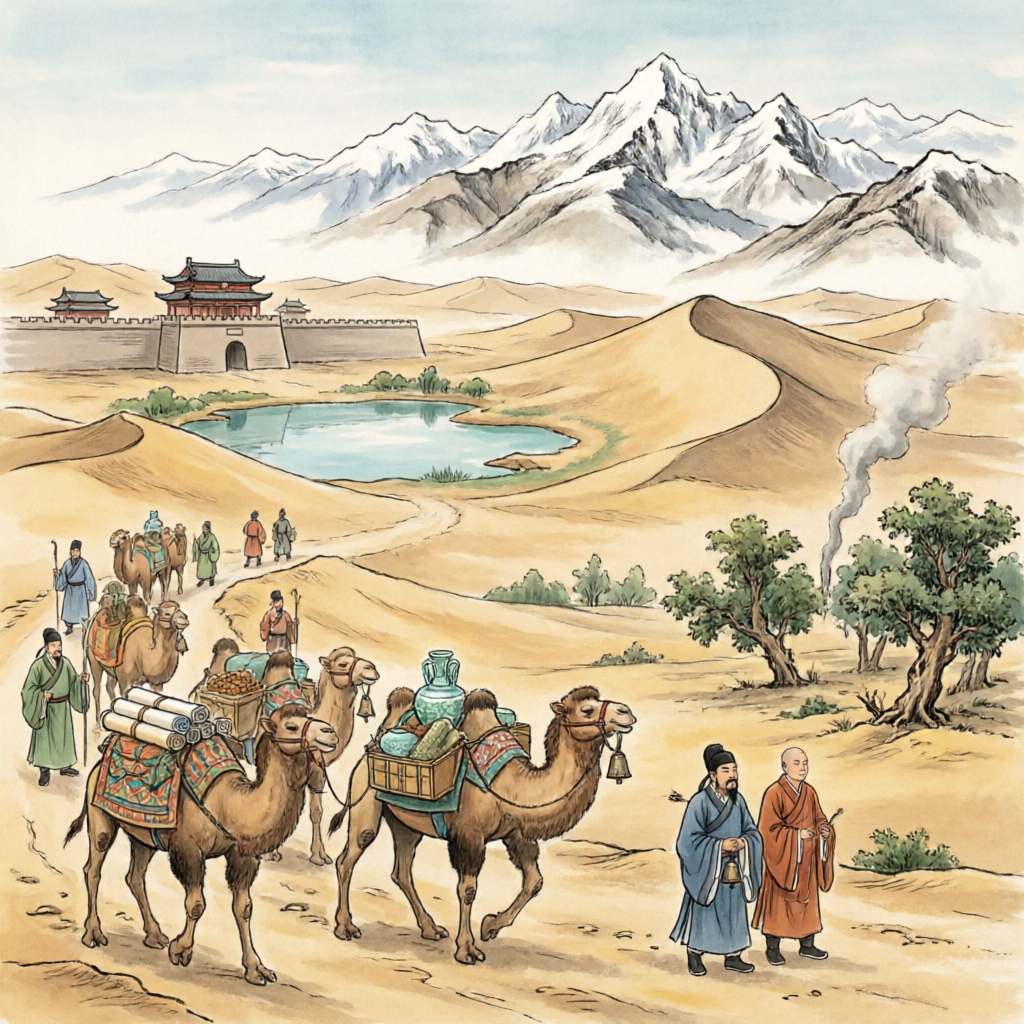
The Silk Road
Overview
The Silk Road was an extensive network of trade routes connecting the East and West from the 2nd century BCE to the 14th century CE. While silk was the most famous commodity flowing from East to West, the routes carried many other goods, ideas, religions, technologies, and cultural practices in both directions. The Silk Road facilitated one of the most significant exchanges in human history, linking the great empires of Han China in the East with the Roman Empire in the West, traversing Central Asia, the Indian subcontinent, Persia, and the Middle East.
History
Early Origins
Cultural exchange between East and West predates the formal establishment of the Silk Road by nearly two millennia. The earliest trade routes were not for silk but for the import of jade from Hotan (Khotan) in what is now Xinjiang, China. The Hexi Corridor served as a crucial passage for these early exchanges, though rather than "silk gates," the region developed "Jade Gates" (Yumen), reflecting the importance of jade in early trade.
Formal Establishment (Western Han Dynasty)
The Silk Road was formally established during the Western Han Dynasty (206 BCE-24 CE), largely due to the diplomatic efforts of Zhang Qian. Initially dispatched by Emperor Wu to form an alliance with the Yuezhi against the Xiongnu, Zhang Qian's journeys (139-126 BCE) opened up diplomatic and commercial relations with Central Asian kingdoms. Though his primary mission failed, his reports on the "Western Regions" (Xiyu) revealed opportunities for trade and expansion.
After Han forces secured the Hexi Corridor by defeating the Xiongnu, Zhang Qian made a second journey (119 BCE) to establish relations with other kingdoms. This led to the formal opening of the Silk Road, with diplomatic missions and trade caravans regularly traveling between China and Central Asia. In 101 BCE, the Han established the "Envoy-Protector" (使者校尉) in Luntai and Quli to manage affairs in the Western Regions, marking the beginning of direct Chinese administration in Central Asia.
Eastern Han Dynasty
During the Eastern Han Dynasty (25-220 CE), the Silk Road continued to develop despite political instability. The general Ban Chao played a crucial role in reopening and securing the routes after a 58-year interruption. Leading a small force of 36 men, he successfully brought numerous kingdoms back under Han influence and was appointed as the Protector-General of the Western Regions in 73 CE. Ban Chao maintained Han control over the region for over 30 years and even sent an envoy, Gan Ying, to reach the Persian Gulf, nearly reaching the Roman Empire.
In 166 CE, the first documented Roman diplomatic mission arrived at the Han capital of Luoyang, presenting gifts to Emperor Huan of Han from "Andun, King of Daqin" (the Roman Empire).
Wei-Jin Period
The Wei-Jin period (220-420 CE) saw the continuation and diversification of Silk Road trade. Three main routes developed: the Northwest Silk Road (also called the Oasis or Desert Road), the Southwest Silk Road, and the Maritime Silk Road. During this time, the Northern Wei Dynasty (386-534 CE) established direct contact with the Persian Sassanian Empire, with multiple Persian embassies recorded between 455-522 CE.
Buddhist monks like Song Yun and Hui Sheng traveled to India via the Silk Road, returning with 170 Mahayana scriptures in 522 CE, significantly enriching Chinese Buddhist culture.
Sui Dynasty
The Sui Dynasty (581-618 CE) reunified China after centuries of division, facilitating renewed Silk Road connections. Despite challenges from the Turkic Khaganate in the west and Tuyuhun in the southwest, trade relations with Central Asian states strengthened. The Sui court sent missions to various western kingdoms, bringing back exotic goods including agate cups, Buddhist scriptures, and musical performers.
Tang Dynasty
The Tang Dynasty (618-907 CE) represents the golden age of the Silk Road. After defeating the Eastern Turkic Khaganate and subduing the Tuyuhun, the Tang established the Protectorates of Anxi and Beiting, extending Chinese control deep into Central Asia. The Tang capital Chang'an (modern Xi'an) became a cosmopolitan metropolis where merchants, diplomats, and religious figures from across Eurasia gathered.
During this period, Buddhism reached its zenith in China with pilgrims like Xuanzang traveling to India and returning with 657 Buddhist scriptures. The Tang also witnessed the arrival of other religions: Nestorian Christianity (Jingjiao) from the Byzantine Empire and Manichaeism (Mingjiao) from Persia.
However, the An Lushan Rebellion (755-763 CE) marked a turning point. The subsequent decline of Tang power, coupled with Tibetan expansion into Central Asia, led to the gradual decline of the overland Silk Road.
Song and Yuan Dynasties
During the Song Dynasty (960-1279 CE), the overland Silk Road declined significantly as Chinese control over the Hexi Corridor was lost. Trade increasingly shifted to maritime routes, with ports like Guangzhou and Quanzhou flourishing as international trading centers.
The Mongol-led Yuan Dynasty (1271-1368 CE) revitalized the Silk Road by establishing the Pax Mongolica, a period of relative peace and stability across Eurasia. The vast Mongol Empire facilitated unprecedented movement of people, goods, and ideas. Marco Polo's famous journey to China occurred during this period, documenting the prosperity of Yuan cities like Dadu (modern Beijing) and the extensive trade networks connecting East and West.
Ming Dynasty
The early Ming Dynasty (1368-1644 CE) continued both overland and maritime trade. The "Silk Road Landscape Map" from the mid-Ming Dynasty clearly depicts over 200 locations along the routes from Jiayuguan westward. However, as the dynasty progressed, focus shifted to maritime routes, with ports like Guangzhou, Quanzhou, and Ningbo becoming the primary conduits for international trade.
Decline and Revival
The Qing Dynasty (1644-1912 CE) implemented a policy of isolationism, leading to the final decline of the Silk Road. Maritime trade dominated international commerce, and the overland routes fell into disuse.
In modern times, the concept of the Silk Road has experienced a revival. In 2013, Chinese President Xi Jinping proposed the "Belt and Road Initiative" (BRI), a modern infrastructure and economic development project inspired by the ancient Silk Road, aimed at enhancing connectivity and cooperation between Asia, Europe, and Africa.
Key Information
| Aspect | Details |
|---|---|
| Chinese Name | 丝绸之路 (Sīchóu zhī lù) |
| World Heritage Name | Silk Road: the Routes Network of Chang'an-Tianshan Corridor |
| Origins | Western Han Dynasty (2nd century BCE) |
| Peak Periods | Han, Tang, Song, Yuan, Ming dynasties |
| Starting Points | Chang'an (Xi'an), Luoyang |
| End Points | (Western Han) Dunhuang; (Eastern Han) Chang'an, Luoyang, Pingcheng (Datong) |
| Cultural Significance | Facilitated exchange of goods, ideas, religions, technologies, and cultures between East and West |
| Modern Status | Revived through Belt and Road Initiative (2013-present) |
Cultural Significance
The Silk Road was far more than a simple trade route; it was a conduit for cultural exchange that profoundly shaped the civilizations it connected. Several major religions traveled these routes: Buddhism entered China from India via Central Asia; Nestorian Christianity from the Byzantine Empire reached China during the Tang Dynasty; and Manichaeism from Persia found followers in China.
Technological innovations spread along the Silk Road, including papermaking from China to the Islamic world and eventually to Europe, as well as glassmaking techniques moving west to east. Agricultural products were exchanged, with crops like grapes, walnuts, and sesame spreading eastward, while peaches, apricots, and various spices traveled westward.
Artistic styles and techniques blended as they traveled the routes. Greco-Buddhist art emerged in Gandhara (modern Pakistan/Afghanistan), blending Greek and Indian artistic traditions. Chinese porcelain and silk influenced Central Asian and Islamic art, while Persian and Central Asian designs influenced Chinese textiles and ceramics.
The Silk Road also facilitated scientific exchange. Astronomical knowledge, mathematical concepts, and medical practices traveled between civilizations. The famous Tang astronomer Yixing studied Indian astronomical texts, while Chinese medical knowledge spread westward.
Modern Status
Today, the historical Silk Road routes are recognized as a UNESCO World Heritage Site, designated as "Silk Road: the Routes Network of Chang'an-Tianshan Corridor" in 2014. This serial property includes 33 sites across China, Kazakhstan, and Kyrgyzstan, representing the development of trade and cultural exchange along the routes.
The concept of the Silk Road has experienced a contemporary revival through China's Belt and Road Initiative (BRI), announced in 2013. This ambitious infrastructure and economic development project aims to enhance connectivity and cooperation between Asia, Europe, and Africa, echoing the historical exchange patterns of the ancient Silk Road while addressing modern economic and geopolitical realities.
Archaeological discoveries continue to shed light on the history of the Silk Road, with new finds of artifacts, documents, and archaeological sites providing deeper understanding of the exchanges that occurred along these routes.
References
- Hansen, V. (2012). The Silk Road: A New History. Oxford University Press.
- Whitfield, S. (2004). The Silk Road: Trade, Travel, War and Faith. British Museum Press.
- Liu, X. (2010). The Silk Road in World History. Oxford University Press.
- Sen, T. (2003). Buddhism, Diplomacy, and Trade: The Realignment of Sino-Indian Relations, 600-1400. University of Hawaii Press.
- Beckwith, C. I. (2009). Empires of the Silk Road: A History of Central Eurasia from the Bronze Age to the Present. Princeton University Press.