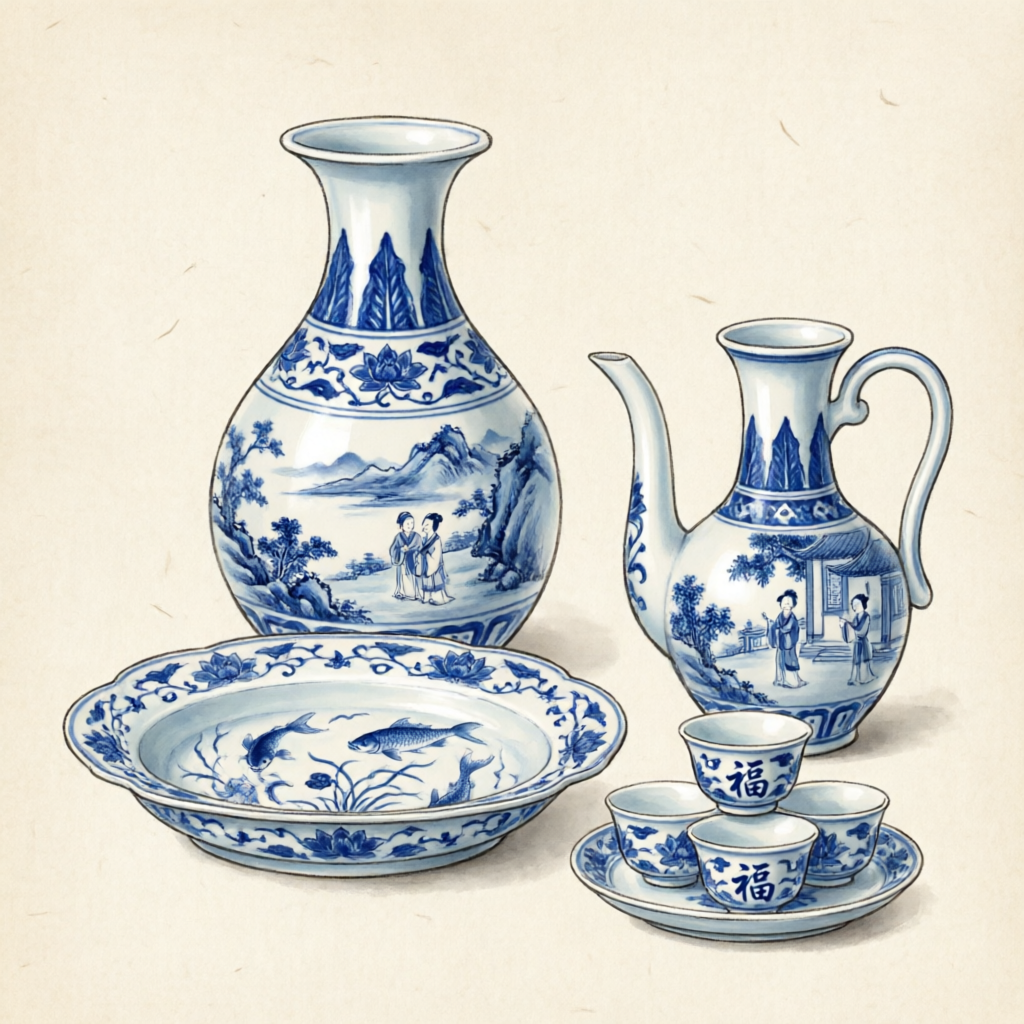
Blue and White Porcelain
Overview
Blue and white porcelain (青花瓷) is one of the most iconic forms of Chinese ceramics, distinguished by its white body decorated with blue patterns created using cobalt oxide under a transparent glaze. This distinctive ceramic ware has been produced for centuries and represents a significant achievement in Chinese artistic and technological innovation. The craft encompasses a wide variety of vessel types including bottles (瓶类), wine vessels (尊类), jars (罐类), vases (花觚类), plates (盘类), and cups (杯类), serving both practical and decorative purposes throughout Chinese history and beyond.
History
Origin
The technique of blue and white porcelain represents a sophisticated technological development in ceramic production. Its origins can be traced to the use of cobalt as a decorative material in pottery, with evidence of cobalt-blue glazed ceramic beads dating back to the Warring States period (475-221 BCE) in northern China. During the Tang Dynasty (618-907 CE), cobalt was occasionally used as a colorant in sancai (三彩) ceramics, though this technique differed from the underglaze painting method that characterizes true blue and white porcelain.
The technological foundation for blue and white porcelain emerged during the Tang and Five Dynasties period (907-960 CE) at the Tongguan Kiln in Changsha, where underglaze painting techniques were already being mastered. By the Song (960-1279) and Yuan (1271-1368) dynasties, underglaze brown-decorated wares using iron pigments appeared in the Cizhou Kiln in the north and the Jizhou Kiln in the south. The substitution of cobalt for iron eventually led to the development of true blue and white porcelain.
Tang Dynasty (618-907)
The Tang Dynasty represents the nascent stage of blue and white porcelain production. Archaeological excavations in Yangzhou have uncovered over twenty fragments of blue and white porcelain from this period, with additional examples found in the Hong Kong Museum of Art, the Museum of Fine Arts in Boston, the National Museum of Denmark, and the Nanjing Museum. Analysis of these fragments suggests they were produced at the Gongxian Kiln in Henan Province.
The Tang blue and white porcelain features a distinctive blue pigment with crystalline spots, identified as low-manganese, low-iron cobalt likely imported from Central or West Asia. The bodies are generally coarse and grayish in color with poor vitrification. The glaze tends to be white-yellowish and coarse, with a layer of white slip applied between the body and glaze. The vessels are primarily small items such as ewers, bowls, jars, and lids. Decorative themes include traditional Chinese floral patterns (such as carnations and plum blossoms) and geometric designs with leaf motifs characteristic of Islamic decorative traditions. The concentration of finds at Yangzhou, a major Tang port city, indicates that these wares were primarily produced for export.
Song Dynasty (960-1279)
Following its initial development during the Tang Dynasty, blue and white porcelain did not continue to flourish but rather declined. Only a dozen fragments have been discovered from Song Dynasty contexts, all unearthed from pagoda foundations: thirteen fragments from Jinsha Pagoda in Longquan, Zhejiang (dated to 977 CE), and one fragment from Huancui Pagoda in Shaoxing, Zhejiang (dated to 1265 CE).
These fragments are all from bowls with varying body quality—some coarse, some fine. The decorative themes include chrysanthemum patterns, circular motifs, and linear designs. The blue coloration ranges from intense and dark to pale, with the darker examples likely resulting from a thin transparent glaze coating. The use of local cobalt sources in Zhejiang Province suggests these wares were not directly connected to the earlier Tang tradition.
Yuan Dynasty (1271-1368)
The Yuan Dynasty witnessed the emergence of mature blue and white porcelain production in Jingdezhen, Jiangxi Province. The adoption of a binary clay mixture ("porcelain stone + kaolin") increased the alumina content in the body, allowing for higher firing temperatures and reduced deformation during firing. Consequently, most Yuan Dynasty vessels have thick, substantial bodies with colors ranging from grayish to yellowish. The glaze comes in two types: bluish-white and egg-white, both with strong opacity.
Two types of cobalt pigment were used: high-manganese, low-iron cobalt that produced bluish-gray tones, and low-manganese, high-iron cobalt that yielded vibrant blue coloration with rust-colored spots. Some vessels feature both types. Common vessel forms include daily-use items, ritual vessels, and tomb objects, with bamboo-stemmed high-foot cups and pedestal vessels being particularly characteristic of the period. Most vessels have unglazed sandy bases with "firestone red" oxidation except for the base of "Yu Hu Chun" (玉壶春) bottles which have exposed glaze.
The most distinctive feature of Yuan Dynasty blue and white porcelain is its rich, multi-layered composition. Painting techniques often feature single-stroke brushwork that is both fluid and powerful, with bold outlining and shading. Decorative themes include human figures, animals, plants, and occasionally poetry. Common motifs include scholar figures (including the "Four Loves" theme), dragons, phoenixes, qilin, mandarin ducks, fish, peonies, lotuses, orchids, bamboo, pine, plum blossoms, lingzhi fungus, and various fruits. Lotus petals typically have white borders; dragons are characterized by small heads, slender necks, long bodies, three or four claws, and ridged backs with net-like scale patterns. Auxiliary decorative elements include scrolling vines, lotus petals, ancient coins, wave patterns, meander patterns, cloud motifs, and banana leaves.
Ming Dynasty (1368-1644)
The Ming Dynasty represents the golden age of blue and white porcelain production, with particularly exceptional achievements during the Yongle (1403-1424) and Xuande (1426-1435) periods. During this era, imperial kilns produced严谨 (carefully crafted) wares, while private kilns produced more casual, expressive pieces.
Early Ming (Hongwu, 1368-1402)
Early Ming blue and white porcelain includes vessels of various sizes such as plates, bowls, "Mei Ping" (梅瓶) bottles, and "Yu Hu Chun" (玉壶春) bottles. The blue pigment was primarily domestic, though some imported material may have been used. The blue coloration ranges from pale blue to grayish. Some pieces show color bleeding (晕散). Decorative layouts retained the multi-layered style of the Yuan Dynasty, though with significant changes: banana leaves have white centers; petal borders are more distinct; peony leaves have deeper indentations; chrysanthemums are depicted as "flat chrysanthemums" with square-patterned centers; dragon bodies remain slender but now include five-clawed examples; and cloud motifs have been simplified from three-tiered to two-tiered designs.
Yongle and Xuande (1403-1435)
The Yongle and Xuande periods represent the pinnacle of Ming Dynasty blue and white porcelain craftsmanship. The primary pigment was "Sumaliqing" (苏泥勃青), an imported cobalt material known for its "iron rust spots," though domestic pigments were also used with excellent results. Vessel forms include plates, bowls, ewers, jars, and cups, with exotic forms like monk's cap ewers, ribbon flat bottles, and flower sprinklers reflecting cultural exchange with foreign regions. Decorative themes feature various flowering plants, dragons, phoenixes, sea creatures, and fish.
Yongle wares tend to be more delicate and elegant with intense blue coloration and prominent iron rust spots. The designs are more open and the painting more detailed. Xuande pieces are generally heavier with denser decoration and a slightly bluish glaze. Xuande marked pieces are more common, featuring four or six-character reign marks in various placements, leading to the saying "Xuande marks cover the entire vessel." Xuande blue and white porcelain is highly regarded for its quality and influence.
Mid-Ming (Zhengtong, Jingtai, Tianshun, 1436-1464)
This period, known as the "blank period" of Chinese ceramics due to political instability and economic decline, saw limited production. Vessel forms remained similar to previous periods, though the quality declined. The blue pigment was still partly "Sumaliqing," with color ranging from intense (similar to Xuande) to pale (similar to Chenghua). The glaze often appears grayish, and bodies are thick with roughly finished bases. Decorative themes include human figures, flowers, dragons, and phoenixes, often with large cloud backgrounds. Bottle and jar necks changed from straight (Zhengtong) to tapered (Tianshun), similar to later Chenghua forms.
Mid-Ming (Chenghua, Hongzhi, Zhengde, 1465-1521)
The Chenghua (1465-1487), Hongzhi (1488-1505), and Zhengde (1506-1521) periods represent the middle phase of Ming Dynasty blue and white porcelain. Early Chenghua and Hongzhi pieces used "Pingdengqing" (平等青) pigment with pale blue coloration. Hongzhi late period and Zhengde pieces show grayish-blue tones. Chenghua wares feature light-outline blue painting (淡描青花) with layouts that start sparse and become denser over time. Common themes include the "Three Fruits," "Three Friends" (pine, bamboo, plum), "Nine Autumns," scholar figures, children at play, and dragons among flowers. The glaze has a jade-like quality but appears slightly bluish. Hongzhi wares resemble Chenghua pieces but are more delicate. Zhengde wares show increasing use of "Huiqing" (回青) pigment with some color bleeding.
Late Ming (Jiajing, Longqing, Wanli, 1522-1620)
The Jiajing (1522-1566), Longqing (1567-1572), and Wanli (1573-1620) periods represent the late phase of Ming Dynasty blue and white porcelain. Jiajing, the longest reigning emperor of this period, saw varying blue coloration from grayish-blue to the distinctive use of "Huiqing" pigment. Decorative themes expanded to include numerous Daoist elements such as cranes among clouds, the Eight Immortals, the Eight Trigrams, and Daoist treasures. The "flower-character" pattern became uniquely characteristic. Longqing pieces, though few due to the short reign, feature stable, pure blue coloration with small, refined forms. Wanli wares show a decline in quality with the use of "Shiziqing" (石子青) and "Zhe material" (浙料) pigments, featuring light-outline painting and dense, complex compositions.
Late Ming (Tianqi, Chongzhen, 1620-1644)
The final decades of the Ming Dynasty, marked by political turmoil, saw a decline in ceramic production. Tianqi (1620-1627) pieces are rare with imperial marks. Chongzhen (1628-1644) wares lack imperial marks and feature thick, coarse bodies with irregular shapes. Decorative themes remain traditional but are painted with less care. Common motifs include scholar figures with distinctive elements like autumn grass, bracket-shaped clouds, and small sun motifs.
Qing Dynasty (1644-1912)
Early Qing (Shunzhi, 1644-1661)
The Shunzhi period (1644-1661) served as a transitional phase leading to the achievements of the Kangxi era. Vessel types were limited mainly to incense burners, vases, bottles, plates, bowls, and jars. Bodies were generally coarse, though some pieces show fine, glutinous-textured clay. The glaze tends to be white with a bluish or grayish tint. The blue pigment included both Zhejiang material and "Shiziqing," resulting in varying coloration from vibrant greenish-blue to grayish-blue. Decorative themes include flowers, birds, landscapes, rocks, autumn grass, boats, mythical beasts, and clouds.
Kangxi (1662-1722)
The Kangxi period (1662-1722) represents another peak in blue and white porcelain production. The use of Zhejiang and "Zhuming" (珠明) pigments produced a range of blues from early grayish tones to later vibrant, clear blues. Painting techniques evolved from early single-line flat application to later sophisticated methods outlining, shading, and using brushstroke variations. Decorative themes diversified to include landscapes, figures, dragons, phoenixes, flowers, birds, fish, insects, poetry, and antiquarian subjects. Kangxi wares are characterized by "blue-and-white multi-color" effects (青花五彩) achieved through varying shades of blue. The body is dense and white with a糯米糕 (glutinous rice cake) texture. The glaze is hard and tightly bound to the body, showing orange-peel texture or pinholes. Vessel forms expanded to include many decorative pieces like covered jars, phoenix-tail vases, flower vases, elephant-leg vases, and brush holders.
Yongzheng and Qianlong (1723-1795)
The Yongzheng (1723-1735) and Qianlong (1736-1795) periods saw a shift toward imitation of earlier Ming styles, particularly the Yongle and Xuande "Sumaliqing" effects and Chenghua light-outline painting. Though lacking imported cobalt, artisans simulated the iron-rust spots through brush techniques. Yongzheng pieces are characterized by exquisite craftsmanship and careful body finishing, while Qianlong pieces, though maintaining high quality early in the period, began to decline later. Qianlong innovations included "blue and white linglong" porcelain with openwork decoration.
Later Qing (Jiaqing and beyond, 1796-1912)
Following the Qianlong period, blue and white porcelain production gradually declined. Jiaqing (1796-1820) pieces continued earlier styles but with reduced quality. The Daoguang (1821-1850), Xianfeng (1851-1861), Tongzhi (1862-1874), and Guangxu (1875-1908) periods saw further technical decline, though Guangxu experienced a brief revival. By the end of the dynasty, blue and white porcelain had largely been superseded by other decorative techniques like famille-rose porcelain.
Key Information
| Feature | Description |
|---|---|
| Chinese Name | 青花瓷 (qīng huā cí) |
| Alternative Names | 白地青花瓷 (bái dì qīng huā cí) - white-ground blue-white porcelain |
| Classification | 釉下彩 (yòu xià cǎi) - underglaze color decoration |
| Primary Material | Porcelain with cobalt oxide (氧化钴) pigment |
| Production Period | Tang Dynasty (618-907) to present |
| Major Production Centers | Jingdezhen (景德镇), Gongxian Kiln (巩县窑) |
| Notable Periods | Yuan (1271-1368), Ming Yongle/Xuande (1403-1435), Qing Kangxi (1662-1722) |
| Major Vessel Types | Bottles, jars, bowls, plates, cups, vases |
Cultural Significance
Blue and white porcelain holds profound cultural significance in China and has influenced ceramic traditions across Asia and beyond. Its development coincided with China's maritime trade expansion, with early examples primarily produced for export to Islamic markets. The fusion of Chinese decorative techniques with Islamic aesthetic preferences during the Yuan Dynasty created a distinctive visual language that continues to influence global ceramic design.
In China, blue and white porcelain became an important medium for cultural expression, incorporating themes from literature, history, religion, and daily life. The motifs often carry symbolic meanings—dragons representing imperial power, lotuses symbolizing purity, and peonies signifying wealth and prosperity. During the Ming Dynasty, blue and white porcelain became closely associated with imperial patronage, with the imperial kilns in Jingdezhen producing the highest quality pieces for court use.
The aesthetic principles of blue and white porcelain—balanced composition, elegant brushwork, and harmonious color contrast—have influenced other art forms in China, including painting and calligraphy. The tradition of appreciating blue and white porcelain as both functional objects and works of art has been passed down through generations, contributing to its enduring cultural value.
Modern Status
Today, blue and white porcelain continues to be produced both as traditional reproductions and contemporary artistic expressions. Jingdezhen remains the center of blue and white porcelain production, with workshops preserving traditional techniques while also experimenting with new forms and decorative approaches.
In the art market, authentic antique blue and white porcelain, particularly from the Yuan, Ming, and Qing dynasties, commands high prices at auctions worldwide. Museums and private collectors value these pieces not only for their aesthetic beauty but also for their historical and cultural significance. The study of blue and white porcelain has become a specialized field of art historical research, with scholars analyzing technological developments, stylistic evolution, and cultural exchange through ceramic trade.
Contemporary artists continue to draw inspiration from blue and white porcelain traditions, creating works that bridge historical techniques with modern sensibilities. The global appreciation of blue and white porcelain has led to cross-cultural collaborations and adaptations, ensuring its relevance in contemporary design and decorative arts.
References
-
Gompertz, G. S. Chinese Celadons and Other Related Wares. Oxford University Press, 1978.
-
Kerr, Rosemary and Craig Clunas. Arts of China. Oxford University Press, 2000.
-
Wood, Nigel. Chinese Glazes: Their Chemistry, Origins and Recreation. A&C Black, 2007.
-
Wang, Helen. Chinese Export Ceramics. British Museum Press, 2011.
-
Scott, Rosemary. Later Chinese Bronzes. Victoria and Albert Museum, 1990.
-
Garner, Harry. Chinese Blue and White Porcelain. Faber and Faber, 1970.