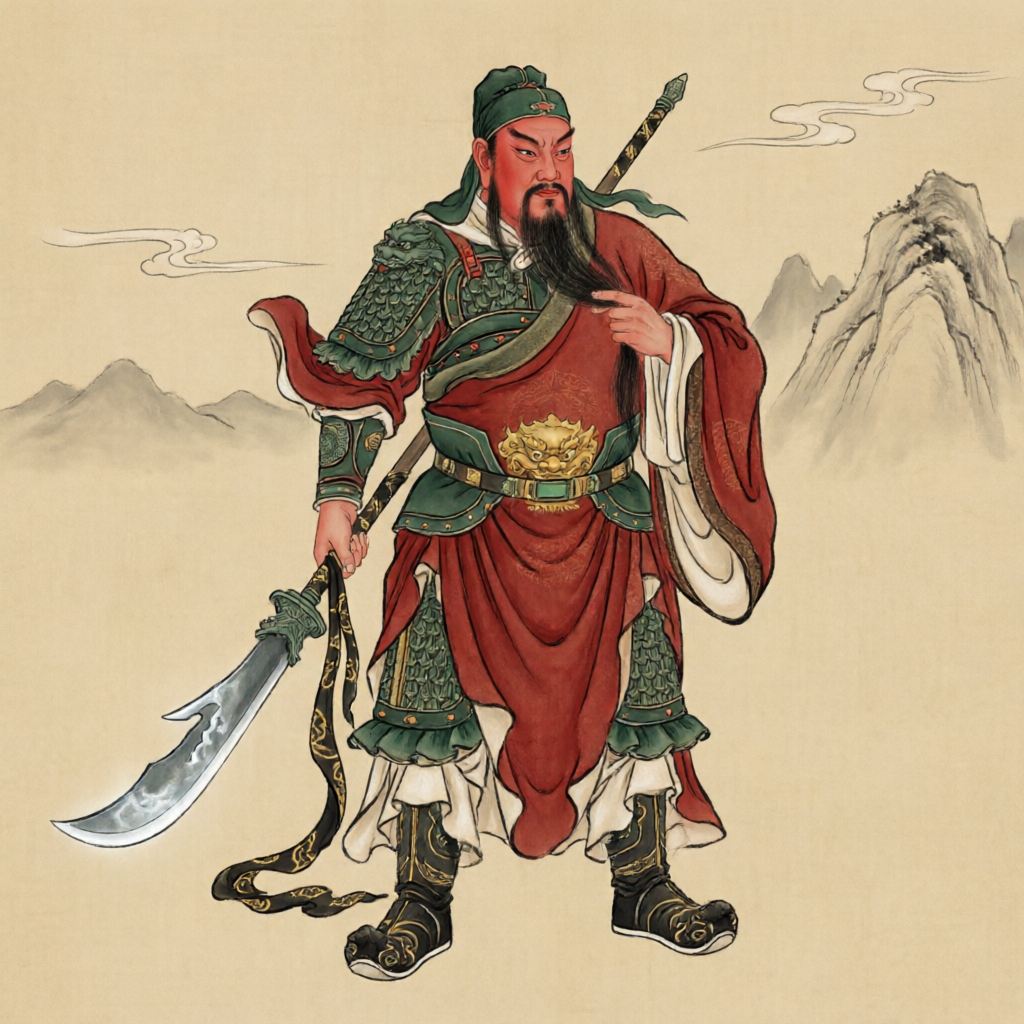
Guan Yu
Overview
Guan Yu (died 220), courtesy name Yunchang and style name Changsheng (later changed to Yunchang), was a military general serving under the warlord Liu Bei during the late Eastern Han dynasty and the Three Kingdoms period of China. He played a significant role in the civil wars that led to the collapse of the Han dynasty and the establishment of the state of Shu Han, founded by Liu Bei. Known for his unwavering loyalty and martial prowess, Guan Yu has been deified over centuries and is revered as a symbol of loyalty and righteousness in Chinese culture.
History
Early Life and Following Liu Bei
Guan Yu was originally from Hedong Commandery (present-day Shanxi province). According to historical records, he fled his hometown after committing a crime and wandered to Zhuo Commandery in You Province. In 184 CE, during the Yellow Turban Rebellion, Liu Bei raised a volunteer army in Zhuo County. Guan Yu and Zhang Fei joined Liu Bei, and the three became sworn brothers with a bond so strong that they even slept together. When Liu Bei became the Chancellor of Pingyuan, he appointed Guan Yu and Zhang Fei as commanders of separate units.
In 194 CE, Cao Tao's father Cao Song was killed by Tao Qian's men. Enraged, Cao Tao attacked Tao Qian in Xu Province. Tao Qian sought help from Liu Bei, who, along with Guan Yu, led a thousand men to rescue him. After Cao Tao's forces withdrew, Tao Qian recommended Liu Bei to become the Inspector of Yu Province. Guan Yu and Liu Bei stationed their troops in Xiao Pei. After Tao Qian repeatedly declined the position, Liu Bei eventually became the Governor of Xu Province.
Battle of White Horse and Service Under Cao Cao
In 200 CE, Liu Bei was defeated by Cao Cao and fled to Yuan Shao. Guan Yu was captured and brought to Cao Cao's capital at Xu. Cao Cao treated Guan Yu with great respect and appointed him as a General of the Household. Later that year, Yuan Shao sent his general Yan Liang to attack Liu Yan, the Administrator of Dong Commandery. Cao Cao accepted Xun You's strategy of feigning an attack on another location while sending a light force to relieve the siege at White Horse. Guan Yu, serving as the vanguard along with Zhang Liao, spotted Yan Liang's banner, charged into the enemy formation, killed Yan Liang, and returned with his head. The siege was lifted, and Cao Cao recommended to Emperor Xian that Guan Yu be ennobled as the Marquis of Hanshou Ting. Shortly after, Guan Yu left Cao Cao to rejoin Liu Bei, who was then serving under Yuan Shao.
Guarding Jing Province
In 208 CE, Cao Cao led a large army southward. Liu Bei fled south while dispatching Guan Yu with several hundred ships to rendezvous at Jiangling. However, Liu Bei was intercepted by Cao Cao's forces at Changban (present-day Yichang, Hubei). Guan Yu arrived at Hanjin and helped Liu Bei escape by boat to Xiakou. After Liu Bei allied with Sun Quan to defeat Cao Cao at the Battle of Red Cliffs, Liu Bei was appointed as the Governor of Jing Province by Sun Quen, with Guan Yu placed in charge of the northern front, confronting Li Tong.
By 214 CE, after Liu Bei conquered Yi Province (modern Sichuan), he appointed Guan Yu as the Governor of Jing Province, responsible for the five commanderies: Nan, Changsha, Lingling, Wuling, and Guiyang. Guan Yu was also granted the title General Who Conquers Bandits.
Conflict with Sun Quan and Death
In 219 CE, Guan Yu launched a northern campaign against Cao Cao, attacking Fancheng and Xiangyang. He achieved significant success, defeating Cao Ren's forces and capturing Yu Jin's seven armies. His victories were so impressive that his "might shook all of China." However, his northern advance created an opportunity for Sun Quan to attack from the rear.
Sun Quan, who had long coveted Jing Province, had previously attempted to establish a marital alliance with Guan Yu, which was rejected with insults. This, combined with Guan Yu's arrogance toward his subordinates, particularly the administrators Mi Fang and Fu Shiren, led them to surrender to Sun Quen's forces when Lü Meng launched a surprise attack on Jing Province.
Cut off from his base, Guan Yu attempted to retreat to Ma City. He was ambushed by Sun Quan's forces led by Pan Zhang and captured along with his son Guan Ping at Linju. Both were executed in early 220 CE. Sun Quan sent Guan Yu's head to Cao Cao, who buried it with honors.
Key Information
| Attribute | Details |
|---|---|
| Name | Guan Yu (关羽) |
| Courtesy Name | Yunchang (云长), originally Changsheng (长生) |
| Style Name | Meirong Gong (美髯公, "Lord of the Beautiful Beard") |
| Title | Marquis of Hanshou Ting (汉寿亭侯) |
| Posthumous Title | Zhuangmou Hou (壮缪侯) |
| Era | Eastern Han dynasty (东汉末年) |
| Birthplace | Hedong Commandery (河东郡) |
| Death Date | 220 CE |
| Death Place | Linju (临沮) |
| Ethnicity | Han (汉族) |
| Major Achievements | Service under Liu Bei, victory at White Horse, northern campaigns against Cao Cao |
| Highest Position | General Who Conquers Bandits (荡寇将军) |
Cultural Significance
Guan Yu's posthumous influence has grown significantly over the centuries. During the Song dynasty, he was deified as a divine being, and by the Ming and Qing dynasties, he was elevated to the status of "Wusheng" (武圣, "Martial Saint") second only to Confucius in the imperial cult.
In Taoism, Guan Yu is revered as the "Emperor Guan" (关公), a powerful deity who protects the righteous and punishes the wicked. He is often depicted with a red face (representing loyalty) and a long beard, symbolizing his noble character. Temples dedicated to Guan Yu can be found throughout China and in Chinese communities worldwide.
In popular culture, Guan Yu is portrayed as nearly superhuman in martial prowess, often depicted with his famous weapon, the Green Dragon Crescent Blade (青龙偃月刀). His story has been adapted into numerous novels, plays, films, and television series, most notably in the historical novel Romance of the Three Kingdoms (三国演义), which romanticizes his life and exploits.
Modern Status
Today, Guan Yu remains one of the most revered figures in Chinese culture. He is worshipped not only as a deity but also as a paragon of loyalty, righteousness, and martial virtue. His image is commonly found in businesses, particularly restaurants and police stations, as he is believed to protect against dishonesty and bring prosperity.
In recent years, academic interest in Guan Yu has grown beyond his religious and cultural significance. Historians have re-examined his life and career within the context of the Three Kingdoms period, separating historical fact from later legendary embellishments. Archaeological discoveries, including tomb artifacts and inscriptions, have provided new insights into the historical Guan Yu and his contemporaries.
References
- Chen, Shou. Records of the Three Kingdoms (三国志). Beijing: Zhonghua Book Company, 1959.
- Luo, Guanzhong. Romance of the Three Kingdoms (三国演义). Beijing: People's Literature Publishing House, 1973.
- de Crespigny, Rafe. The Three Kingdoms and Chinese Culture. Canberra: Australian National University Press, 2007.
- Ebrey, Patricia Buckley. The Cambridge Illustrated History of China. Cambridge: Cambridge University Press, 1999.
- Pei, Songzhi. Annotations to Records of the Three Kingdoms (三国志注). Beijing: Zhonghua Book Company, 1982.