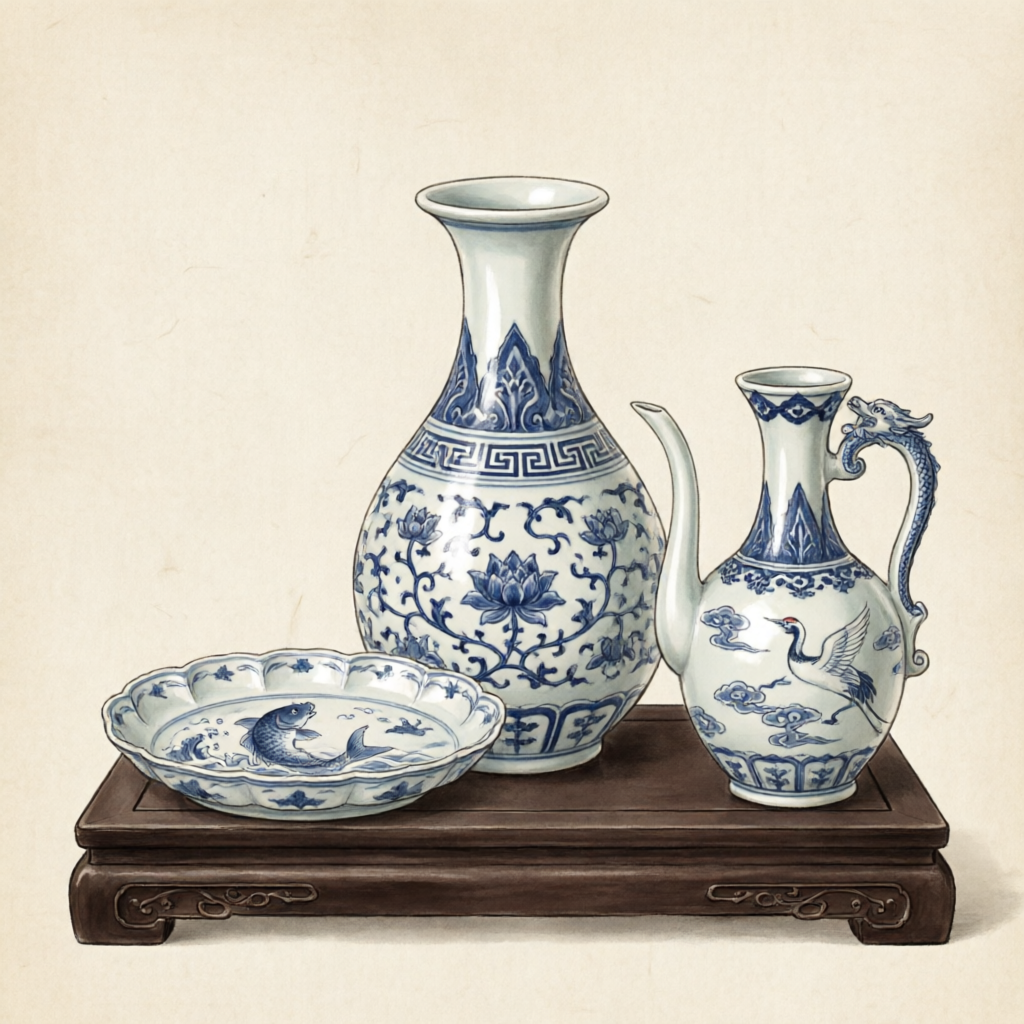
Overview
Porcelain is a ceramic material made by heating raw materials, generally including clay in the form of kaolin, in a kiln to temperatures between 1,200 and 1,400 °C. The toughness, strength, and translucence of porcelain arise from vitrification and glassy phase development at high temperatures. Porcelain has been one of the most common materials for making tableware, decorative objects, and architectural components for centuries.
History
China is the homeland of porcelain, and porcelain represents an important creation by the Chinese working people. The invention of porcelain was a great contribution of the Chinese nation to world civilization, as evidenced by the fact that the English word for porcelain, "china," is the same as the name of the country, "China."
Early Origins
The earliest porcelain discovered in China so far appeared at the Erlitou site in Yanshi, Luoyang, and is called "protcelain." It developed on the basis of impressed hard pottery technology, inheriting its forming and decoration methods. The glazing method was relatively primitive, using brushing and dipping techniques.
In the mid-16th century BCE, during the Shang Dynasty, early porcelain emerged. Due to the roughness of both the body and glaze layer, as well as the relatively low firing temperature, it showed primitiveness and transitional characteristics, so it is generally called "protcelain."
Invention in the Eastern Han Dynasty
The invention of porcelain began in the Eastern Han Dynasty. Although "protcelain" was created in the mid-16th century BCE during the Shang Dynasty, it was still in its initial stage and not yet mature. The transition from pottery to porcelain in China was completed during the Eastern Han Dynasty. In the strict scientific sense, Chinese porcelain began in the Eastern Han Dynasty. The porcelain successfully fired in the mid to late Eastern Han Dynasty made China the inventor and earliest producer of porcelain. The character "ci" (瓷), corresponding to the actual object, officially appeared in the Western Jin Dynasty.
Maturity in the Song Dynasty
By the Song Dynasty, famous porcelain and famous kilns had spread over most of China, marking the most prosperous period for the porcelain industry. At that time, the Ru kiln, Guan kiln, Ge kiln, Jun kiln, and Ding kiln were collectively known as the Five Great Kilns of the Song Dynasty. Other famous kilns included the Chai kiln and Jian kiln. Jingdezhen in Jiangxi Province, later known as the "Porcelain Capital," produced blue and white porcelain during the Yuan Dynasty, which became the representative of porcelain. Blue and white porcelain has a transparent glaze like water, a thin and light body, and blue decorations on the white porcelain body, which is elegant, fresh, and full of vitality. Once it appeared, blue and white porcelain became popular immediately, becoming the crown of traditional famous porcelain in Jingdezhen. Together with blue and white porcelain, the four famous types of porcelain include blue and white exquisite porcelain, famille-rose porcelain, and colored glaze porcelain. In addition, there are also sculptural porcelain, thin-bodied porcelain, and colorful porcelain, all of which are exquisite and have their own characteristics.
Key Information
| Feature | Description |
|---|---|
| Raw Materials | Composed of porcelain stone, quartz, mullite, and other materials fired at high temperatures |
| Firing Temperature | 1,200°C to 1,300°C |
| Key Characteristics | Low iron content, white body, transparent or semi-transparent, water absorption rate less than 1% |
| Major Production Centers | Jingdezhen (China), Arita (Japan), Meissen (Germany), Limoges (France) |
| Cultural Significance | Porcelain has been a symbol of Chinese culture and technological achievement for millennia |
Cultural Significance
Colorful porcelain is one of the great inventions of ancient China. The fact that "porcelain" and "China" are the same word in English fully demonstrates that the exquisite quality of Chinese porcelain can represent China. High-quality porcelain has much higher production difficulty than ordinary porcelain, so exquisite porcelain collections were not lacking in ancient royal courts. As one of the special luxury products of ancient China, porcelain was transmitted to various countries through various trade channels, and exquisite ancient porcelain was collected by many collectors as valuable antiques.
In Western countries, it is particularly popular to give high-quality porcelain tea sets as wedding gifts. From the perspective of the art market, the value ranking (from high to low) is: Yuan, Ming, and Qing Dynasty porcelain, Song Dynasty porcelain, Tang and Five Dynasties porcelain, Six Dynasties porcelain, primitive celadon, and late Qing and Republic of China porcelain. In terms of artistic value, it mainly includes three aspects: shape, decoration, and pattern. In terms of shape, display vessels have the highest value, followed by stationery, burial objects, and daily-use vessels. In terms of decoration, colored decoration currently has the highest value (such as enamel-colored porcelain in the Yongzheng period). In terms of patterns, human figure patterns have the highest value.
Modern Status
Today, famous porcelain production areas include: Jingdezhen in Jiangxi Province, famous for blue and white porcelain, blue and white exquisite porcelain, colored glaze porcelain, and famille-rose porcelain. Tangshan in Hebei, Changzhi in Shanxi, and Shiwan in Guangzhou all use traditional craftsmanship and modern technical equipment to fire various colored porcelain. In addition, there are also porcelain from Jun kiln in Yuxian County, red porcelain from Liling in Hunan, Ru porcelain from Linru, and celadon from Longquan in Zhejiang.
The development of porcelain has been closely related to tea culture. In China, porcelain tea sets have been refined over centuries to enhance the tea-drinking experience. Similarly, in Japan, the tea ceremony culture has developed its unique tea vessels, many inspired by Chinese porcelain techniques but with distinct Japanese aesthetics.
References
-
Kerr, R., & Wood, N. (2004). Science and Civilisation in China: Volume 5, Chemistry and Chemical Technology, Part 12, Ceramic Technology. Cambridge University Press.
-
Rawson, J. (Ed.). (1990). The British Museum Book of Chinese Art. British Museum Press.
-
Valenstein, G. S. (1998). A Companion to Chinese Archaeology. Blackwell Publishing.
-
Tregear, M. (2003). Chinese Ceramics: From the Paleolithic Period to the Present. Thames & Hudson.
-
Wood, N. (1999). Chinese Glazes: Their Chemistry, Origins and Development. A & C Black Publishers Limited.