Overview
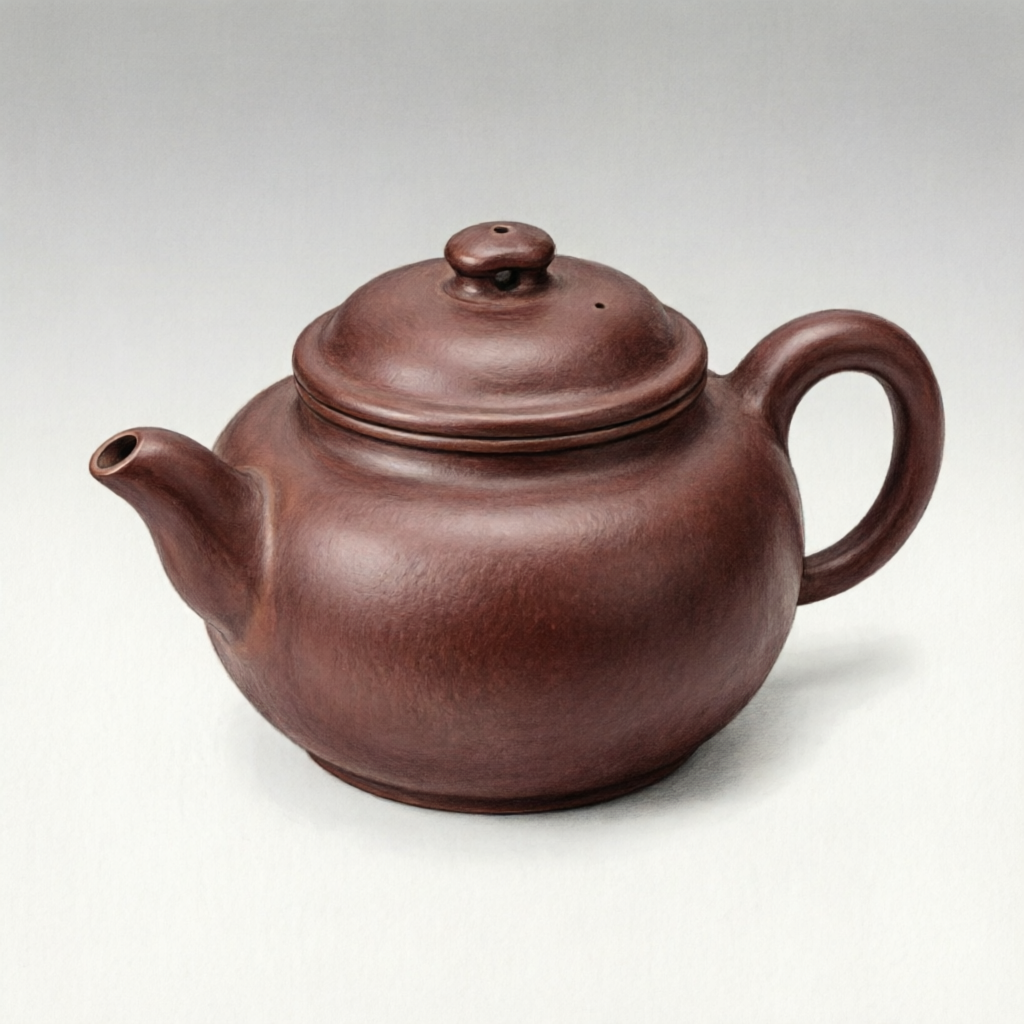
Zisha teapots, also known as Yixing teapots, are traditional Chinese teapots made from Zisha clay (purple clay) from the Yixing region of Jiangsu Province, China. These teapots are highly prized in Chinese tea culture for their unique porous structure that enhances tea flavor and their artistic value as handicrafts. Zisa teapots represent a perfect blend of functionality and artistic expression, embodying the Chinese philosophy of "art in daily life" (日常生活美学).
History
The origins of Zisha teapots can be traced back to the Ming Dynasty during the reign of Emperor Wuzong (1505-1521). According to historical records, the founder of Zisha teapot making was Gong Chun, who was originally a servant to scholar Wu Yushan. The story goes that Gong Chun observed local potters making clay jars and was inspired to create teapots from the same material. His work was described as "栗色暗暗,如古今铁,敦庞周正" (dark chestnut color, like ancient iron, simple and well-proportioned).
Gong Chun passed his techniques to Shi Dabin, who along with his disciples Xu Youquan and Li Zhongfang, became known as the three great masters of Zisha teapots after the Wanli era (1573-1620). Shi Dabin's style was elegant and unconventional, with flowing forms that showcased unique craftsmanship without excessive ornamentation.
The second generation of masters included Chen Mingyuan and Hui Mengchen from the early Qing Dynasty. Chen Mingyuan revolutionized Zisha teapots by incorporating natural elements like chestnuts, walnuts, and lotus flowers into his designs, transforming teapots into living sculptures. He also established the practice of signing the bottom of teapots and marking the lid with seals, which became standard practice.
The third generation emerged during the Jiaqing and Daoguang reigns (1796-1850) with Chen Hongshou and Yang Pengnian. Chen Hongshou, a renowned calligrapher and painter, integrated poetry, calligraphy, and painting with Zisha teapots, creating a new artistic synthesis.
Key Information
| Feature | Description |
|---|---|
| Origin | Yixing, Jiangsu Province, China |
| Founder | Gong Chun (Ming Dynasty) |
| Materials | Zisha clay (purple clay), green clay, and red clay |
| Colors | Purple, red, and yellowish-brown |
| Firing Temperature | 1100-1200°C |
| Porosity | Over 10% |
| Key Masters | Gong Chun, Shi Dabin, Chen Mingyuan, Chen Hongshou, Gu Jingzhou |
Cultural Significance
Zisha teapots hold a special place in Chinese tea culture and aesthetics. The saying "人间珠宝何足取,宜兴紫砂最要得" (Why seek worldly treasures when Yixing Zisha is most precious) reflects their esteemed status. These teapots are not merely functional vessels but objects of artistic and cultural value.
The integration of poetry, calligraphy, and painting with Zisha teapots represents the Confucian ideal of uniting different art forms. Each teapot often bears inscriptions of classical poems or philosophical sayings, transforming it into a medium for cultural transmission.
Modern Status
Today, Zisha teapots continue to be highly valued both as functional tea vessels and as art collectibles. Contemporary masters such as Xu Xiutang, Xu Hantang, Bao Zhiqiang, He Daohong, and Zhou Guizhen carry forward the tradition while innovating in design and technique.
The Zisha industry faces challenges including resource scarcity, with the Yixing government implementing mining restrictions to protect the clay deposits. Modern production includes both traditional handcrafted pieces and machine-made versions, with significant differences in quality and value.
The market for authentic Zisha teapots, especially those made by renowned masters, has seen steady growth. A replica of a Gong Chun teapot by master Gu Jingzhou could fetch around 600,000 Hong Kong dollars, demonstrating the high valuation placed on these artifacts.
References
-
Lo, K. S. Y. (1986). The Stonewares of China: From the Neolithic Period through the Thirteenth Century. Oxford University Press.
-
Li, J. & Tsang, S. (1998). The Classic of Tea: Origins and Rituals of Chinese Tea Culture. Hong Kong University Press.
-
Wu, R. & Wu, C. (2005). Chinese Ceramics: From the Paleolithic to the Present. Thames & Hudson.
-
Gompertz, G. S. (1968). Chinese Pottery and Porcelain. Faber and Faber.
-
Kwo, D. (1981). Later Chinese Bronzes. Chinese University Press.