Qigong
Overview
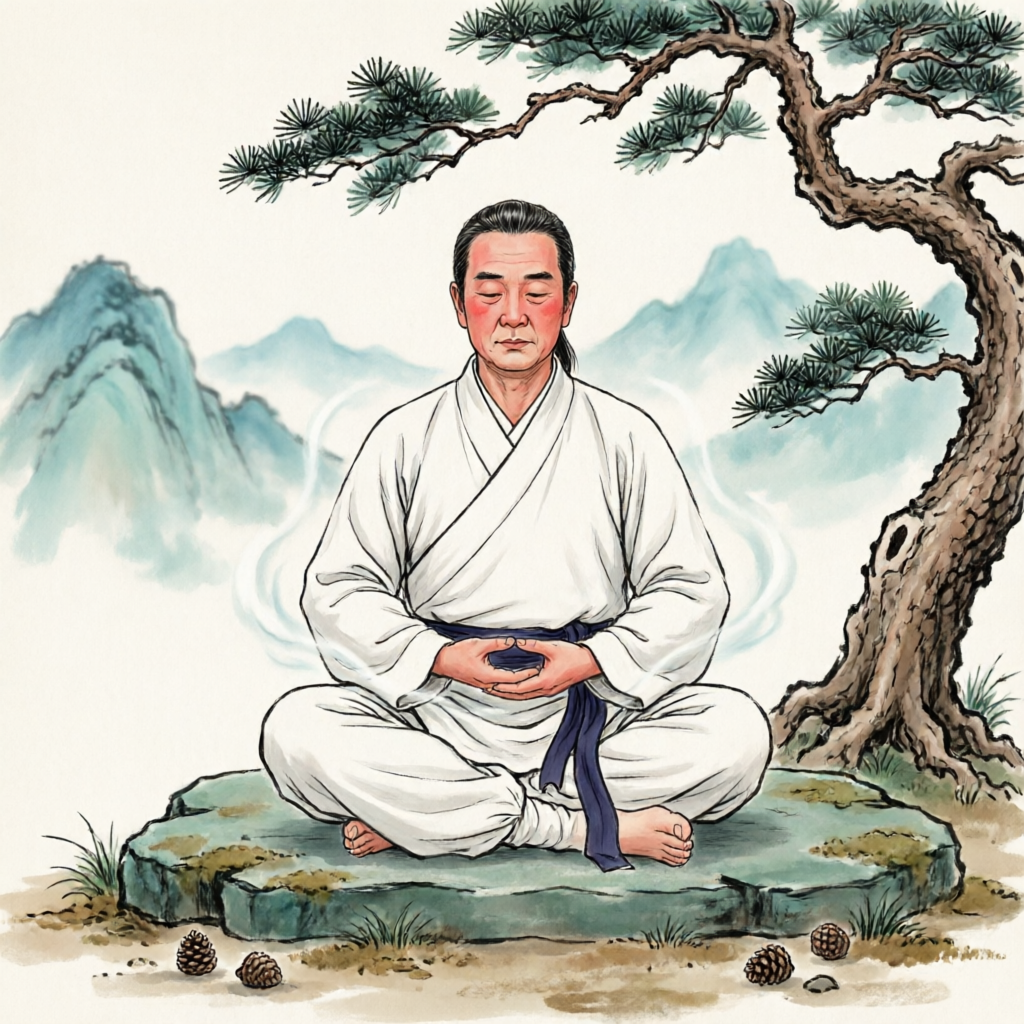
Qigong (气功, pronounced "chee-gong") is a traditional Chinese practice that involves coordinated breathing, movement, and meditation techniques. From the perspective of Traditional Chinese Medicine (TCM), qigong is defined as a mind-body exercise skill that integrates three key adjustments: regulating the body (调身), regulating the breath (调息), and regulating the mind (调心) [1]. This ancient practice has evolved over thousands of years and is considered an important component of Chinese cultural heritage alongside traditional medicine and martial arts.
Modern scientific approaches to qigong view it as a behavioral therapy that involves learning and training beneficial behaviors for psychophysical health, eventually establishing these behaviors through conditioned reflex mechanisms. From a psychophysiological perspective, qigong can be understood primarily as a self-cultivation method that uses self-suggestion as its core technique, guiding the consciousness into a self-hypnotic state to adjust psychophysical balance through psychological-physiological-morphological self-regulation mechanisms, ultimately achieving fitness and therapeutic purposes.
History
Qigong originated in China and has a long history. In ancient times, practices now classified as qigong were known by various names including tuna (吐纳, breath control), xingqi (行气, circulating qi), buqi (布气, emitting qi), fuqi (服气, absorbing qi), daoyin (导引, guidance exercises), liandan (炼丹, alchemy practice), xiudao (修道, cultivating the Dao), and zuochan (坐禅, seated meditation) [1].
The theoretical foundations of classical qigong are based on the health preservation theories of Traditional Chinese Medicine and have been passed down since ancient times. Early forms of qigong were partially referred to as "dance," as mentioned in the Lüshi Chunqiu ("When the sinews and bones are constricted and unresponsive, therefore one creates dance to guide them"). During the Spring and Autumn and Warring States periods, some qigong practices were incorporated into "daoyin anqiao" (导引按跷, guidance and massage techniques).
The Huangdi Neijing (Yellow Emperor's Inner Canon), a foundational text of TCM, records cultivation methods such as "grasping heaven and earth, grasping yin and yang, breathing the vital essence, standing alone and guarding the spirit, with muscles as one," "accumulating essence to complete the spirit," and "not scattering the spirit" [1]. The Laozi mentions the "hux or chui" (or blow) breathing technique, and the Zhuangzi contains the description: "Blowing and breathing, expelling the old and taking in the new, stretching like bears and extending like birds—this is all done merely to prolong life. This is what those who practice guidance and those who nurture their forms, like Peng Zu who lived a long life, delight in" [1].
Artifacts unearthed from the Han tomb at Mawangdui in Changsha, Hunan Province, include the silk manuscript "Qu Gu Shi Qi Pian" (Breathing and Abstaining from Grain) and the colored silk painting "Daoyin Tu" (Guidance Diagram). The "Qu Gu Shi Qi Pian" is a work focusing on breathing techniques, while the "Daoyin Tu" can be considered the earliest qigong diagram, containing 44 images depicting ancient people using qigong for disease prevention and treatment.
The term "qigong" itself has a more recent history. While the practice is ancient, the specific term "qigong" first appeared in the Jin Dynasty (265-420 CE) in the Jingming Zongjiao Lu (Religious Records of Purity and Brightness) by Daoist Xu Xun. Some scholars suggest this work may have been attributed to Xu Xun at a later date, meaning the term was in use no later than the Sui and Tang dynasties (581-907 CE). The term gained wider popularity after the 1950s with the establishment of the Beidaihe Qigong Sanatorium [1].
During the Wei-Jin period (220-420 CE), figures like Cao Cao and his son Cao Pi were enthusiasts of qigong. Cao Cao assembled numerous qigong masters such as Gan Shi and Huangfu Long to teach "owl-like vision and wolf-like gaze, with breathing and breath control" techniques. Cao Pi recorded in his Lidian (Ritual Regulations) what may be the first documented case of qigong deviation: "...excessive practice led to qi blockage, which不通 (不通, obstructed), and after a long time, he revived" [1].
Key Information
| Aspect | Description |
|---|---|
| Chinese Name | 气功 (qìgōng) |
| Pronunciation | "chee-gong" |
| Origin | China, ancient practice with documented history dating back to at least the Warring States period (475-221 BCE) |
| Nature | Mind-body practice combining movement, breathing techniques, and meditation |
| Theoretical Basis | Traditional Chinese Medicine, particularly concepts of qi (vital energy), meridians, and yin-yang |
| Historical Names | Tuna (吐纳), Xingqi (行气), Buqi (布气), Fuqi (服气), Daoyin (导引), Liandan (炼丹), Xiudao (修道), Zuochan (坐禅) |
| Key Texts | Huangdi Neijing (黄帝内经), Laozi (老子), Zhuangzi (庄子), Daoyin Tu (导引图) |
| Modern Development | Popularized in the 1950s by Liu Guizhen with the publication of "Qigong Therapy Practice" (气功疗法实践) |
Cultural Significance
Qigong holds significant cultural importance in China and has influenced various aspects of traditional Chinese culture. As one of the three pillars of traditional Chinese culture alongside medicine and martial arts, qigong embodies the Chinese philosophical concepts of tian ren he yi (天人合一, harmony between humans and nature) and xing shen he yi (形神合一, unity of body and spirit) [1].
The practice has been historically associated with various philosophical and religious traditions in China, including Confucianism, Taoism, Buddhism, and martial arts. Each tradition developed its own approach to qigong, incorporating specific philosophical perspectives and goals. For instance, Taoist qigong often focuses on longevity and spiritual cultivation, while Buddhist qigong may emphasize enlightenment and the development of wisdom.
During different historical periods, qigong has experienced varying degrees of popularity and acceptance. During the Wei-Jin period, it gained attention among the literati and nobility. In the Tang and Song dynasties, it became more integrated into medical practice. However, during certain political periods, particularly the Cultural Revolution (1966-1976), traditional practices like qigong faced suppression. After the Cultural Revolution, qigong experienced a significant revival and has since developed into a more systematic discipline recognized for its health benefits [1].
Modern Status
In contemporary China, qigong has been formally organized and promoted as a health practice. The General Administration of Sport of China established the National Fitness Qigong Management Center, which oversees the development and standardization of qigong practices. In 2010, fitness qigong showed strong development momentum across China, with numerous large-scale activities held throughout the year. The number of national fitness qigong activity sites reached over 13,000, with more than one million people practicing recommended forms such as Yijinjing (易筋经, Muscle-Tendon Changing Classic), Wuqinxi (五禽戏, Five Animal Frolics), Liujué (六字诀, Six Character Formula), and Baduanjin (八段锦, Eight Section Brocade) [1].
Internationally, qigong has gained increasing recognition as a mind-body practice with potential health benefits. In 2011, plans were underway to establish the International Health Qigong Federation, indicating growing global interest in the practice [1].
Modern research has begun to explore the physiological mechanisms underlying qigong's effects. Studies have suggested that regular qigong practice may benefit various health conditions, including hypertension, anxiety, chronic pain, and immune function. However, the scientific community continues to call for more rigorous, controlled studies to better understand qigong's mechanisms and efficacy [1].
Qigong is now widely practiced in various settings, including hospitals, community centers, parks, and homes. It has been incorporated into some healthcare systems as a complementary therapy, particularly for chronic conditions and stress management. The practice has also evolved into different styles and approaches, ranging from traditional forms to more modernized versions designed for specific health purposes.
References
[1] Liu, G. (1957). Qigong Therapy Practice (气功疗法实践). Beijing: People's Health Publishing House.
[2] Kaptchuk, T. J. (2000). The Web That Has No Weaver: Understanding Chinese Medicine. Contemporary Books.
[3] Needham, J., & Lu, G. D. (1983). Science and Civilisation in China, Vol. 5: Chemistry and Chemical Technology, Part 2: Spagyrical Discovery and Invention: Magisteries of Life and Elixirs of Death. Cambridge University Press.
[4] Maciocia, G. (2009). The Foundations of Chinese Medicine: A Comprehensive Text (3rd ed.). Elsevier Health Sciences.
[5] Sneath, P. H. A. (2008). Chinese Medicine and Healing: An Illustrated History. Harvard University Press.