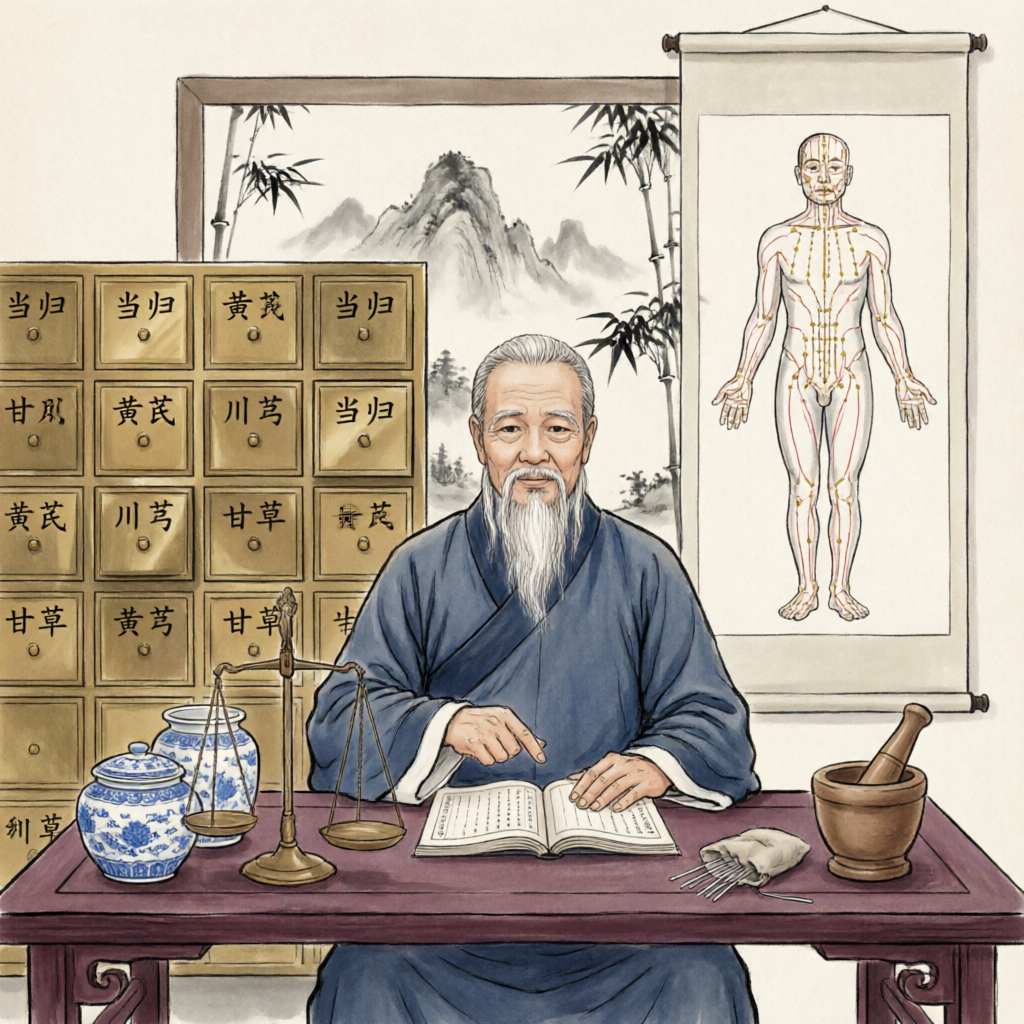
Traditional Chinese Medicine
Overview
Traditional Chinese Medicine (TCM) is a broad range of medicine practices sharing common concepts originating in ancient China, including various forms of herbal medicine, acupuncture, massage (Tui na), exercise (qigong), and dietary therapy. TCM is one of the oldest continuously practiced systems of medicine in the world, with a history dating back more than 2,000 years. The theoretical framework of TCM is based on a holistic view of the body and the balance of opposing yet complementary forces known as "yin" and "yang". TCM practitioners use these concepts to diagnose and treat health problems, aiming to restore balance and harmony within the body.
History
Formation Period
In ancient times, Chinese ancestors discovered that certain plants and animals could alleviate ailments, accumulating knowledge about medicinal substances. As human civilization evolved, people began to systematically search for drugs and methods to prevent and treat diseases. The legends of "Shennong tasting hundreds of herbs" and "medicine and food sharing the same origin" reflect this early period. The invention of alcohol during the Xia Dynasty (c. 2070-1600 BCE) and medicinal decoctions during the Shang Dynasty (1600-1046 BCE) helped improve therapeutic effects. By the Western Zhou Dynasty (1046-771 BCE), medical specialization had emerged with different practitioners focusing on diet therapy, internal medicine, surgical wounds, and veterinary medicine.
During the Spring and Autumn and Warring States periods (770-221 BCE), TCM theory had largely taken shape. Anatomical knowledge and medical specialization developed, and the "four diagnostic methods" (inspection, auscultation and olfaction, inquiry, and palpation) were established. Treatment methods included stone acupuncture, needling, herbal decoctions, moxibustion, breathing exercises, energy transmission, and spiritual healing. The Huangdi Neijing (Yellow Emperor's Inner Canon), compiled during this period, stands as one of the four foundational classics of TCM and the earliest medical text in the Chinese medical canon. It established theoretical frameworks including the Yin-Yang and Five Elements theories, pulse diagnosis, Zang-Fu organ theory, meridian theory, etiology, pathogenesis, diagnosis principles, treatment methods, and health preservation.
Development Period
During the Qin and Han Dynasties (221 BCE-220 CE), the Huangdi Neijing systematically discussed human physiology, pathology, disease prevention, and treatment principles, establishing the intellectual framework of TCM and marking its transition from empirical experience to systematic theory. Zhang Zhongjing's Shanghan Zabing Lun (Treatise on Cold Damage and Miscellaneous Diseases) from the Eastern Han Dynasty proposed principles and methods for treating exogenous febrile diseases including epidemics, and established the theoretical and methodological system of syndrome differentiation and treatment. The Shennong Ben Cao Jing (Shennong's Materia Medica), also from this period, summarized theories of herbal compatibility and properties, providing guidance for rational prescription, safe medication, and improved therapeutic efficacy. Hua Tuo, another physician of the late Eastern Han Dynasty, created "mafeisan," an anesthetic preparation, pioneering the use of anesthesia in surgery.
During the Western Jin Dynasty (265-316 CE), Huangfu Mi's Zhenjiu Jia Yi Jing (A-B Classic of Acupuncture and Moxibustion) systematically discussed theories of Zang-Fu organs and meridians, laying the foundation for meridian and acupuncture theory.
Golden Age
The Tang Dynasty (618-907 CE) saw the emergence of "Dayi Jingcheng" (Great Physician's Sincerity), proposed by Sun Simiao, which embodied the pursuit of exquisite medical skill, utmost sincerity, and ethical conduct in TCM practice. This represents the core values of Chinese medical culture. Sun Simiao devoted his life to compiling Beiji Qianjin Yaofang (Essential Formulas for Emergencies Worth a Thousand Gold Pieces) and Qianjin Yifang (Supplement to the Formulas Worth a Thousand Gold Pieces), which collectively became comprehensive collections of medical knowledge covering all clinical departments, acupuncture, diet therapy, prevention, and health preservation.
The Song Dynasty (960-1279 CE) represented the golden age of TCM development. The government established the "Taiyi Bureau" as the highest institution for medical education and made significant improvements in teaching methods. For example, acupuncture official Wang Weiyi designed and cast two bronze acupuncture models with detailed engravings of the twelve meridians and 354 acupuncture points, serving as the earliest teaching models with intuitive, concrete, and realistic effects—a pioneering achievement in the history of Chinese medical education. The Song government also established the "Bureau for the Rectification of Medical Books," systematically collecting, organizing, verifying, and collating important medical texts over more than a decade. Classic medical texts such as the Suwen, Shanghan Lun, Jin Gui Yao Lue, Zhenjiu Jia Yi Jing, Zhu Bing Yuan Hou Lun, Qianjin Yaofang, Qianjin Yifang, and Waitai Miyao were collated and published during this period.
Innovation and Integration
During the Ming Dynasty (1368-1644 CE), Li Shizhen's Bencao Gangmu (Compendium of Materia Medica) provided the first scientific classification of medicinal plants in the world, innovating the theory and practice of Chinese herbal medicine and becoming a monumental work in pharmacology and natural history.
In the Qing Dynasty (1644-1912 CE), Ye Tianshi's Wen Lun (Discourse on Warm Diseases) proposed principles and methods for preventing and treating warm diseases and seasonal epidemics, forming a theoretical and practical system for TCM in combating infectious diseases. Physician Wang Qingren wrote Yilin Gaicuo (Errors Corrected in the Forest of Medicine) based on autopsy and clinical experience, correcting anatomical errors in ancient medical texts and emphasizing the importance of anatomical knowledge for physicians, while also developing theories and treatments for blood stasis diseases. Since the mid-Qing Dynasty, particularly during the Republican period, with the introduction of Western medicine, some scholars began to explore the integration of Chinese and Western medicine.
Revival
Since the SARS outbreak in 2003, classical formula-based TCM has shown signs of revival. Today, TCM remains one of the common means of treating diseases in China. Internationally, acupuncture has generated significant interest in the medical community. Acupuncture has been proven effective in reducing post-surgical pain, pregnancy-related nausea, chemotherapy-induced nausea and vomiting, and dental pain with minimal side effects. However, data on chronic pain, back pain, and headaches shows mixed or controversial results. The WHO considers that the effectiveness of many acupuncture therapies and some herbal medicines is strongly supported by double-blind scientific studies, but further research is needed for other traditional therapies, and safety issues cannot be ignored. On May 26, 2002, the WHO published the "Global Strategy for Traditional Medicine Research 2002-2005," inviting over 180 countries worldwide to incorporate alternative medicine into their healthcare policies.
On October 1, 2018, the WHO included TCM in its influential International Classification of Diseases for the first time. The newly included information on traditional Chinese medicine was incorporated into Chapter 26 of the 11th edition of the International Classification of Diseases, which primarily explains the classification system of traditional medicine and is to be implemented in WHO member countries in 2022.
Medical Theory
Overview
TCM theory originates from the summarization of medical experience and ancient Chinese philosophical concepts of Yin-Yang and the Five Elements. It includes theories of Qi, Essence, and Spirit; Yin-Yang and the Five Elements; Qi, Blood, and Body Fluids; Zang-Fu organs; meridians; constitution; etiology; pathogenesis; treatment principles; and health preservation. As early as 2,000 years ago, the medical classic Huangdi Neijing established the foundation of TCM. To this day, the theories, diagnostic methods, and treatment approaches of Chinese traditional medicine can trace their roots to this book.
The theoretical system of TCM was gradually formed through long-term clinical practice under the guidance of materialist and dialectical thinking. It originates from practice and, in turn, guides practice. Through the analysis of phenomena, it seeks to understand their internal mechanisms. Therefore, this unique theoretical system has two basic characteristics: the holistic concept and syndrome differentiation and treatment.
Yin-Yang Theory
Yin and Yang are philosophical concepts describing two opposing yet complementary aspects of phenomena in the universe. Initially referring to the direction of sunlight (Yang being the sunny side, Yin the shady side), their interaction includes mutual generation, mutual restraint, interdependence, dynamic balance, and mutual transformation.
In TCM, Yin-Yang theory is used to explain the complex relationships between the various parts of the human body and between the body and its natural and social environments. The relative balance of Yin and Yang is the foundation for maintaining normal physiological activities, while the disruption of this balance leads to disease.
Five Elements Theory
The Five Elements theory is an important achievement of ancient Chinese philosophy. It uses five philosophical categories—Wood, Fire, Earth, Metal, and Water—to summarize the properties of different things in the objective world and explains the relationships and transformation patterns between things through dynamic models of generation and restriction. In TCM, the Five Elements correspond to the five Zang organs: Wood to the Liver, Fire to the Heart, Earth to the Spleen, Metal to the Lung, and Water to the Kidney. The Five Elements theory is primarily used to explain functional relationships among Zang-Fu organs and the pathogenesis of diseases when organ functions are imbalanced, as well as to guide treatment.
Qi, Blood, and Body Fluids
Qi, Blood, and Body Fluids are the fundamental substances that constitute the human body and provide the material basis for physiological activities of Zang-Fu organs, meridians, and other tissues.
- Qi: The most fundamental substance constituting and maintaining human life activity. Physiologically, Qi has functions of propulsion, warming, defense, containment, and transformation. When Qi gathers, it forms the organic body; when it disperses, the body perishes.
- Blood: A substance that constitutes the body and maintains life activities, with significant nourishing and moistening effects. Blood must circulate within vessels to perform its physiological functions, providing nourishment and moisture to all tissues and organs.
- Body Fluids: Refers to the internal fluids and normal secretions of various Zang-Fu organs and tissues, collectively known as all normal water fluids in the body. Jin (the more dilute fluid) is distributed to the skin and muscles, providing moisture; Ye (the more viscous fluid) flows to joints, Zang-Fu organs, and the brain and marrow, providing nourishment.
Zang-Fu Theory
The Zang-Fu theory primarily studies the physiological functions and pathological changes of the five Zang organs (Heart, Liver, Spleen, Lung, Kidney), six Fu organs (Gallbladder, Stomach, Large Intestine, Small Intestine, Bladder, Triple Burner), and extraordinary Fu organs (Brain, Marrow, Bones, Vessels, Gallbladder, Uterus).
- Zang (Solid organs): Include Heart, Liver, Spleen, Lung, and Kidney, generally responsible for "transforming and storing Essence."
- Fu (Hollow organs): Include Gallbladder, Stomach, Large Intestine, Small Intestine, Bladder, and Triple Burner, generally responsible for "rotting and ripening food, separating the clear from the turbid, and transmitting waste products."
- Extraordinary Fu organs: Include "Brain, Marrow, Bones, Vessels, Gallbladder, and Uterus."
Meridian Theory
Meridian theory studies the physiological functions and pathological changes of meridians and their close relationship with Zang-Fu organs. Meridians are defined as channels within the body that circulate Qi and Blood, connecting Zang-Fu organs, tissues, orifices, and communicating between the interior and exterior. In pathological conditions, changes in meridian function manifest as corresponding symptoms and signs through which internal organ diseases can be diagnosed. The importance of meridians in TCM is emphasized in the Bianque Xinshu (Bianque's Medical Classic): "To study medicine without understanding meridians is to make mistakes in diagnosis and treatment. Without clear knowledge of meridians, one cannot understand the root of diseases or the transmission of Yin and Yang."
Cultural Significance
TCM has profoundly influenced Chinese culture and society throughout history. The concepts of "Qihuang" (referring to the legendary Yellow Emperor and physician Qi Bo) and "Qihuang zhi shu" (the art of Qihuang) originated from the Huangdi Neijing, which is presented as a dialogue between the Yellow Emperor and Qi Bo. The term "Shengshou" (divine hands) refers to highly skilled physicians, while "Xuhu" (hanging gourd) became a metaphor for medical practice, derived from the legend of an old physician who hung a gourd as his sign. "Xinglin" (apricot forest) and "Hushou Xinglin" (tiger guarding the apricot forest) are terms of praise for physicians with excellent medical skills and ethics, originating from the story of Dong Feng, a physician of the Three Kingdoms period who asked his patients to plant apricot trees as payment and later used the apricots to help the poor.
The term "Cangsheng Dayi" (great physician for all living beings) comes from Sun Simiao's writings in the Qianjin Yaofang, emphasizing the ethical ideal that physicians should treat all patients equally regardless of social status, wealth, or personal relationship, and should dedicate themselves wholeheartedly to saving lives without considering personal gain or danger.
Modern Status
Today, TCM is an integral part of China's healthcare system. The Chinese government has established dedicated TCM hospitals, universities, and research institutions. TCM is also increasingly recognized internationally, with acupuncture being widely practiced in many countries. The inclusion of TCM in the WHO's International Classification of Diseases in 2018 marked a significant milestone in the global recognition of TCM.
Modern research has begun to explore the scientific basis of TCM mechanisms, particularly in areas such as acupuncture, herbal medicine, and Qigong. However, challenges remain in reconciling TCM concepts with modern scientific paradigms and in establishing rigorous methodologies for evaluating TCM effectiveness and safety.
Key Information
| Aspect | Description |
|---|---|
| Origin | Ancient China, dating back over 2,000 years |
| Theoretical Foundation | Yin-Yang theory, Five Elements theory, Qi, Blood, Body Fluids, Zang-Fu organs, Meridians |
| Key Texts | Huangdi Neijing, Shanghan Zabing Lun, Bencao Gangmu, Qianjin Yaofang |
| Main Treatment Methods | Herbal medicine, acupuncture, moxibustion, cupping, Tui na massage, Qigong, dietary therapy |
| Diagnostic Methods | Inspection, auscultation and olfaction, inquiry, palpation (the "four diagnostic methods") |
| Modern Status | Integrated into China's healthcare system, increasingly recognized internationally |
References
-
Unschuld, P. U. (2003). Huang Di Nei Jing Su Wen: Nature, Knowledge, Imagery in an Ancient Chinese Medical Text. University of California Press.
-
Kaptchuk, T. J. (2000). The Web That Has No Weaver: Understanding Chinese Medicine. Contemporary Books.
-
Maciocia, G. (2015). The Foundations of Chinese Medicine: A Comprehensive Text (3rd ed.). Elsevier Health Sciences.
-
World Health Organization. (2002). WHO Traditional Medicine Strategy 2002-2005. WHO Press.
-
Liu, Z. (2015). Acupuncture and Moxibustion: A Pocket Textbook. People's Medical Publishing House.