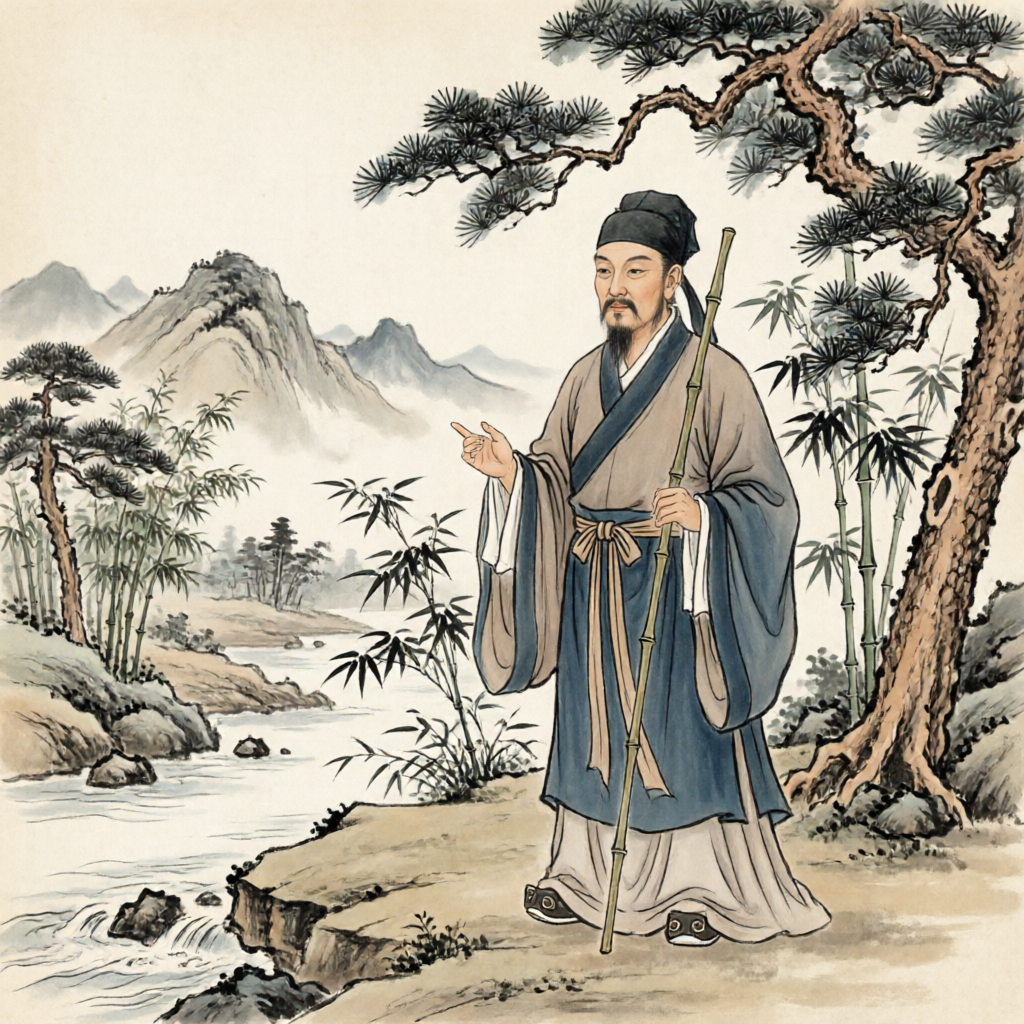
Wang Yangming
Overview
Wang Yangming (1472-1529), also known as Wang Shouren, was a prominent Chinese philosopher, military general, and official during the Ming dynasty. Born in Yuyao, Zhejiang province, he is best known as the founder of the School of the Mind (Xin Xue), a major philosophical movement that challenged the orthodox Neo-Confucianism of Zhu Xi. His teachings, collectively known as Yangming School or Yangmingism, emphasized innate moral knowledge (liangzhi) and the unity of knowledge and action (zhi xing he yi). Wang's philosophy had profound influence not only in China but also in Japan and other parts of East Asia, where it contributed to the development of modern thought.
History
Early Life
Wang Yangming was born on October 31, 1472, in Yuyao, Zhejiang province. His father, Wang Hua, was a scholar-official who later became the Minister of Personnel in Nanjing. According to accounts, Wang's grandmother dreamed of a celestial deity presenting her a child before his birth, which led to his original name "Yun" (Cloud). However, at age five, Wang still couldn't speak. A visiting monk touched his head and said, "What a fine child, but it's a pity that his true nature has been revealed." Based on a passage from the Analects, his grandfather changed his name to "Shouren" (Guarding Benevolence), after which Wang began to speak.
At age twelve, Wang entered school. His mother's death when he was thirteen was a significant emotional blow, but he maintained his ambition to become a sage. By age fifteen, he was already displaying extraordinary intellectual abilities, questioning conventional wisdom about the importance of imperial examinations in favor of pursuing sagehood. Around this time, he also developed an interest in military affairs, studying strategy and practicing archery.
Career and Philosophical Development
Wang passed the provincial examination at age twenty-one but failed the higher metropolitan examination twice. Despite his scholarly father's encouragement, Wang famously remarked, "You consider it shameful not to pass the examinations; I consider it shameful to be upset about not passing them."
In 1499, Wang passed the metropolitan examination and was appointed to the Ministry of Works. However, his career was interrupted in 1506 when he offended the powerful eunuch Liu Jin by defending officials who had criticized him. As punishment, Wang was beaten with forty strokes and exiled to serve as the驿丞 (yicheng, postal station master) at Longchang, a remote region in Guizhou.
Longchang Enlightenment
During his exile in Longchang, Wang experienced a profound philosophical revelation known as the "Longchang Enlightenment" (龙场悟道). In this epiphany, he realized that "the Way of the sage is inherent in our minds; seeking it in external things was my former mistake." This insight became the foundation of his philosophy of innate moral knowledge (liangzhi) and the unity of knowledge and action.
After Liu Jin's fall from power in 1509, Wang was rehabilitated and appointed as magistrate of Luling County. Over the next decade, he held various official positions while continuing to develop his philosophical ideas.
Military Achievements
Wang's military career reached its peak when he suppressed the Prince of Ning's Rebellion (宁王之乱) in 1519. The Prince of Ning, Zhu Chenhao, launched a major rebellion with the aim of overthrowing the emperor. Wang, with limited resources, employed strategic deception to delay the prince while hastily assembling an army. He ultimately captured the prince's capital, forcing him to return and fight. In a decisive naval battle on Poyang Lake, Wang defeated the rebel forces and captured the prince within 35 days.
Despite this significant achievement, Wang faced political complications. The emperor, who had planned to personally capture the rebel as a demonstration of his own martial prowess, was displeased with Wang's rapid success. Wang wisely handed the captured prince to a trusted eunuch and retired from public life temporarily to avoid political entanglements.
Later Years and Death
In 1521, the Jiajing Emperor ascended the throne and recognized Wang's achievements, granting him the title of Earl of Xinjian (新建伯). Wang devoted his later years to teaching and writing. In 1527, he was appointed Governor-General of Liangguang to suppress rebellions in the southern frontier. Despite his success, his health deteriorated due to the harsh conditions.
Wang Yangming died on January 9, 1529, while returning home from his final military campaign. His final words to his disciples were: "This heart is bright, what more is there to say?" (此心光明,亦复何言!).
Key Information
| Aspect | Details |
|---|---|
| Birth Name | Wang Shouren (王守仁) |
| Courtesy Name | Bo'an (伯安) |
| Pseudonyms | Yangming (阳明) |
| Birth Date | October 31, 1472 |
| Birthplace | Yuyao, Zhejiang province (modern Ningbo) |
| Death Date | January 9, 1529 |
| Death Place | Dayu County, Jiangxi province |
| Dynasty | Ming Dynasty (明朝) |
| Philosophy | School of the Mind (Xin Xue, 心学) |
| Major Works | Chuanxilu (传习录), Wen Cheng Gong Quanji (文成公全集) |
| Key Concepts | Liangzhi (良知, innate moral knowledge), Zhi Xing He Yi (知行合一, unity of knowledge and action) |
| Official Titles | Earl of Xinjian (新建伯), Governor-General of Liangguang |
Cultural Significance
Wang Yangming's philosophy represented a significant departure from the orthodox Neo-Confucianism of Zhu Xi, which emphasized external investigation of principles (gewu). Instead, Wang taught that moral knowledge is innate and that true understanding comes from self-cultivation and practical application.
His concept of "liangzhi" (innate moral knowledge) suggested that everyone possesses an intuitive understanding of good and evil. The "unity of knowledge and action" (zhi xing he yi) argued that genuine knowledge necessarily leads to action, and that action is inseparable from knowledge.
Wang's ideas had profound influence beyond philosophy. His military strategies were studied for centuries, and his administrative reforms in southern China, including the implementation of community compacts (乡约) and the ten-household system (十家牌法), helped stabilize local governance.
The Yangming School became one of the major intellectual movements of the late Ming dynasty and continued to influence Chinese thought through the Qing dynasty. It also spread to Japan, where it influenced thinkers like Nakae Tōju and Ōyōmei, and contributed to the development of modern Japanese thought.
Modern Status
Today, Wang Yangming is recognized as one of the most important Chinese philosophers. His ideas continue to be studied in academic contexts, particularly in East Asian philosophy departments. In recent decades, there has been a resurgence of interest in Wang's thought, both in China and internationally, as scholars explore its relevance to contemporary issues in ethics, political philosophy, and education.
Wang's emphasis on moral intuition and personal responsibility has resonated with modern thinkers concerned with individual autonomy and ethical decision-making. His philosophy has been compared to various Western philosophical traditions, including existentialism and pragmatism.
In China, Wang is commemorated through numerous memorials, including the Yangming Academy in Shaoxing and the Wang Yangming Museum in his hometown of Yuyao. His birthday is still celebrated in some communities as a day for educational reflection.
References
-
Chan, Wing-tsit. A Source Book in Chinese Philosophy. Princeton University Press, 1963.
-
de Bary, Wm. Theodore. Self and Society in Ming Thought. Columbia University Press, 1970.
-
Huang, Siu-chi. Liang Ch'i-ch'ao and Chinese Modernity. Harvard University Asia Center, 1975.
-
Ivanhoe, Philip J. Ethics in the Confucian Tradition: The Thought of Mengzi and Wang Yangming. Hackett Publishing Company, 2002.
-
Angle, Stephen C. and Slote, Michael. Neo-Confucianism: A Philosophical Introduction. Polity Press, 2013.