Chan Buddhism
Overview
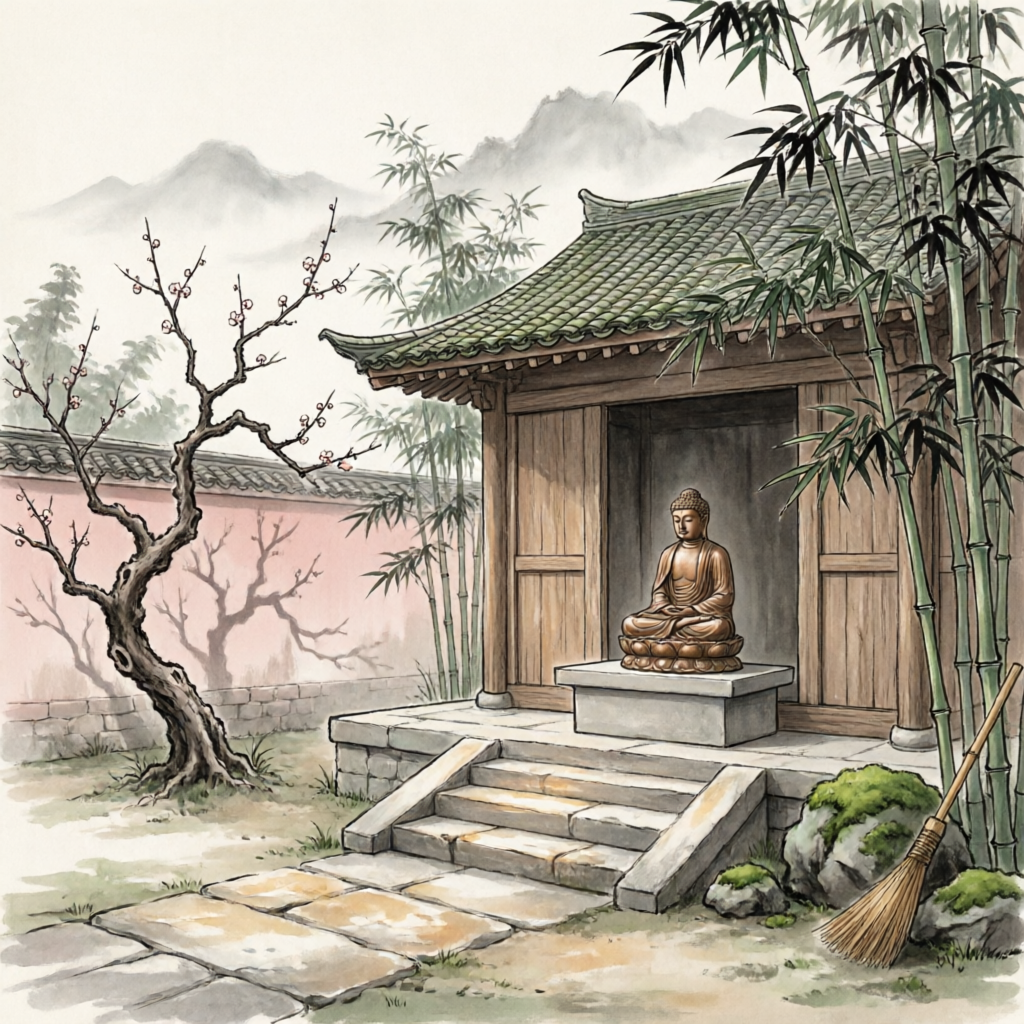
Chan Buddhism, also known as the Buddha-Mind School (Fóxīn Zōng), is a distinctive school of Mahayana Buddhism that originated in China and later spread throughout East Asia. It emphasizes the practice of meditation (Chan) as the primary means to attain enlightenment, focusing on direct experience and insight rather than reliance on scriptures or rituals. The tradition traces its origins to the legendary figure Bodhidharma, who is traditionally regarded as the first patriarch (or first ancestor) of the school. Chan Buddhism has had a profound influence on Chinese culture, art, literature, and philosophy, and its distinctive teachings and practices continue to resonate in contemporary society.
History
According to tradition, Chan Buddhism was founded by the Indian monk Bodhidharma (Dámó), who is revered as the First Patriarch. The subsequent lineage of patriarchs included Huìkě (Second Patriarch), Sēncán (Third Patriarch), Dàoxìn (Fourth Patriarch), and Hóngrěn (Fifth Patriarch). The influence of Chan Buddhism began to expand significantly during the time of the Fourth Patriarch, Dàoxìn, who settled at Mount Shuangfeng in Huangmei, ending the nomadic lifestyle and establishing a self-sufficient community. The Fifth Patriarch, Hóngrěn, received official recognition from the imperial court, and his teaching became known as the "East Mountain Dharma Gate" (Dōngshān Fǎmén), with disciples spreading throughout the country and establishing numerous Chan teaching centers.
After the An Lushan Rebellion (755-763), Chan Buddhism divided into two major branches: the Northern School and the Southern School. The Northern School, led by Shénxiù, emphasized "dusting the mind to see purity" (fúchén kànjìng), requiring "wiseful thoughts to cease conceptual thinking, and utmost concentration to control the mind." Through seated meditation, practitioners aimed to eliminate defilements and achieve a pure mind, a path known as "gradual enlightenment" (jiànwù). The Southern School, led by Huìnéng, gained support from regional military governors (fānzhèn) to the imperial court. It taught that the nature of mind is inherently pure, and enlightenment does not require external seeking. It placed less emphasis on strict monastic discipline, prescribed meditation postures, or textual study, instead advocating "no-mind" (wúniàn), "no-form" (wúxiàng), "the mind is Buddha" (jíxīn shìfó), and "seeing one's nature becomes Buddha" (jiànxìng chéngfó). This approach was called the "sudden gate" (dùnmén). Huìnéng's famous disciples included Nányuè Huairáng, Qīngyuán Xīngsī, Hézé Shénhuì, Nányáng Huìzhòng, and Yǒngjiā Xuéjué, forming the mainstream of Chan Buddhism. Among these, the lineages of Nányuè and Qīngyuán flourished most prominently.
From the Nányuè lineage emerged the Wéiyǎng and Línjì schools, while the Qīngyuán lineage developed into the Cáodòng, Yúnmén, and Fǎyǎn schools, collectively known as the "Five Houses" (Wǔjiā). Of these, the Línjì and Cáodòng schools have survived the longest. During the Song Dynasty, the Línjì school further divided into the Huánglóng and Yángqí branches, resulting in the "Five Houses and Seven Schools" (Wǔjiā Qīzōng) of Chan Buddhism.
Key Information
| Aspect | Details |
|---|---|
| Chinese Name | 禅宗 (Chán Zōng) |
| Alternative Name | 佛心宗 (Fóxīn Zōng) - Buddha-Mind School |
| Founding Place | Mount Song Shaolin Temple (Sōngshān Shàolín Sì) |
| Founder | Bodhidharma (菩提达摩) - traditionally regarded as the First Patriarch |
| Main Texts | The Platform Sutra of the Sixth Patriarch (六祖坛经), Lankavatara Sutra (楞伽经), Diamond Sutra (金刚经) |
| Major Divisions | Northern School (北宗), Southern School (南宗), later developing into Five Houses and Seven Schools |
| Key Concepts | Gradual enlightenment (渐悟), Sudden enlightenment (顿悟), No-mind (无念), Buddha-nature (佛性) |
Cultural Significance
As Chan Buddhism spread, its natural, spontaneous attitude permeated various aspects of Chinese culture. After one or two generations from the Southern School's founders Nányuè and Qīngyuán, the essence of Chan was integrated into the daily lives of practitioners, forming an attitude of "following circumstances and acting spontaneously" (suíyuán rènyùn). Strictly speaking, this transcended the orthodox categories of Buddhist learning (the Three Studies: precepts, meditation, and wisdom), and its theoretical basis gradually diverged from traditional Buddhist teachings.
The Southern School originally taught that meditation and wisdom should be cultivated simultaneously without distinction, explaining them as two aspects of a unified practice through rational understanding and integrated action. It also stated that "being externally free from forms is Chan, and internally undisturbed is concentration," thereby expanding the scope of meditation. Later, under the influence of Nányuè's disciple Mǎzǔ (Mǎzǔ Dàoyī), the practice was vividly illustrated by the metaphor that grinding bricks cannot make a mirror, meaning that seated meditation alone cannot lead to Buddhahood. This approach moved beyond conventional seated meditation practices.
However, the motivation behind all Chan actions remained focused on transcending life and death, achieving freedom from attachment, and directly grasping the root of enlightenment. For Chan practitioners, this root was understood as the human mind, or what could be called the "original mind" (běnxīn). To make this less abstract, they explained it through the various manifestations of mind—speech, actions, and so forth. For example, when asked about cultivating the path, Dàzhū Huìhǎi (a disciple of Mǎzǔ) replied: "When hungry, eat; when tired, sleep." What distinguished this from ordinary behavior was the complete absence of calculation, acting purely according to nature. Chan masters often said, "The ordinary mind is the Way" (píngcháng xīn shì dào) and "Intentional seeking misses the mark" (nǐ xiàng jí guāi), indicating their focus on daily life.
Later thinkers argued that these manifestations were not just expressions of mind but revelations of one's nature, citing the dialogue between King Yi and the elder波罗提 (Bōluótí), who said, "Seeing nature is Buddha; nature is in function," referring to perception, awareness, and cognition. Neo-Confucian scholars of the Song and Ming dynasties often criticized Chan Buddhism for understanding mind but not nature, because ordinary perception and awareness lack inherent moral significance and cannot be considered nature. However, Chan Buddhism maintained that "mind is Buddha" (jíxīn shìfó), requiring no cultivation, and that the natural expression of this original mind leads to liberation. Thus, they considered it valid to view this as nature. The true practitioner, they said, "follows circumstances to eliminate past karma, and acts spontaneously to put on clothes"—acting when action is needed, stopping when stopping is needed, and naturally forming a life of following circumstances and acting spontaneously.
Modern Status
Chan Buddhism continues to exert influence in contemporary society. Lǔ Sōngtāo, a disciple of the Sinologist Nán Huáijīn, organizes corporate executives to participate in Chan practice and meditation retreats at Táihú University. Lǔ takes a Buddhist approach of "leaving the worldly realm" (chūshì) while being motivated by the Confucian ideal of "engaging with the world" (rùshì).
In the field of artificial intelligence, expert Zhū Sōngchún has incorporated Chan Buddhist thought as a representative category of Chinese philosophy in his research on Artificial General Intelligence (AGI).
During the Qing Dynasty, the Yongzheng Emperor particularly identified with Chan Buddhism's wisdom of "cultivating the mind" (xiūxīn). He ordered the renovation of Niānhuā Temple in Beijing, personally inscribed the plaque naming it "Niānhuā Temple," and had a stele erected (calligraphed by Prince Yǔnlǐ) to establish Chan Buddhism as a model. This aimed to enhance governance by promoting religious faith that aligned with imperial authority.
References
[1] Faure, Bernard. Chan Buddhism in Ritual Context. Routledge, 2003.
[2] Gregory, Peter N. Sudden and Gradual: Approaches to Enlightenment in Chinese Thought. University of Hawaii Press, 1987.
[3] McRae, John R. Seeing Through Zen: Encounter, Transformation, and Genealogy in Chinese Chan Buddhism. University of California Press, 2003.
[4] Wright, Dale S. Philosophical Meditations on Zen Buddhism. Cambridge University Press, 1998.
[5] Yampolsky, Philip B. The Platform Sutra of the Sixth Patriarch. Columbia University Press, 1967.