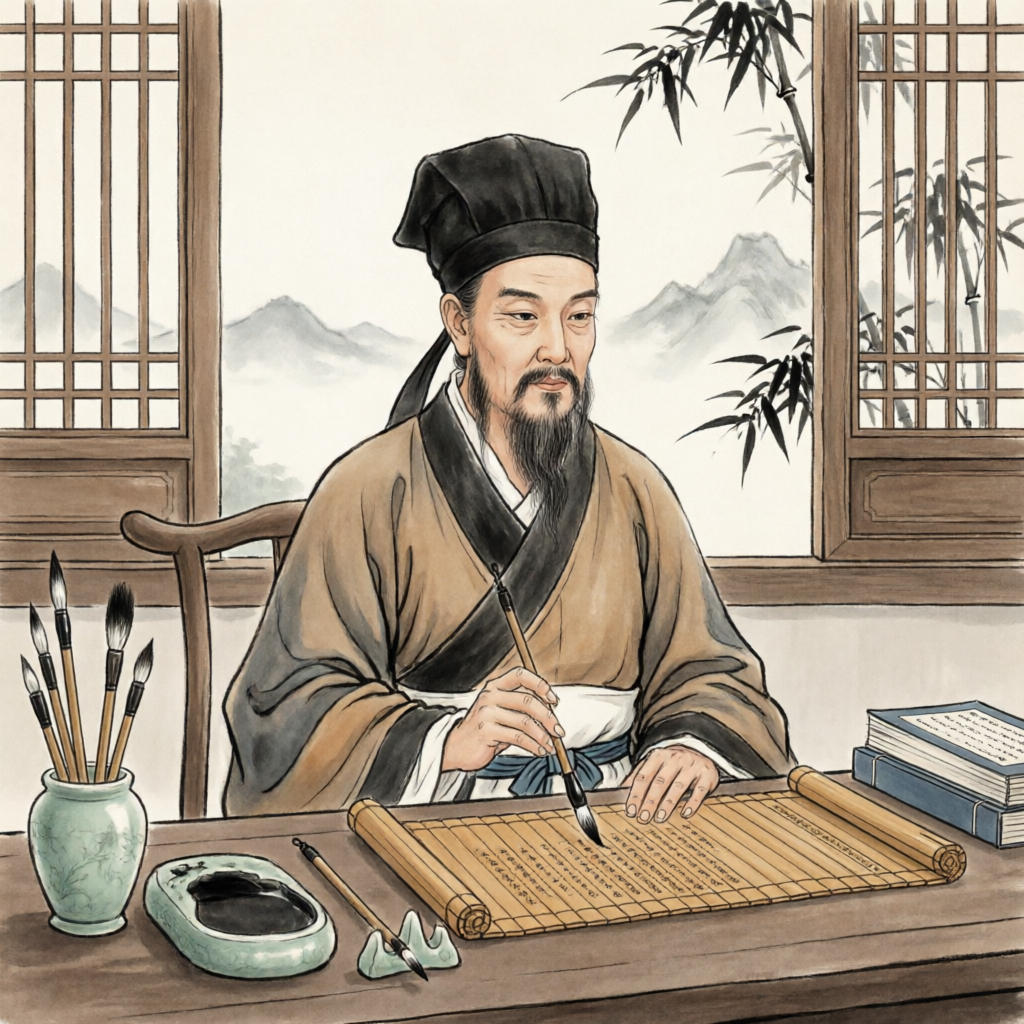
Overview
Zhu Xi (1130-1200), courtesy name Yuanhui (also known as Zhonghui), art name Huizhang, was a highly influential Neo-Confucian philosopher, educator, and official of the Song dynasty. He is often referred to by his literary names such as Hui'an (Hui'an Master), Ziyang (Purple Sun Master), and Kaoting (Kaoting Master). Zhu Xi's philosophical synthesis became the dominant orthodoxy in imperial China for centuries, profoundly shaping Chinese thought, education, and culture. His commentaries on the Four Books (Great Learning, Doctrine of the Mean, Analects, and Mencius) became the standard texts for civil service examinations from the Yuan dynasty through the Qing dynasty.
History
Zhu Xi was born in Youxi County, Fujian Province, on October 18, 1130, to a family that had recently moved from Wuyuan in Huizhou (present-day Jiangxi Province). His father, Zhu Song, held the position of county sheriff in Youxi. Zhu Xi demonstrated exceptional intellectual abilities from a young age, reportedly being able to read the Classic of Filial Piety at age five.
After his father's death in 1143, Zhu Xi was placed under the tutelage of three prominent scholars: Liu Zihui (Pingshan), Liu Mianzhi (Baishui), and Hu Xian (Jixi). In 1148, at age 18, he passed the provincial examination and became a tribute student. The following year, he passed the imperial examination and earned the "Jinshi" degree.
Zhu Xi began his official career in 1153 as an assistant magistrate in Tong'an County, Fujian. During his tenure, he focused on educational initiatives, establishing the "Jingshi Pavilion" and improving local schools. After completing his term in 1157, he devoted himself to scholarship and teaching.
In 1162, following the accession of Emperor Xiaozong, Zhu submitted a memorial advocating for military resistance to the Jurchen Jin dynasty and promoting Confucian education. Despite his efforts, his militarist views were not adopted by the court. Throughout his career, Zhu held various official positions but frequently returned to scholarly pursuits, establishing schools and writing extensively.
Key Information
| Aspect | Details |
|---|---|
| Full Name | Zhu Xi (朱熹) |
| Courtesy Name | Yuanhui (元晦), Zhonghui (仲晦) |
| Art Names | Huizhang (晦庵), Ziyang (紫阳), Kaoting (考亭) |
| Posthumous Title | Duke Wengong (文公) |
| Birth Date | October 18, 1130 (September 15, 1130 in lunar calendar) |
| Death Date | March 9, 1200 (March 9, 1200 in lunar calendar) |
| Birthplace | Youxi County, Fujian Province (尤溪县, 福建省) |
| Death Place | Jianyang, Fujian Province (建阳县, 福建省) |
| Major School | Neo-Confucianism (理学), particularly the Cheng-Zhu school (程朱理学) |
| Key Works | Collected Works of Zhu Xi (《朱子文集》), Four Books Commentary (《四书章句集注》) |
| Major Contributions | Systematization of Neo-Confucian philosophy, establishment of educational curriculum |
Cultural Significance
Zhu Xi's influence on Chinese civilization cannot be overstated. His philosophical system, known as the "Learning of Principle" (理学), became the official state ideology of imperial China for over 600 years. His commentaries on the Four Books became the foundation of civil service examinations, effectively shaping the intellectual and moral framework of generations of Chinese officials.
Zhu Xi's educational philosophy emphasized the importance of "investigating things to extend knowledge" (格物致知), advocating for both moral cultivation and practical learning. His "White Deer Gorge Academy Rules" (《白鹿洞书院教规》) established one of the most influential educational charters in Chinese history, which emphasized moral education, proper conduct, and the integration of knowledge with action.
Beyond China, Zhu Xi's thought spread to Korea, Japan, and Vietnam, where it became a major intellectual force. In Korea, his philosophy was adopted as the state ideology during the Joseon Dynasty, while in Japan it influenced the development of bushido (the way of the warrior) and various schools of thought.
Modern Status
In contemporary scholarship, Zhu Xi is recognized as one of the most significant philosophers in Chinese history. His systematic integration of Confucian, Buddhist, and Daoist elements into a coherent philosophical system represents a major achievement in world intellectual history.
Modern scholars continue to debate various aspects of Zhu Xi's thought, particularly his concept of "Principle" (理) and its relationship to material force (气). His emphasis on moral self-cultivation and educational reform remains relevant to contemporary discussions in ethics and education.
In mainland China, Zhu Xi is studied both as a historical figure and as a philosopher whose ideas contribute to contemporary discourse on Chinese cultural identity. In Taiwan and Hong Kong, his works remain central to Confucian educational traditions. Internationally, Zhu Xi studies have become a specialized field in East Asian philosophy, with conferences, journals, and academic societies dedicated to his thought.
References
-
Chan, Wing-tsit. Zhu Xi and Neo-Confucianism. University of Delaware Press, 1986.
-
Gardner, Daniel K. Learning to Be a Sage: Selections from the Conversations of Master Chu, Arranged Topically. University of California Press, 1990.
-
de Bary, Wm. Theodore. The Message of the Mind in Neo-Confucianism. Columbia University Press, 1991.
-
Elman, Benjamin A. A Cultural History of Civil Examinations in Late Imperial China. University of California Press, 2000.
-
Tillman, Hoyt C. Confucian Discourse and Chu Hsi's ascendancy. University of Hawaii Press, 1992.