Overview
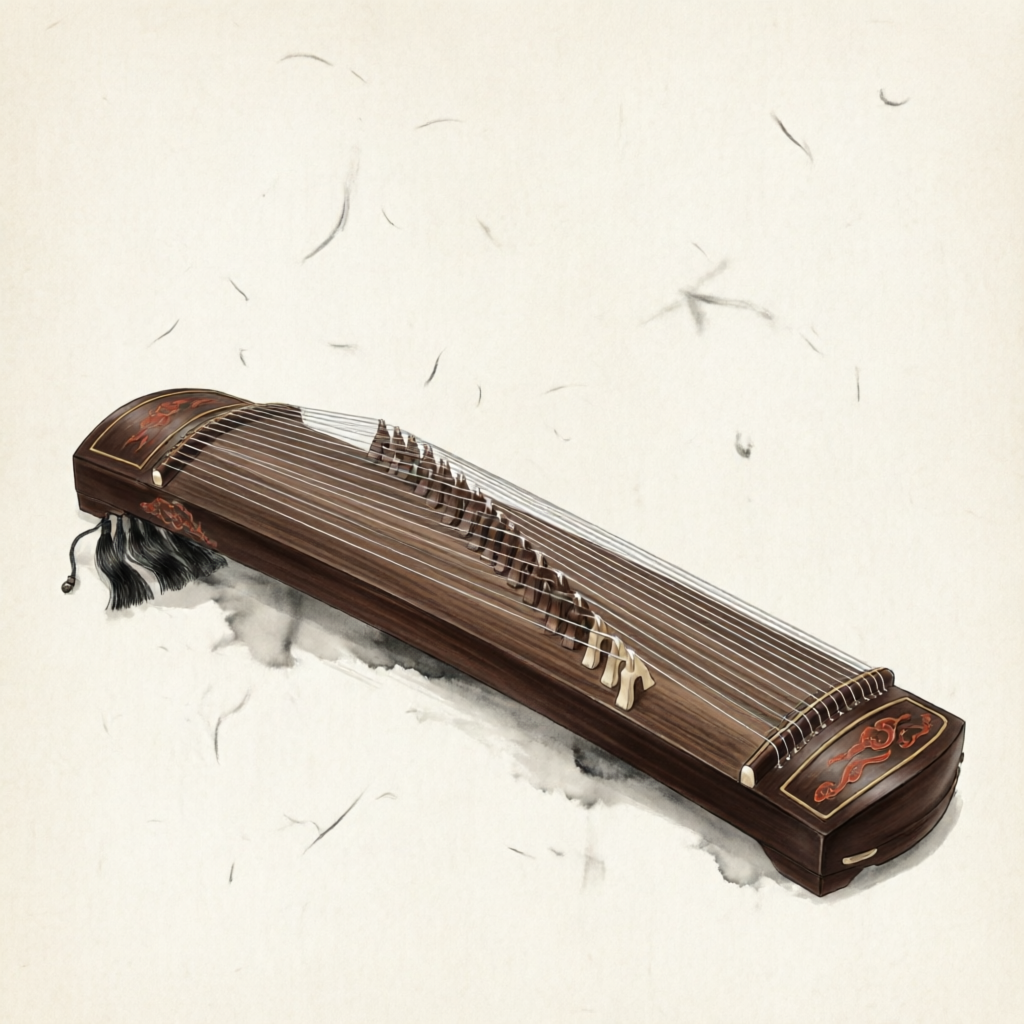
The guzheng (古筝), also known as the Chinese zither, is a traditional Chinese plucked string instrument with a history of over 2,500 years. It belongs to the zither family of instruments and is characterized by its large, resonant body and numerous strings. The guzheng has played a significant role in Chinese musical tradition and has evolved through various historical periods, regional styles, and technical innovations. Today, it remains one of China's most iconic and widely recognized musical instruments, both within China and internationally.
History
Origins
The guzheng has ancient origins dating back to the Warring States period (475-221 BCE) in the state of Qin, located in present-day Shaanxi province, which is why it was originally called the "Qin zheng" (秦筝). Despite its long history, the exact origins of the guzheng remain a subject of scholarly debate.
Several theories attempt to explain the instrument's beginnings:
-
The Broken Se Theory: According to records from the Tang dynasty's "Yin Hua Lu" (因话录) and Song dynasty's "Ji Yun" (集韵), the guzheng originated when a father and two sons fought over a 25-string se (a similar zither instrument), breaking it into two pieces. The smaller piece became the guzheng. Japanese sources from the Genroku period offer similar accounts, though with variations (sometimes involving sisters or unrelated individuals).
-
Weapon Theory: Some scholars suggest the guzheng evolved from a weapon. When strings were added to this instrument, it was discovered to produce pleasant sounds, leading to its development as a musical instrument. This theory is supported by the saying "zheng heng wei le, li di cheng bing" (筝横为乐,立地成兵), meaning "when horizontal, it becomes music; when vertical, it becomes a weapon."
-
Sound Theory: The "Zheng" name itself may derive from its sound. Liu Xi's "Shi Ming" (释名) from the Later Han dynasty states: "Shi xian gao ji, zheng zheng ran ye" (施弦高急,筝筝然也), meaning "when strings are tightened high, they produce a 'zheng zheng' sound."
-
Meng Tian Theory: Ying Shao's "Feng Su Tong" (风俗通) from the Han dynasty mentions that the guzheng might have been created by Meng Tian, a historical figure known for inventing the writing brush and improving the crossbow. This theory is repeated in Tang dynasty sources.
Archaeological discoveries have provided some physical evidence of early zither-like instruments. In the 1980s and 1990s, artifacts unearthed in Jiangxi and Jiangsu were identified by some scholars as early forms of the guzheng, though their exact classification remains debated.
Development Through the Dynasties
The guzheng has undergone significant changes throughout Chinese history:
- Pre-Han Period: Early guzhengs likely had five strings and a "zhu" body construction (similar to another ancient zither called the zhu).
- Han Dynasty: The instrument began to take on a more familiar shape, with some regional variations resembling the se. The influence of musician Jing Fang is notable, as his "five-tone zheng" (五音准) was essentially a 13-string zheng used for tuning purposes.
- Sui and Tang Dynasties: The guzheng evolved from 12 strings to 13 strings, as evidenced by Tang poetry and historical records.
- Ming and Qing Dynasties: The instrument gradually increased to 15 strings. The "Da Qing Hui Dian" (大清会典) from the Guangxu era (1875-1908) documents the "15-string Qin zheng."
- Modern Era: In the early 20th century, a 16-string version became popular. After 1949, the S-shaped 21-string nylon-wrapped steel string guzheng was developed, which has become the standard instrument today. This innovation improved resonance and expanded the instrument's technical capabilities.
Key Information
| Feature | Description |
|---|---|
| Classification | Plucked zither string instrument |
| Materials | Soundboard: Paulownia wood; Frame: White pine; Sides: Various hardwoods (rosewood, mahogany, nanmu, etc.) |
| Standard Size | 1.63 meters long |
| Number of Strings | 21 (modern standard) |
| Tuning System | Pentatonic scale by default, with movable bridges for pitch adjustment |
| Regional Variations | Multiple playing styles developed across China (Henan, Shandong, Chaozhou, Hakka, etc.) |
| Modern Innovations | S-shaped soundboard, nylon-wrapped steel strings, improved resonance |
Cultural Significance
The guzheng holds profound cultural significance in Chinese tradition. As one of China's oldest instruments, it has been associated with literary and scholarly pursuits, often featured in poetry and painting. The instrument's expressive capabilities have made it a favorite for conveying a wide range of emotions, from the subtle and delicate to the passionate and powerful.
In traditional Chinese aesthetics, the guzheng embodies the concept of "yi bu sheng" (以韵补声), or "using ornamentation to supplement the basic sound." This technique involves using the left hand to press and slide on the strings after they are plucked, creating microtonal variations and embellishments that enrich the melodic line. This approach is particularly prominent in regional styles like Shandong, Henan, and some Hakka music.
The guzheng has also played important roles in various regional performance traditions:
- Yulin Music: In Shaanxi's Yulin region, the guzheng accompanies local folk songs and instrumental ensembles.
- Opera Accompaniment: In some regional opera traditions, the guzheng provides rhythmic and melodic support.
- Court Music: Historically, the instrument was featured in imperial court ensembles.
Modern Status
In contemporary China, the guzheng has experienced remarkable revitalization and innovation. Since the mid-20th century, the instrument has undergone significant technical and artistic development:
Technical Innovations
- 1960s: Wang Changyuan's composition "Zhan Taifeng" (战台风) introduced new techniques like "sao yao si dian" (扫摇四点), "mi yao" (密摇), and "kou yao" (扣摇), expanding the instrument's technical vocabulary.
- 1970s: Zhao Qin developed the "fast finger sequence technique system" (快速指序技法体系), enabling single-hand playing of pentatonic, heptatonic, and chromatic scales without retuning.
- 1990s: Composers began experimenting with new tuning systems, incorporating elements from Japanese Ryukyu scales, Miyako scales, and even Messiaen's synthetic modes. This period saw works like "Xian Qu" (幻想曲) by Wang Jianmin and "Ming Shan" (溟山) by Wang Zhongshan.
Contemporary Performance and Education
Today, the guzheng enjoys unprecedented popularity both in China and internationally. A generation of virtuoso performers, including Wang Zhongshan, Zhai Zhirong, Qiu Ji, Yuan Sha, Jiang Zhoujian, Liu Le, Bao Dong, and Song Xinxin, have helped elevate the instrument's status through international performances, recordings, and educational activities.
Music education systems in China have established standardized curricula for guzheng instruction, from beginner to advanced levels. The instrument is now commonly taught in conservatories, specialized music schools, and even some regular schools as part of cultural education programs.
Global Spread
The guzheng has gradually gained international recognition through:
- Cultural exchange programs
- World music festivals
- Collaborations with Western musicians and composers
- Recordings and digital media
Instruments inspired by the guzheng, such as the Japanese koto and Korean gayageum, have also contributed to the instrument's global recognition.
References
-
Cao, Zheng. (1985). Guzheng Yishu (The Art of Guzheng). Beijing: People's Music Publishing House.
-
Liang, Mingzhao. (2003). Zhongguo Yinyue Shigao (A History of Chinese Music). Shanghai: Shanghai Music Publishing House.
-
Zhang, Zhigang. (2011). Guzheng Jifa yu Yanjiu (Guzheng Playing Techniques and Research). Beijing: Central Conservatory of Music Publishing House.
-
Yuan, Naichang. (2003). Guzheng de Lishi yu Fazhan (The History and Development of Guzheng). Nanjing: Jiangsu Education Publishing House.
-
Liu, Dongsheng. (2005). Zhongguo Yinyue Wenwu Dacidian (Great Dictionary of Chinese Music Cultural Relics). Zhengzhou: Henan Education Publishing House.