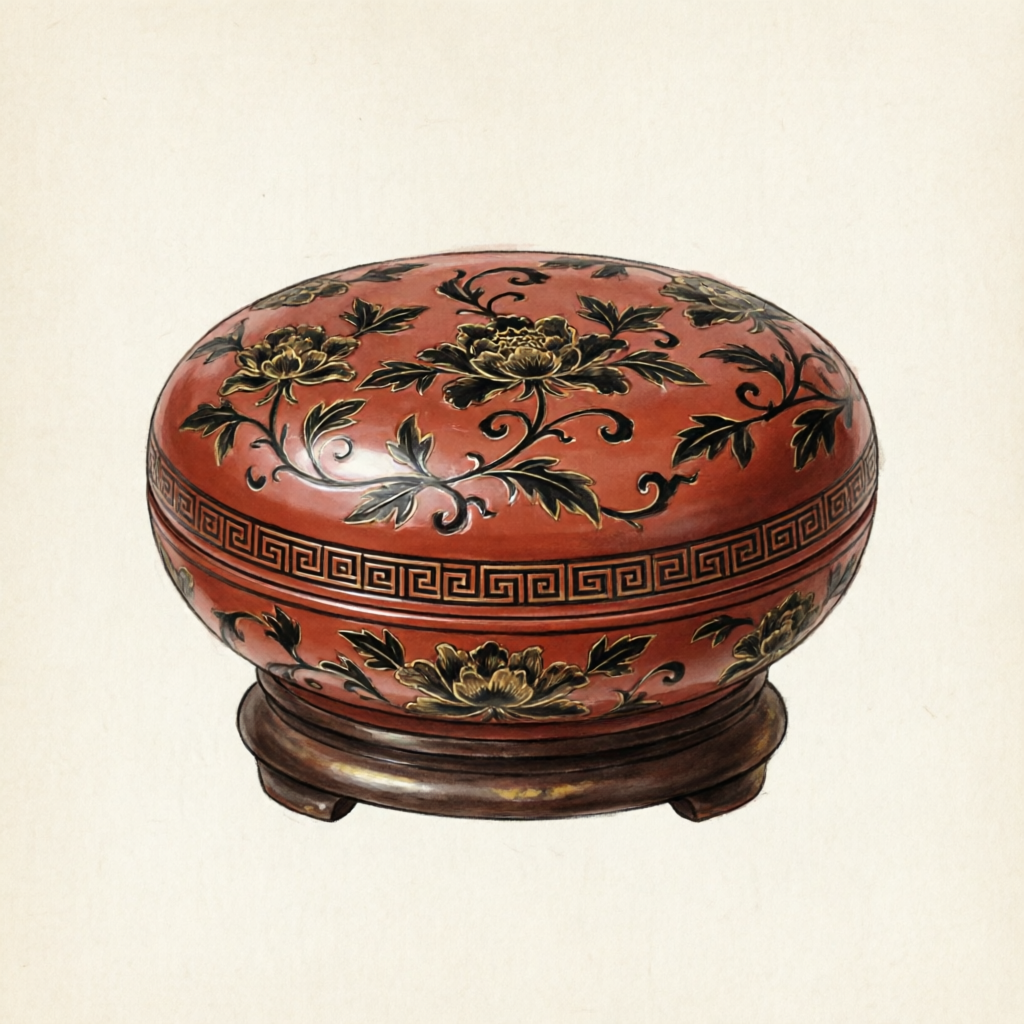
Lacquerware
Overview
Lacquerware refers to objects decorated with lacquer, a natural resin obtained from the sap of trees in the genus Toxicodendron, particularly T. vernicifluum. This ancient craft involves applying multiple layers of lacquer to various materials, primarily wood, but also bamboo, cloth, and sometimes metal or pottery. The resulting objects are renowned for their durability, water resistance, and aesthetic beauty. Lacquerware production developed independently in several East Asian cultures, with particularly sophisticated traditions in China and Japan.
History
China
The history of Chinese lacquerware dates back to the Neolithic period, with archaeological evidence showing that lacquer was used as early as 7,000 years ago. Excavations at the Hemudu culture site in Yuyao, Zhejiang province, have revealed wooden bowls coated with natural lacquer. During the Xia, Shang, and Western Zhou dynasties, artisans began to use colored lacquer and decorative techniques beyond simple coating.
The Spring and Autumn and Warring States periods (771-221 BCE) witnessed significant developments in lacquer production. By this time, specialized imperial lacquer gardens existed, and private lacquer production was subject to substantial taxation (one-fourth of the value), indicating its economic importance. Notably, the philosopher Zhuangzi is said to have served as an official in charge of a lacquer garden.
The Han Dynasty (206 BCE-220 CE) saw lacquer production reach new levels of sophistication. Large-scale workshops produced items with intricate techniques such as gold inlay, mother-of-pearl inlay, and carved designs. Archaeological finds from this period include lacquered objects with inscriptions listing the names of officials and craftsmen, suggesting organized production.
During the Tang Dynasty (618-907 CE), lacquerware flourished with the introduction of new techniques including gold and silver inlay (pingtuo), mother-of-pearl inlay (luodian), and carved lacquer (diaoqi). These techniques produced luxurious objects that reflected the dynasty's prosperity and cultural sophistication.
The Song Dynasty (960-1279 CE) is often associated with monochrome lacquerware, though excavations have revealed numerous decorated pieces from this period. Song lacquerware is characterized by its elegant proportions and restrained aesthetic, often featuring simple but refined forms.
The Yuan Dynasty (1271-1368 CE) saw the emergence of carved red lacquer (tihong) as a major art form. The technique involved building up dozens of layers of red lacquer and then carving through them to create designs. Master craftsmen like Zhang Cheng and Yang Mao became famous for their intricate carved lacquer pieces.
During the Ming (1368-1644) and Qing (1644-1912) dynasties, lacquer production reached unprecedented levels of technical complexity and artistic achievement. The Ming government established imperial workshops, and numerous famous artisans emerged. Huang Cheng's Xiangshilu (Treatise on the Preparation and Adornment of Lacquer), written in the late 16th century and annotated by Yang Ming, became the definitive technical manual for lacquer production.
In modern China, lacquerware remains an important traditional craft, with notable regional styles including Pingyao polished lacquer and Poyang bodiless lacquer.
Japan
Japanese lacquerware traditions date back to the Jomon period (c. 14,000-300 BCE), with the earliest known example being a red lacquer comb from approximately 6000 BCE. The Edo period (1603-1868) is particularly renowned for the exquisite quality of Japanese lacquerware.
Regional specialties developed throughout Japan, each with distinctive characteristics:
- Echiku lacquer: Produced in Fukui Prefecture (formerly Echiku Province), known for its refined techniques.
- Yamanaka lacquer: Originating in Kaga (now part of Ishikawa Prefecture), developed with influences from Kyoto techniques.
- Wajima lacquer: Considered the most elaborate and refined Japanese lacquer tradition, featuring unique techniques such as makie (sprinkled gold) and chinkin (gold inlay). Wajima lacquer incorporates diatomaceous earth (kiesu) that helps the lacquer adhere firmly to wooden bases.
- Shunkei lacquer: From Takayama in Gifu Prefecture, characterized by its transparent finish that reveals the natural beauty of the wood grain.
- Kamakura carving: A carved lacquer technique from Kamakura that originated during the Kamakura period (1185-1333), with technological influences from Song Dynasty China.
Key Information
| Aspect | Description |
|---|---|
| Primary Materials | Wood, bamboo, cloth, metal, pottery |
| Main Lacquer Source | Toxicodendron vernicifluum (Chinese lacquer tree) |
| Key Historical Periods | Neolithic origins, Warring States development, Tang innovation, Song refinement, Yuan carving, Ming-Qing complexity |
| Major Techniques | Carving, inlay (mother-of-pearl, gold, silver), painting, polishing, bodiless construction |
| Notable Regional Styles | Chinese: Pingyao, Poyang; Japanese: Wajima, Echiku, Yamanaka, Shunkei, Kamakura |
Cultural Significance
Lacquerware has held significant cultural and social value throughout its history. In imperial China, finely crafted lacquer objects were symbols of status and wealth, often presented as prestigious gifts. The intricate techniques and labor-intensive processes made high-quality lacquerware valuable commodities.
In Japan, lacquerware is deeply integrated into traditional culture and daily life. The meticulous craftsmanship reflects Japanese aesthetic principles of wabi-sabi (appreciating beauty in imperfection and transience) and shibui (understated elegance). Many Japanese lacquer techniques have been designated as Important Intangible Cultural Properties, recognizing their cultural significance.
Religious contexts have also been important for lacquerware development. In China, the rise of Buddhism during the Northern and Southern Dynasties (420-589 CE) led to the creation of large lacquer statues using the jiāzhú technique, where layers of lacquer and cloth were applied over a clay mold.
Modern Status
Traditional lacquerware production continues in both China and Japan, though it faces challenges from modern manufacturing techniques and changing consumer preferences. In China, government support and cultural preservation efforts have helped maintain traditional techniques. Organizations like the China National Arts and Crafts Group promote lacquerware as part of China's cultural heritage.
Japan has also made efforts to preserve its lacquer traditions. The government designates certain lacquerware techniques as "Important Intangible Cultural Properties," and master artisans (ningen kokuhō) receive recognition and support. Contemporary Japanese artists often blend traditional techniques with modern designs, creating innovative lacquerware that appeals to international markets.
Internationally, lacquerware appreciation has grown beyond its traditional markets. Museums around the world feature historical lacquer collections, and contemporary artists explore new possibilities in the medium. The technical sophistication and aesthetic appeal of lacquerware continue to inspire craftspeople and artists globally.
Conservation and Care
Proper conservation is essential for preserving lacquerware, as environmental changes can cause damage. Key care guidelines include:
- Maintaining stable humidity levels (40-60% ideal) to prevent cracking or warping
- Avoiding direct sunlight and extreme temperature fluctuations
- Handling with care to prevent impact damage to the often fragile lacquer layers
- Regular dusting with soft brushes or cloths
- Cleaning with mild methods when necessary
Special considerations apply to different types of lacquerware. Metal-bodied lacquerware is more durable but still requires protection of the lacquer surface. Wood or bamboo-bodied pieces need additional care for the substrate material.
References
-
Rawski, Evelyn S. China's Last Empire: The Great Qing. Harvard University Press, 2009.
-
Tsuji, Nobuo. Japanese Lacquerware. Kodansha International, 1986.
-
Clunas, Craig. Art in China. Oxford University Press, 1997.
-
Garner, Peter. Chinese Lacquer. Victoria & Albert Museum, 1999.
-
Takeshi, Nishimura. Japanese Decorative Arts. Kodansha International, 2005.