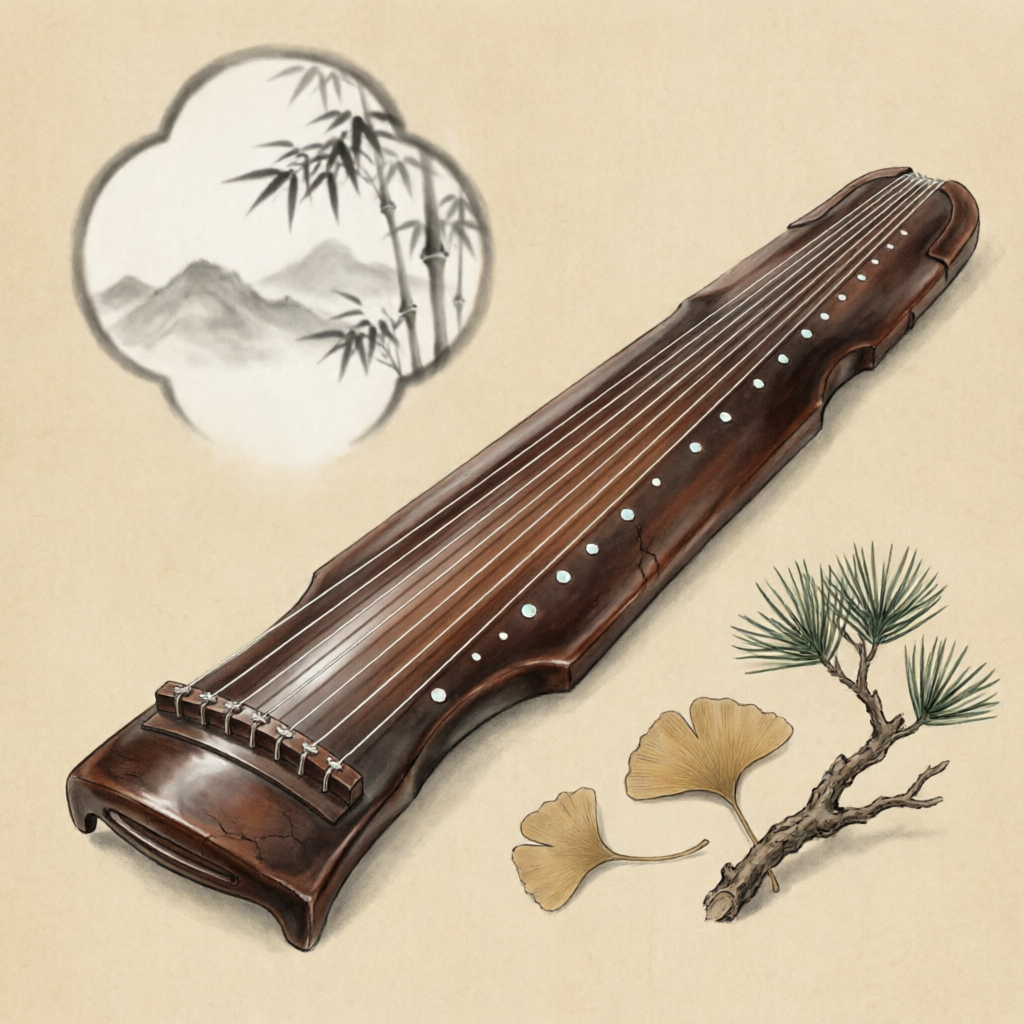
Guqin
Overview
The guqin (古琴) is a traditional Chinese musical instrument with a history spanning over 3,000 years. As one of the oldest plucked chordophones in East Asia, it holds a prestigious position in Chinese cultural heritage and was recognized by UNESCO as a Masterpiece of the Oral and Intangible Heritage of Humanity in 2003. The guqin is characterized by its distinctive shape, seven strings, and unique playing techniques that produce a range of subtle and expressive sounds. Historically associated with scholars and literati, the instrument embodies philosophical and aesthetic principles that have influenced Chinese musical traditions for centuries.
History
According to ancient texts, the creation of the qin is linked to early Chinese emperors. The Qin Cao states: "Fuxi created the qin." The Qin Dang Xu records: "Fuxi's qin had one string, seven feet and two inches long." The Book of Rites mentions: "Shun created a five-stringed qin to sing the South Wind." During the Han Dynasty, Huan Tan's New Discourses recorded: "Shennong's qin used pure silk for strings and carved paulownia wood for the body. By the time of the Five Emperors, it was changed to eight feet and six inches. Yu Shun changed it to five strings, King Wen and King Wu added strings to make seven." Historical records indicate that the earliest guqin had five strings representing the five elements (metal, wood, water, fire, earth). King Zhou Wen later added one string, and King Zhou Wu added another, resulting in the seven-stringed instrument that gave rise to the name "qinqin" (seven-stringed qin).
The earliest written references to the qin appear in classics like the Book of Songs. During the Zhou Dynasty, the guqin was used not only in court ceremonies, sacrifices, and rituals but also became popular among common people. Poems from the Book of Songs such as "Guan Ju" and "Lu Ming" contain references to the qin and se (another string instrument), indicating its widespread popularity and cultural significance by the Zhou Dynasty.
Archaeological discoveries have provided physical evidence of the guqin's ancient origins. A qin dating from the early Spring and Autumn Period of the Zeng State (circa 700 BCE), unearthed in 2016 from Guojiamiao in Zaoyang, Hubei Province, is approximately 2,700 years old, pushing back the verified history of the instrument by about 300 years.
The qin's form was established during the late Eastern Han Dynasty. A seven-stringed qin from the early Han Dynasty excavated from Tomb No. 3 at Mawangdui had a simple structure with a small sound box and little resonance. The tail was solid wood, and the soundboard had no inlaid markers (hui). From the Eastern Han to the Wei-Jin periods, the qin became extremely popular among the literati. Cai Yong's Qin Cao is the most detailed surviving work on early qin pieces, though the original text is lost and was later reconstructed. He is also said to have created the famous "Jiao Wei Qin" from scorched wood from a stove.
During the turbulent Wei-Jin period, numerous scholar-musicians emerged from the aristocracy, including the "Seven Scholars of Jian'an" and the "Seven Sages of the Bamboo Grove." The qin flourished during this time, not only as an instrument of performance but also as a medium for composition. Ji Kang created four qin pieces collectively known as the "Ji Si Si Nong" (Four Ji Pieces), though the existing versions in Ming Dynasty tablature may not be the originals. He also authored important theoretical works like Qin Fu and Sheng Wu Ai Lun.
During the Southern and Northern Dynasties, the qin continued to be appreciated by rulers and scholars. The earliest written tablature, the Jieshi Diao You Lan, attributed to the hermit Qiu Ming of the Southern Liang Dynasty, dates from this period.
The Sui and Tang Dynasties saw the rise of Yanle (court banquet music), causing the popularity of the qin to slightly decline. However, significant developments in qin making occurred, with the Lei family of Sichuan producing the famous "Jiu Xiao Huan Pei" qin, which remains a treasured artifact today. Tang qins were characterized by their fuller, rounder shape. Most surviving Tang qins have two small paulownia wood pieces inlaid on the soundboard near the Dragon Pond (longchi) and Phoenix Marsh (fengzhao) as fake soundboards, a technique that continued into the early Ming Dynasty. Tang qins developed distinctive crack patterns (duanwen) such as snake belly (shedu), ice crack (bingwen), and flowing water (liushui).
The Song Dynasty (960-1279) marked a peak in qin appreciation due to the government's policy of suppressing martial arts and promoting cultural pursuits. From Emperor Taizong onward, everyone from the emperor to common people valued the ability to play the qin. The first distinct qin school, the Zhe School, emerged in the late Southern Song Dynasty, represented by musicians like Guo Mian. The qin also began to spread to Korea and Japan during this period.
During the Song Dynasty, the qin's form evolved to approximately 128 cm in length with a shoulder width of 25 cm. Song qins were generally flatter and longer than Tang qins. The materials used for construction typically included paulownia for the soundboard and catalpa or pine/spruce for the bottom. The Zhejiang School's influence grew, and the concept of regional qin schools began to take shape.
The Yuan Dynasty served as a transitional period between Song and Ming qin-making, with relatively few surviving examples due to the dynasty's short duration.
The Ming and Qing Dynasties saw the flourishing of various qin schools and the extensive publication of qin tablatures. The first surviving collection of减字谱 (jianzipu or abbreviated notation), the Shen Mi Mi Pu (Secret and Wondrous Tablature), preserved numerous ancient pieces. However, qin art experienced relative decline during the late Qing Dynasty.
In the early 20th century, the qin faced challenges as traditional literati culture waned. By the 1950s, only about 100 qin players remained in China. The establishment of the Yu Qin She in Suzhou and Shanghai in the 1920s and the publication of the Yu Qin journal were significant events for qin preservation. From the 1950s to 1960s, Zha Fuxi led survey teams to document qin players, collect textual and audio materials, and publish important works like Cun Jian Gu Qin Qu Pu Ji Lan and Qu Ji Cheng, laying the foundation for the qin's revival.
Key Information
| Feature | Description |
|---|---|
| Name | 古琴 (Guqin), also known as 瑶琴 (Yaogin) |
| Type | Seven-stringed plucked zither |
| Materials | Soundboard: paulownia or cedar; Bottom: catalpa or other hardwood |
| Length | Approximately 120-125 cm (Tang), 128 cm (Song) |
| Strings | Traditionally silk, now often steel |
| Markers | 13 inlaid markers (hui) indicating harmonic nodes |
| Origin | China, dating back to at least 700 BCE |
| UNESCO Recognition | 2003 as Masterpiece of the Oral and Intangible Heritage of Humanity |
| National Recognition | 2006 as National Intangible Cultural Heritage (No. II-34) |
Cultural Significance
The guqin holds the most esteemed position among traditional Chinese musical instruments, with the saying "shi gu bu che qin se" (a scholar never parts with his qin and se) reflecting its importance in literati culture. It ranks first among the Four Arts (琴棋书画 - qin qi shu hua), which also include Go calligraphy and painting. The qin has been considered a symbol of refined taste and an essential skill for educated Chinese throughout history.
The famous story of Boya and Zhong Ziqi, who recognized each other through the qin piece "High Mountains and Flowing Water" (Gaoshan Liushui), remains a powerful symbol of true friendship and spiritual resonance in Chinese culture. This tale has given rise to the idiom "zhiyin" (知音), meaning "to know one's music," which has come to mean finding a soulmate or someone who truly understands you.
The guqin embodies philosophical concepts and cosmological symbolism. Its length of three feet six and five inches symbolizes the 365 days of a year. The round top and flat bottom represent heaven and earth, respectively. The seven strings correspond to the five elements (metal, wood, water, fire, earth) plus the two added strings by Kings Wen and Wu. The thirteen markers (hui) symbolize the twelve months and the intercalary month.
Modern Status
After a period of decline in the early 20th century, the guqin has experienced significant revival in recent decades. In 2003, UNESCO recognized guqin art as a Masterpiece of the Oral and Intangible Heritage of Humanity, and in 2006, it was included in China's first National Intangible Cultural Heritage list. Educational institutions such as Southeast University have been designated as bases for preserving and promoting this traditional art form.
Contemporary qin players and scholars have made efforts to document and preserve traditional pieces while also creating new compositions. Research institutions and museums house valuable historical qins and related materials, ensuring this cultural treasure is preserved for future generations.
The guqin has also gained international recognition, with players and societies established in countries including Malaysia, Singapore, the United States, Canada, Germany, the United Kingdom, the Netherlands, and Sweden. This global spread reflects the instrument's universal appeal and the increasing interest in traditional Chinese cultural expressions worldwide.
References
-
Ku, Chie-chang. The Guqin: Ancient Chinese Zither. Yale University Press, 2013.
-
Liang, Ming-yue. The Chinese Pipin and Its Music, 1900-1930. Asian Music Publications, 1985.
-
Gulik, Robert van. The Lore of the Chinese Lute: An Essay in the Ideology of the Ch'in. Sophia University, Tokyo, 1969.
-
Law, P.Y. and Wei, T. "The Guqin: China's Ancient Art of Zither Playing." Asian Music 36, no. 2 (2005): 1-38.