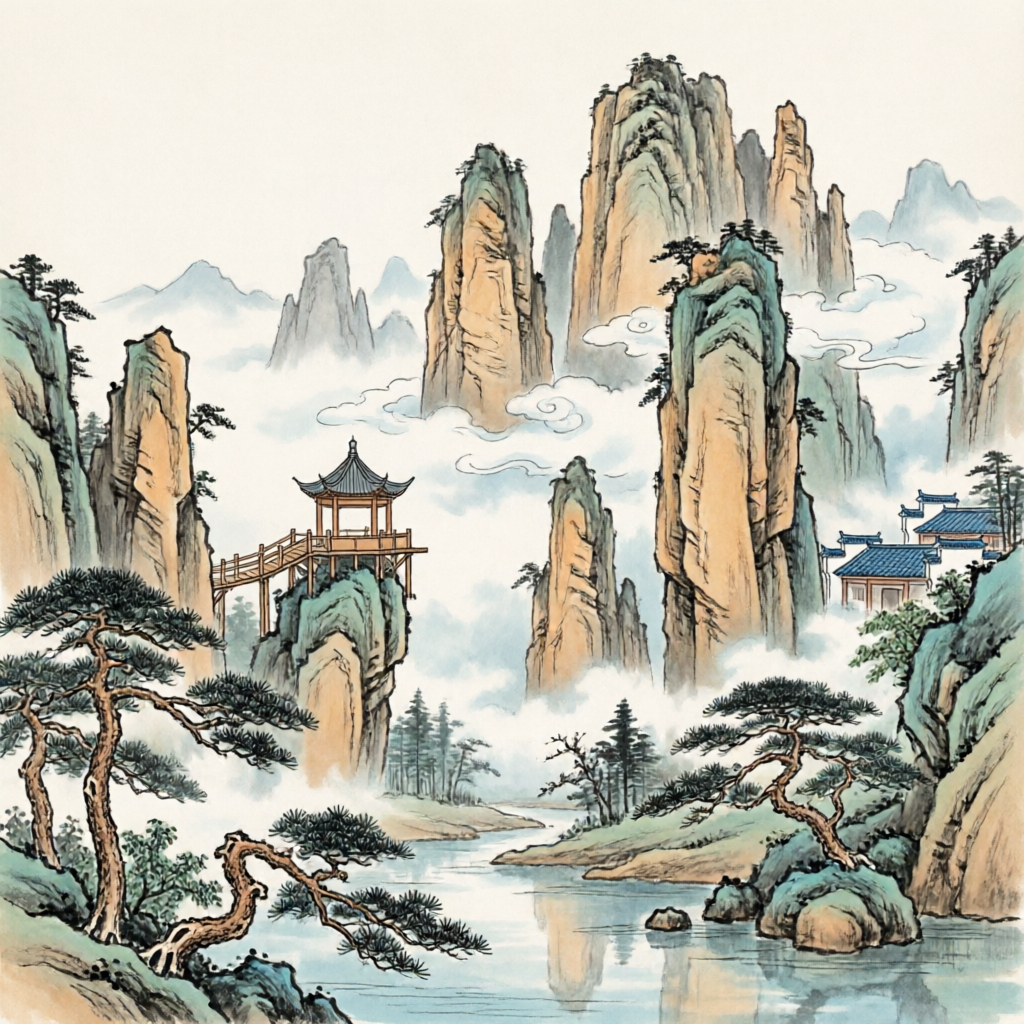
Overview
Zhangjiajie City, formerly known as Dayong, is a prefecture-level city located in the northwestern part of Hunan Province, China. The city is internationally famous for its stunning natural landscapes, particularly the unique quartz sandstone peak forest formations that inspired the floating mountains in the movie "Avatar." Zhangjiajie National Forest Park, China's first national forest park, is located within the city's jurisdiction and has been designated as a UNESCO World Heritage Site as part of the Wulingyuan Scenic and Historic Interest Area. The city covers an area of 9,533 square kilometers and has a population of approximately 1.49 million people (2024 data), with a significant ethnic minority population, primarily consisting of Tujia, Bai, and Miao peoples.
History
The history of human settlement in the Zhangjiajie area dates back to the Neolithic period, with evidence of human activity along the banks of the Lishui River. According to ancient Chinese classics, including the Shangshu·Shundian, there are records of "Shun exiling Huan Dou to Chong Mountain" during the legendary era.
During the Qin Dynasty (221 BCE), the area was part of Qianzhong Commandery, making it one of the earliest administrative regions in what is now Hunan Province, predating the provincial capital Changsha. The region's administrative boundaries have changed numerous times throughout Chinese history:
- Western Han Dynasty (202 BCE): Qianzhong Commandery was divided into Wuling Commandery.
- Three Kingdoms Period (263 CE): During the reign of Sun Liu of Eastern Wu, Mount Songliang was renamed Mount Tianmen (Heavenly Gate Mountain), and Wuling Commandery was renamed Tianmen Commandery.
- Tang Dynasty (621 CE): The area was organized into Lizhou and Liyang Commandery under Shannan Circuit.
- Ming Dynasty (1369): Cili Prefecture was reduced to Dayong County.
- Qing Dynasty (1730): Sangzhi and Maogang Tusi were incorporated into the regular administrative system, and Li Zhou was elevated to a directly administered prefecture.
- Modern Era: After the founding of the People's Republic of China in 1949, the area was successively organized as Dayong County and then Dayong City. On April 4, 1994, the State Council approved the renaming of Dayong City to Zhangjiajie City, named after the famous Zhangjiajie National Forest Park.
Key Information
| Category | Details |
|---|---|
| Chinese Name | 张家界市 (Zhangjiajie Shi) |
| Administrative Status | Prefecture-level city |
| Location | Northwestern Hunan Province, China |
| Area | 9,533 km² |
| Population | 1.487 million (2024) |
| Climate | Mid-subtropical mountain monsoon climate (humid) |
| Average Temperature | 16°C |
| Annual Precipitation | 1,400 mm |
| Administrative Divisions | 2 districts (Yongding, Wulingyuan), 2 counties (Cili, Sangzhi) |
| Government Seat | No. 2 Nanzhuang Road, Nanzhuangping Sub-district, Yongding District |
| Famous Attractions | Zhangjiajie National Forest Park, Tianmen Mountain, Baofeng Lake |
| Airport | Zhangjiajie Hehua International Airport |
| Railway Stations | Zhangjiajie Railway Station, Zhangjiajie West Railway Station |
Cultural Significance
Zhangjiajie is home to 33 ethnic minority groups, with Tujia, Bai, and Miao being the predominant populations. The city's cultural landscape is rich with traditional customs, festivals, and arts unique to these ethnic groups. The Tujia people's hand-waving dance (摆手舞), Baishou dance (摆手舞), and traditional architectural forms like the diaojiaolou (吊脚楼, stilted wooden houses) are significant cultural elements.
The region's unique natural landscapes have also inspired numerous works of art and literature. The quartz sandstone peak forests, with their towering pillars and deep valleys, have become symbols of Chinese natural beauty and have been featured prominently in films, television shows, and photography exhibitions worldwide.
Modern Status
Today, Zhangjiajie is primarily known as a tourist destination, with tourism accounting for approximately 72.8% of its GDP in 2024. The city has developed comprehensive tourism infrastructure, including hotels, transportation networks, and visitor facilities to accommodate millions of domestic and international tourists annually.
Economically, beyond tourism, Zhangjiajie has developed industries in agriculture, forestry, and light manufacturing. The city's agricultural products include rice, corn, tea, and various fruits. Mineral resources include coal, iron, nickel, molybdenum, limestone, and quartz sand, which forms the distinctive geological features of the region.
The city continues to balance economic development with environmental conservation, implementing policies to protect its unique ecosystems while promoting sustainable tourism practices. Zhangjiajie's international profile has grown significantly, particularly since the release of James Cameron's "Avatar," which prominently featured landscapes similar to those found in the Zhangjiajie National Forest Park.
References
-
Chen, A. (2018). Geological Formations and Tourism Development in Zhangjiajie, China. Journal of Asian Earth Sciences, 165, 243-252.
-
Li, H., & Wang, J. (2020). Ethnic Minorities and Cultural Preservation in Western Hunan. Ethnic Studies Review, 43(2), 78-95.
-
Zhang, L., & Liu, M. (2022). Sustainable Tourism Development in China's National Parks: The Case of Zhangjiajie. Tourism Management Perspectives, 41, 100876.
-
State Council of the People's Republic of China. (1994). Approval on Renaming Dayong City to Zhangjiajie City. Official Document No. 41.
-
Hunan Provincial Bureau of Statistics. (2025). Hunan Statistical Yearbook 2024. Changsha: Hunan Press.