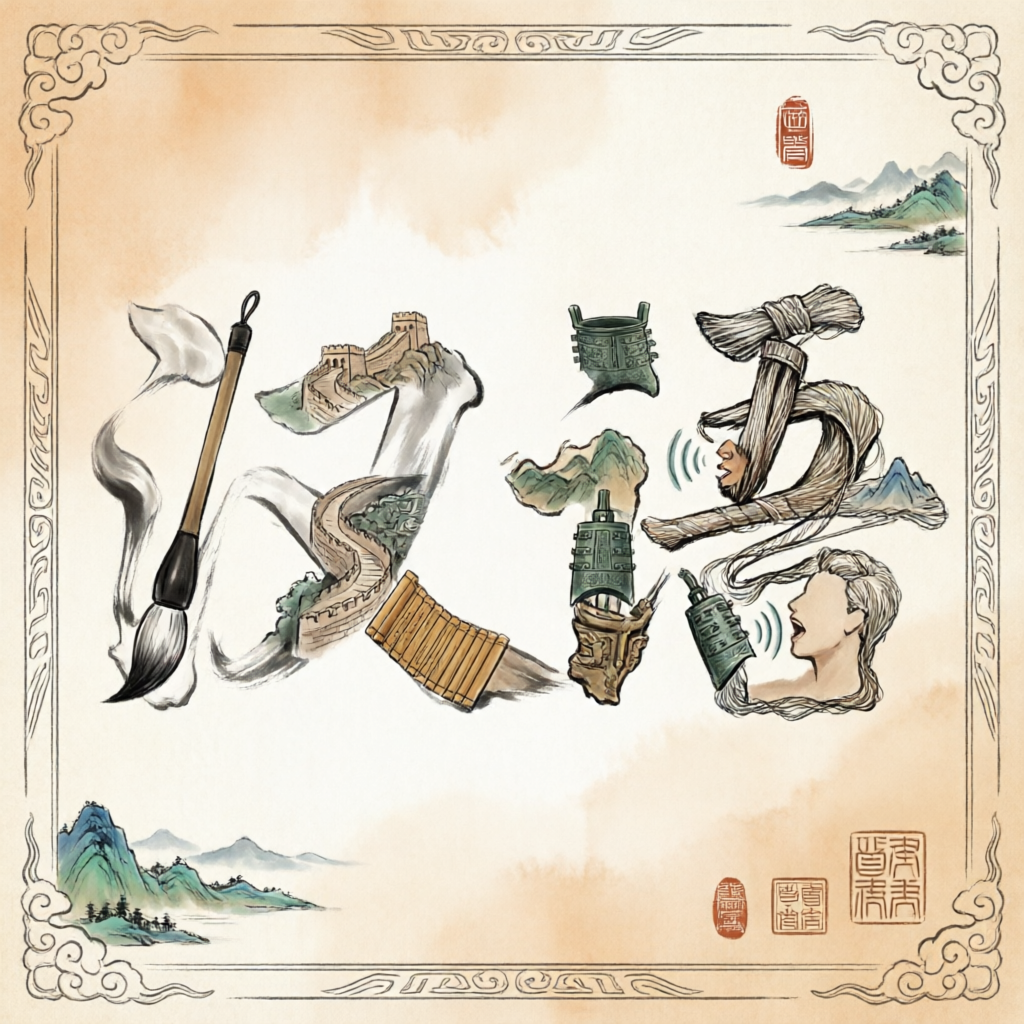
Overview
Standard Chinese, commonly known as Putonghua (普通话), is the official language of the People's Republic of China and one of Singapore's four official languages. It serves as a lingua franca for the country's diverse linguistic landscape, with approximately 1.14 billion speakers globally as of 2025, making it the second most spoken language worldwide. The name "Putonghua" translates to "common speech" and was officially adopted in 1955, though its origins trace back centuries in Chinese linguistic history.
History
The development of Standard Chinese reflects China's complex linguistic evolution over millennia:
Early Foundations
The concept of a standardized "elegant speech" (雅言) dates back to the Shang Dynasty (1600-1046 BCE). During the Zhou Dynasty (1046-256 BCE), the language of Luoyang (modern-day Henan province) became the basis for this elegant speech, which Confucius used for teaching his disciples. The Analects notes: "The Master's way of speaking was the elegant speech of the Shijing and Shujing, and the prescribed rites."
Imperial Era Standardizations
During the Sui Dynasty (581-618 CE), Emperor Yang Jian ordered the compilation of the Qieyun, establishing a standardized pronunciation based on the elegant speech of Jinling (Nanjing) and Luoyang. This formed the basis of "Guanyin" (official sound) in the Tang Dynasty (618-907 CE), which was required for officials and imperial examinations.
The Yuan Dynasty (1271-1368 CE) established Dadu (modern Beijing) as the capital, with its dialect becoming the basis for the "Tianxia Tongyu" (universal language). The Zhongyuan Yinyun by Zhou Deqing documented this dialect, which already resembled modern Beijing speech.
Republican Era Developments
The early Republic of China (1912-1949) initially established a hybrid standard combining Beijing and Nanjing dialects, known as "Lao Guoyin" (Old National Pronunciation). However, by 1932, the "New Guoyin" (New National Pronunciation) fully adopted Beijing pronunciation as the standard.
Modern Standardization
After the founding of the People's Republic of China in 1949, the government formally standardized the language. In 1955, at the "National Language Reform Conference" and "Academic Conference on Modern Chinese Language Standardization," the name "Putonghua" was officially adopted, defined as "using Beijing phonology as its standard pronunciation, the Northern dialects as its basis, and exemplary modern vernacular Chinese literature as its grammatical model."
Key Information
| Aspect | Description |
|---|---|
| Official Name | Putonghua (普通话) / Standard Chinese |
| Standard Pronunciation | Beijing dialect phonology |
| Basis Dialect | Northern Chinese dialects |
| Grammar Model | Exemplary modern vernacular Chinese literature |
| Writing System | Standard Chinese characters (simplified mainland China, traditional Taiwan/Hong Kong) |
| Status | Official language of China; one of Singapore's official languages |
| Number of Speakers | 1.14 billion globally (2025) |
| Legal Foundation | National Language Law of the People's Republic of China (2001) |
Cultural Significance
Standard Chinese plays a crucial role in Chinese society as a unifying linguistic force across diverse regional dialects and ethnic groups. Before standardization, China's linguistic landscape was highly fragmented, with numerous mutually unintelligible dialects creating communication barriers. The promotion of Putonghua has facilitated national integration, particularly in education, media, and administration.
The language's development reflects China's sociopolitical changes. For instance, the shift from Nanjing-based to Beijing-based pronunciation in the early 20th century paralleled political power transitions. Similarly, the name change from "Guoyu" (National Language) to "Putonghua" (Common Speech) after 1949 symbolized the new government's emphasis on linguistic accessibility for all citizens rather than maintaining elite linguistic traditions.
Modern Status
Today, Standard Chinese is the dominant language in mainland China, used in education, government, media, and formal communication. The government continues to promote its use through various initiatives, including the National Language Law, which mandates its use in official contexts, education, and public services.
In Singapore, Putonghua was promoted through the "Speak Mandarin Campaign" launched in 1979 by Prime Minister Lee Kuan Yew, which successfully reduced the use of Chinese dialects in favor of Standard Mandarin. This policy aimed to facilitate communication among different Chinese dialect groups and strengthen Singapore's connection with China.
Despite its official status, Standard Chinese exists alongside numerous regional dialects and minority languages, creating a complex linguistic ecology. In recent years, there has been growing appreciation for linguistic diversity, with some communities working to preserve local dialects alongside the national standard.
References
-
Ramsey, S. R. (1987). The Languages of China. Princeton University Press.
-
Chen, P. (2006). Modern Chinese: History and Sociolinguistics. Cambridge University Press.
-
Llamas, C., & Watt, D. (Eds.). (2010). Language and Linguistic Diversity in Urban Spaces. Continuum International Publishing Group.
-
Norman, J. (1988). Chinese. Cambridge University Press.
-
Spence, J. D. (2012). The Search for Modern China. W. W. Norton & Company.