Overview
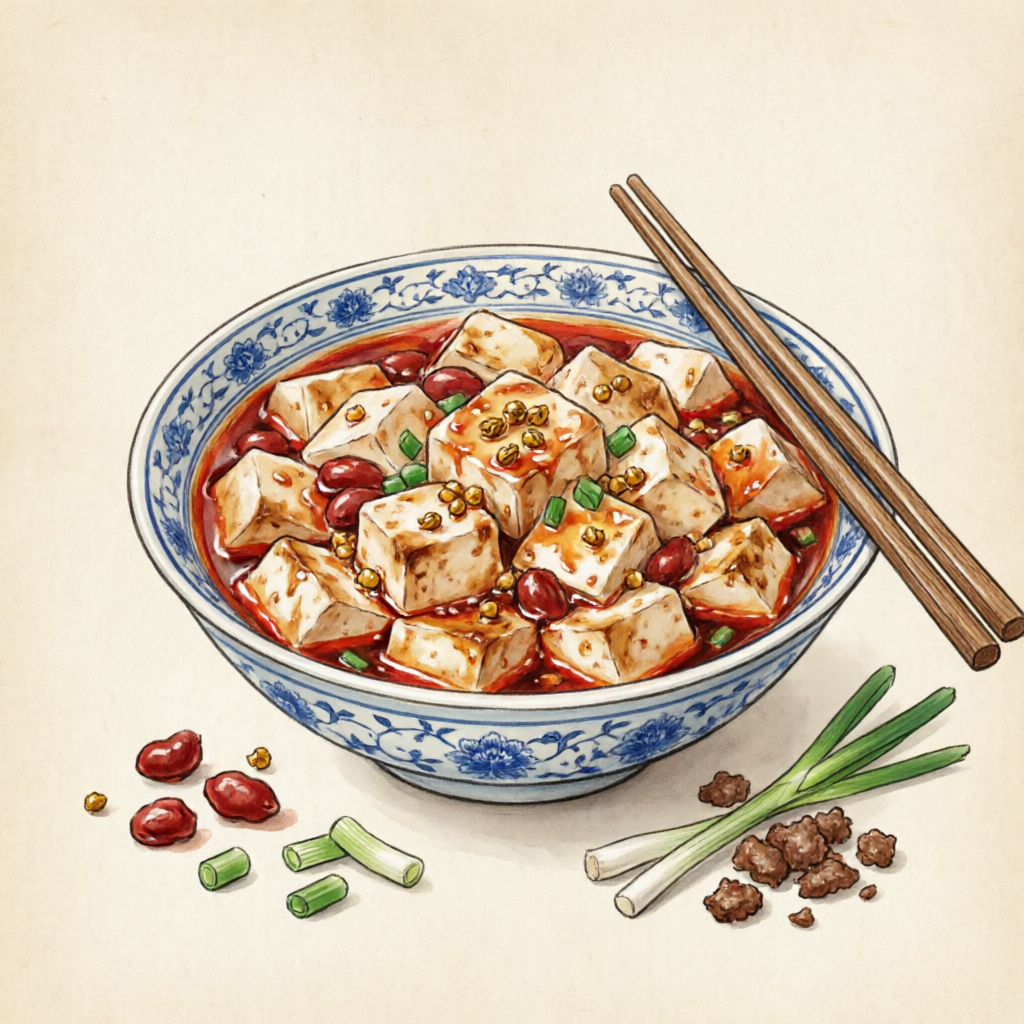
Mapo Tofu (麻婆豆腐) is a renowned traditional Chinese dish originating from Sichuan cuisine. It is celebrated for its distinctive combination of spicy, numbing, and aromatic flavors, featuring soft tofu cubes cooked in a chili-and-bean-based sauce with minced meat. The dish exemplifies the characteristic "málà" (麻辣) flavor profile of Sichuan cooking, which balances the numbing sensation of Sichuan peppercorns with the fiery heat of chili peppers.
History
Mapo Tofu was created in 1862 at a small restaurant called "Chen Xingxing Eatery" located near Wanfu Bridge in Chengdu. The restaurant was originally owned by Chen Chunfu, but after his early death, his wife took over the business. Due to a pockmarked complexion, she became known as "Chen Mapo" (literally "Pockmarked Chen").
The restaurant primarily served porters and laborers who frequented the area. According to historical accounts, one evening when ingredients were running low, Chen Mapo prepared a dish using remaining tofu, beef mince, broad bean chili paste (doubanjiang), and fermented black beans (douchi). The resulting dish was so well-received by the customers that it became the establishment's signature offering.
Historical texts such as "Jincheng Zhuzhici" (Bamboo Branch Songs of Chengdu) and "Chengdu Tonglan" (Comprehensive Guide to Chengdu) document the origins and popularity of Mapo Tofu during the late Qing Dynasty. The "Jincheng Zhuzhici" contains a poem praising the dish: "Mapo Chen's name still spreads, Tofu baked to finest taste, By Wanfu Bridge curtain stirs, Together spring wine makes guests merry."
Key Information
| Characteristic | Description |
|---|---|
| Origin | Chengdu, Sichuan Province, China (1862) |
| Flavor Profile | Spicy (辣), numbing (麻), fresh (鲜), tender (嫩) |
| Main Ingredients | Tofu, minced meat (traditionally beef), doubanjiang (broad bean chili paste), douchi (fermented black beans) |
| Key Seasonings | Sichuan peppercorns, chili peppers, garlic, ginger, scallions, soy sauce |
| Cooking Method | Stir-frying and braising |
| Serving Temperature | Traditionally served very hot (烫) |
Cultural Significance
Mapo Tofu represents the essence of Sichuan cuisine and has become a cultural ambassador for Chinese culinary arts. The dish exemplifies the "one dish, one style; hundred dishes, hundred tastes" philosophy of Sichuan cooking.
Interestingly, the dish gained wider popularity through its association with the Whampoa Military Academy's Chengdu branch. Military cadets from the academy, which had opened a special gate called "Cunzheng Gate" in the city wall between the north and west gates, became regular customers at Chen Mapo's restaurant. These cadets helped spread the dish's fame throughout Chengdu and later abroad.
The name "Mapo" itself has become iconic in Chinese culinary culture, symbolizing the dish's authentic Sichuan origins and distinctive flavor profile.
Modern Status
Today, Mapo Tofu has evolved beyond its original form with numerous regional variations. While the traditional version features beef mince, many modern adaptations use pork instead. Additionally, the intensity of spice and numbing sensation can be adjusted to suit different preferences.
Internationally, Mapo Tofu has been adapted to local tastes while maintaining its core characteristics. In Japan, a sweeter version with reduced spice became popular. American variations sometimes incorporate tomato sauce, while Italian chefs have created "Mapo Tofu Pasta," and Mexican versions might serve it in tacos. Despite these adaptations, the dish remains recognizable by its essential flavor elements.
The original Chen Mapo Tofu restaurant has been recognized as a "National Time-Honored Brand" and its preparation technique was listed as a provincial-level intangible cultural heritage in 2011. The dish has also received numerous accolades, including the "Golden Tripod Award" in 1989 and recognition as one of the "Top 10 Classic Sichuan Dishes" at the 2018 World Sichuan Cuisine Conference.
References
- Dunlop, F. (2003). Land of Plenty: A Treasury of Authentic Sichuan Cooking. W.W. Norton & Company.
- Sen, T. (2018). Feast and Famine: A History of Food in China. Reaktion Books.
- Zhang, Y. (2015). The Food of Sichuan: Authentic Recipes from the Land of Abundance. Houghton Mifflin Harcourt.