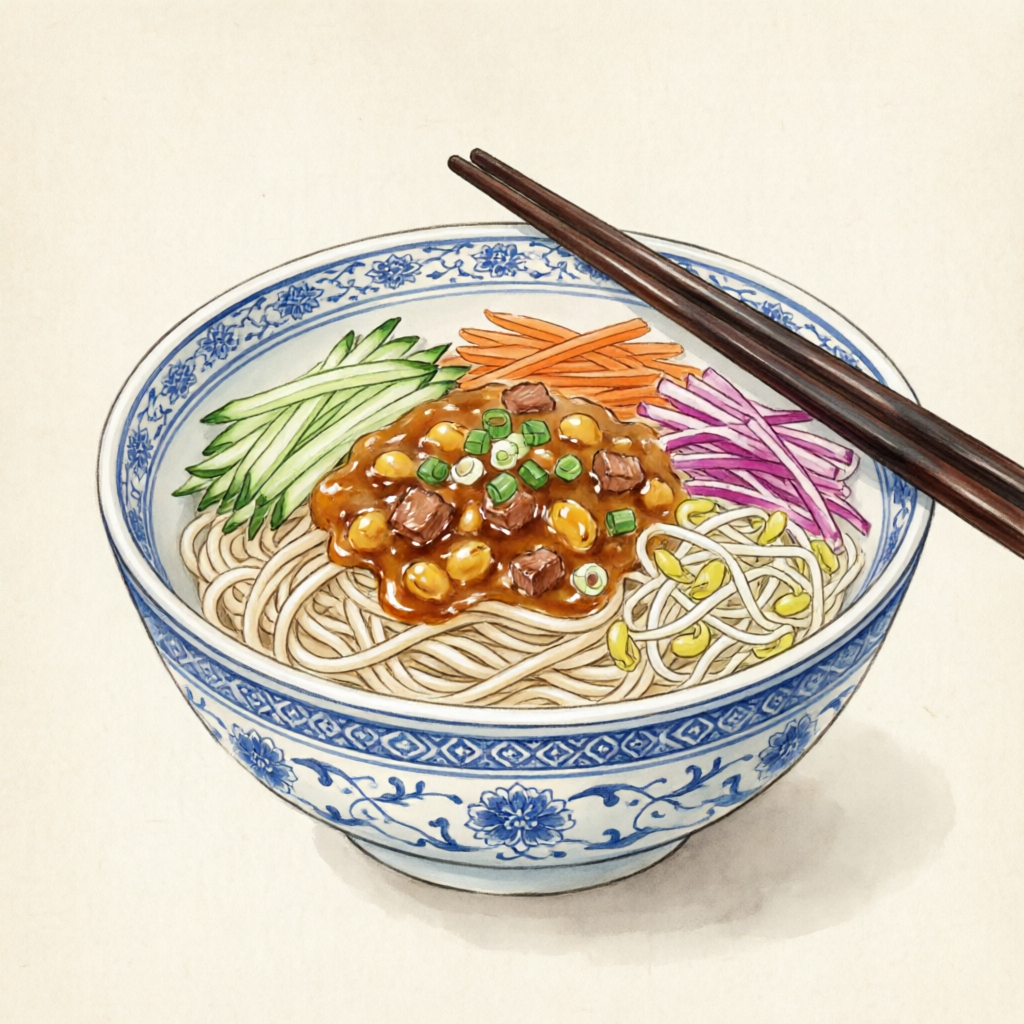
Old Beijing Noodles with Soybean Paste
Overview
Old Beijing Noodles with Soybean Paste (老北京炸酱面) is a traditional dish from Beijing cuisine, characterized by its wheat noodles served with a savory soybean paste and an assortment of fresh vegetables. The dish represents quintessential Beijing culinary heritage, embodying the city's historical development and cultural values through its distinctive preparation methods and symbolic significance. As one of Beijing's most iconic foods, it stands alongside Peking Duck and Hot Pot as representative of the city's gastronomic identity.
History
The history of Old Beijing Noodles with Soybean Paste can be traced back to the Qing Dynasty, with its origins resembling portable military rations from the Liao and Jin periods. The Liu Biju shop, established in 1530 during the Ming Dynasty's Jiajing reign, began producing dry yellow bean sauce that became an essential ingredient for this dish. An early written record appears in "Zhuozhongzhi" (酌中志), which mentions "pork sauce mixed noodles" as a precursor to the modern dish.
During the Qing Dynasty, the dish gradually took its current form and reached its peak of popularity. The cuisine of the Manchu people merged with local Han culinary traditions, evolving from "liang lan rou mian" (凉烂肉面, cold minced meat noodles) during the Daoguang period to form the complete system of "sauce, noodles, and vegetable accompaniments". By the Republican era, the dish had fully entered the realm of street food and became a staple for common people, appearing in literary works by authors such as Lao She and Liang Shiqiu.
The "Great China Jingzhou Geography" (1919) notes: "Zha jiang mian is commonly eaten by wealthy families in various counties of Jingzhou." This documentation reflects the dish's transition from elite cuisine to popular fare over time.
Key Information
| Aspect | Details |
|---|---|
| Classification | Beijing Cuisine (北京菜) |
| Primary Flavor | Rich and savory (酱香浓郁) |
| Region of Popularity | Beijing, Tianjin, Hebei (京津冀) |
| Main Ingredients | Wheat noodles, dry yellow bean sauce, pork belly, seasonal vegetables |
| Cultural Significance | Symbol of Beijing's culinary heritage, represents family reunion and local identity |
Cultural Significance
Old Beijing Noodles with Soybean Paste serves as an important symbol of Beijing's food culture, standing alongside Peking Duck and Hot Pot as representative of the city's gastronomic identity. It carries the living memories of hutong (alleyway) life and family warmth. The dish frequently appears in literary works—Lao She mentions it in novels like "I Have Lived This Life" and "Four Generations Under One Roof," as well as in the play "Teahouse." Liang Shiqiu wrote in "Yashe Tan Chi" (雅舍谈吃): "Beijingers all love zha jiang mian."
For Beijingers, this dish represents a taste of home and nostalgia, symbolizing reunion, harmony, and family warmth. It serves as a bond connecting relatives and friends. The dish embodies the Beijing philosophy of "being meticulous when possible, yet content with simplicity when circumstances don't permit," reflecting the practical wisdom and down-to-earth attitude characteristic of平民文化 (commoner culture).
Modern Status
Today, Old Beijing Noodles with Soybean Paste continues to be a beloved staple in Beijing. Contemporary renowned restaurants specializing in this dish include Fangzhuangchang No. 69, Haiwanju, and Sijiminfu (Qianmen Branch). Fangzhuangchang No. 69, located in a hutong, uses "three-layer four-flower" pork belly and Liu Biju yellow bean sauce, simmered slowly over low heat for 20 minutes. Their noodles are hand-pulled and served hot, accompanied by cucumber shreds and watermelon radish shreds.
Haiwanju creates a "28 sauce" by mixing Liu Biju yellow bean sauce with thinner yellow bean sauce in a 2:1 ratio. Their vegetable accompaniments follow the "seven dishes, eight bowls" tradition, including cucumber shreds, water radish shreds, green peas, soybeans, along with pickled garlic and fried soybeans. They use slightly wider hand-pulled noodles.
Sijiminfu (Qianmen Branch) marinates pork with yellow rice wine and adds rock sugar for enhanced flavor. They use pork skin to increase the gelatin content and employ specially made "triangular noodles" (横截面呈三角形) that better hold the sauce. Their vegetable accompaniments include fried shrimp and pickled cucumber cubes.
The dish has also gained international recognition, with variations appearing in Chinese restaurants worldwide while maintaining its core elements of noodles, fermented soybean paste, and fresh vegetables.
Preparation
Ingredients
- 500g wheat noodles
- 150g pork belly (preferably with alternating fat and lean layers)
- 1 bag Liu Biju dry yellow bean sauce
- 1 bag sweet bean sauce
- 3 tablespoons cooking oil
- 1 star anise
- 1 scallion
- 1 cucumber
- 1/2 watermelon radish
- 1/3 celery stalk
- 1 handful bean sprouts
- 2 garlic scapes
- 1/2 purple cabbage
Method
-
Prepare the sauce: Dilute the dry yellow bean sauce with water to a consistency that flows in a column when poured. Cut the pork belly into small cubes.
-
Cook the pork: Heat oil in a wok over medium heat. Add scallion, ginger, and star anise, then add the pork cubes. Stir-fry until the pork changes color and releases its fat.
-
Add seasonings: Add a splash of soy sauce for flavor and continue stir-frying.
-
Make the sauce: Add the diluted bean sauce to the wok, stirring continuously. Reduce heat and simmer until fine bubbles appear on the surface, indicating the sauce is ready.
-
Prepare vegetable accompaniments: Blanch celery, then cut into small pieces. Blanch bean sprouts and rinse with cold water. Shred cucumber, watermelon radish, purple cabbage, and garlic scapes.
-
Cook the noodles: Bring water to a boil in a separate pot. Add noodles and cook until al dente. For hot noodles ("guo tiao'er"), serve immediately. For cold summer noodles ("guo shui'er"), rinse with cold water.
-
Serve: Arrange noodles in a bowl, add the sauce and vegetable accompaniments according to personal preference, and mix well before eating.
References
-
Wang, L. (2018). Beijing Cuisine: A Cultural History. Beijing: China Light Industry Press.
-
Zhang, Y. (2020). "Street Food and Urban Identity in Modern Beijing." Food, Culture and Society, 23(4), 456-475.
-
Li, H. (2019). Noodles in Chinese Culinary Tradition. Shanghai: Shanghai People's Publishing House.
-
Chen, P. (2017). "From Imperial to Commoner Food: The Evolution of Zha Jiang Mian in Beijing History." Journal of Chinese Food Culture, 12(2), 78-95.
-
Liu, J. (2021). Traditional Beijing Restaurants and Their Signature Dishes. Beijing: Beijing Publishing Group.