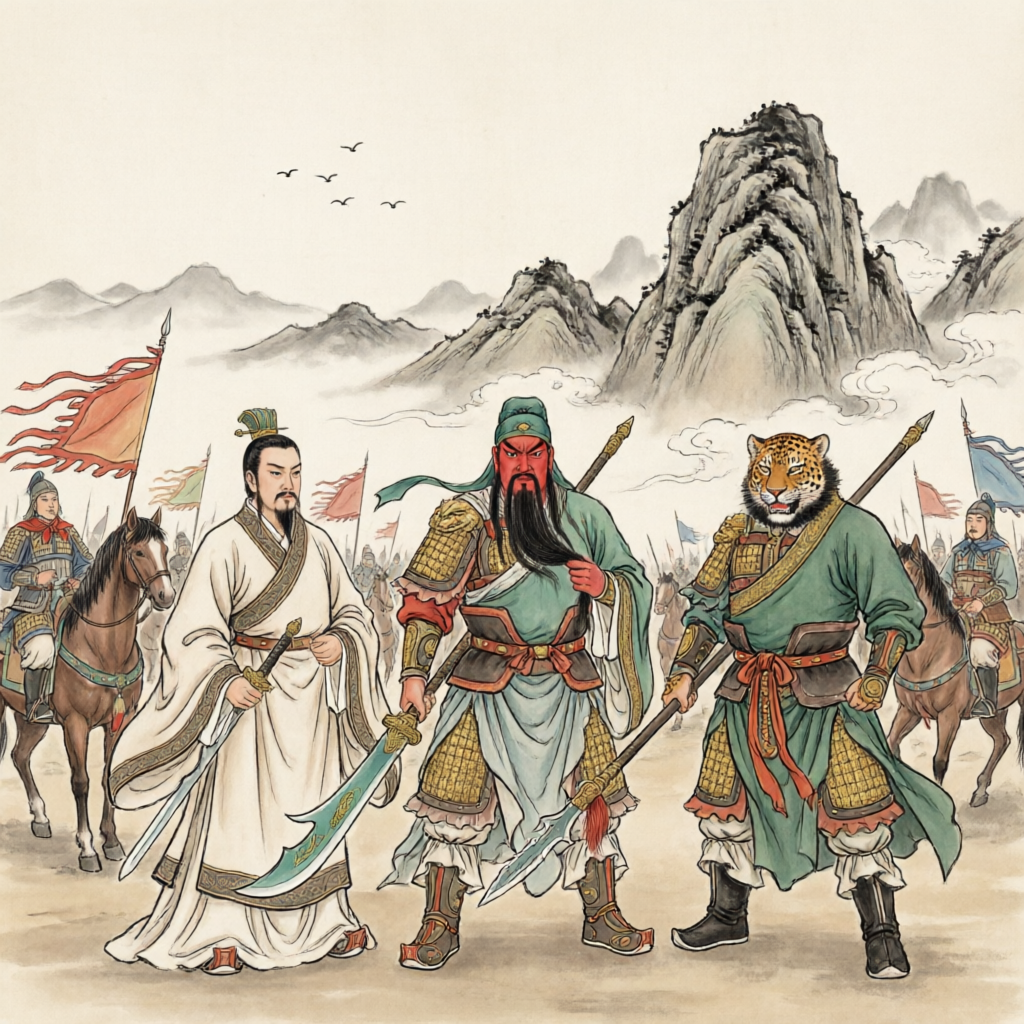
Romance of the Three Kingdoms
Overview
Romance of the Three Kingdoms (三国演义) is a classic Chinese historical novel considered one of the Four Great Classical Novels of Chinese literature. Written in the 14th century during the Ming Dynasty, it spans nearly a century of Chinese history from the late Eastern Han dynasty to the end of the Three Kingdoms period. The novel combines historical accounts with popular legends and folk tales to create a rich tapestry of political intrigue, military strategy, and personal loyalty that has profoundly influenced Chinese culture for centuries.
History
Historical Background
The earliest source for the Three Kingdoms period is the Records of the Three Kingdoms (三国志) by the Western Jin historian Chen Shou. This historical text, however, is a concise chronicle that merely provides the basic framework of events. During the Southern Song dynasty, Pei Songzhi added extensive annotations to Chen Shou's work, incorporating many anecdotes and legends that greatly enhanced the narrative's color and readability.
By the mid-Tang dynasty, stories about the Three Kingdoms were already widely circulating among the populace, as evidenced by Liu Zhiji's observation in his Historical Records that stories about Zhuge Liang's exploits were "heard from travelers and passed by word of mouth." The Tang poet Li Shangyin's poem "Proud Son" contains lines mocking Zhang Fei's appearance and Deng Ai's speech patterns, indicating that by the late Tang period, Three Kingdoms stories were common knowledge among women and children.
During the Song dynasty, these stories became even more popular through performances by folk storytellers and singers, who began to show a clear preference for the Shu Han kingdom over Cao Wei. In the Jin and Yuan dynasties, Three Kingdoms stories were extensively adapted for the stage, with numerous "yuanben" (early Yuan dramas) and "zaju" (variety plays) based on these tales. According to records like The Ghostly Register and The Grand Harmony of Correct Tones, there were nearly thirty Yuan dynasty plays based on Three Kingdoms stories.
Creative Process
During the late Yuan and early Ming dynasties, Luo Guanzhong wrote the Romance of the Three Kingdoms, drawing on Chen Shou's Records of the Three Kingdoms, Pei Songzhi's annotations, and various popular legends, storyteller scripts, and theatrical performances. The earliest known printed edition dates to 1522 during the Jiajing reign, known as the Jiajing edition. This version was titled "Historical Records by Chen Shou of Jin, Compiled by Luo Ben of Guanzhong," establishing Luo Guanzhong as the author.
In the early Qing dynasty, father-son duo Mao Lun and Mao Zonggang revised the Romance of the Three Kingdoms and added chapter-by-chapter commentaries. They further emphasized the legitimacy of the Shu Han kingdom and made numerous textual improvements, tightening the narrative and improving the flow. Their revised and annotated version quickly became the most widely circulated edition of the novel.
Authorship Controversy
Like many classical Chinese novels that evolved over time, the authorship of Romance of the Three Kingdoms remains a subject of academic debate. During the Ming and Qing dynasties, Luo Guanzhong was generally accepted as the author, though some attributed the work to Wang Shifu. However, the "Wang Shifu theory" has never been substantiated, while the "Luo Guanzhong theory" has remained predominant.
Since the 1980s, scholars have challenged Luo Guanzhong's authorship, and debates between the "Luo Guanzhong" and "non-Luo Guanzhong" camps continue to this day. It is now widely accepted that the novel was not the work of a single author but rather the culmination of contributions from many individuals across different historical periods, particularly from the common people who transmitted and developed these stories.
Title Evolution
The earliest known title was Romance of the Three Kingdoms in Plain Language (三国志通俗演义), appearing in the 1522 Jiajing edition. The titles Romance of the Three Kingdoms (三国演义) and Chronicle of the Three Kingdoms (三国志演义) emerged later during the novel's transmission. The latter appears in Zhou Hongzu's Ancient and Modern Book Carvings of the Ming dynasty, while the former appears in Mao Zonggang's Reading Methods for the Three Kingdoms of the Qing dynasty.
During the Qing dynasty, Mao Zonggang's edition was often published under titles like "First of the Four Great Classical Novels" or "First Scholarly Book." The name Romance of the Three Kingdoms became standardized only after the People's Literature Publishing House adopted it for their influential classical novel collection published after the establishment of the People's Republic of China.
Key Information
| Aspect | Details |
|---|---|
| Chinese Title | 三国演义 (Sānguó Yǎnyì) |
| Alternative Title | 三国志通俗演义 (Sānguózhì Tōngsú Yǎnyì) |
| Author | Luo Guanzhong (attributed) |
| Creation Period | Late Yuan to early Ming dynasty (14th century) |
| Literary Genre | Historical novel |
| Length | Approximately 800,000 Chinese characters |
| Structure | 120 chapters divided into 3 parts |
| Historical Period | Late Eastern Han to end of Three Kingdoms (c. 169-280 CE) |
| Major Themes | Loyalty, political strategy, military tactics, Confucian values |
Cultural Significance
The novel has profoundly influenced Chinese culture and thought for centuries. It has shaped popular perceptions of historical figures, often creating lasting impressions that differ from historical records. Characters like Guan Yu, Zhuge Liang, and Cao Cao have become archetypes of loyalty, wisdom, and ambition respectively, their stories serving as moral exemplars in Chinese society.
The novel's emphasis on loyalty, particularly exemplified by the brotherhood of Liu Bei, Guan Yu, and Zhang Fei, has become a central cultural value in China. The phrase "sworn brothers" (结义, jiéyì) has entered the Chinese lexicon to describe deep, loyal friendships. Similarly, Zhuge Liang's wisdom has made "borrowing the east wind" (草船借箭, cǎochuán jièjiàn) and "empty fort strategy" (空城计, kōngchéngjì) part of the Chinese cultural vocabulary.
Beyond literature, the novel has influenced numerous art forms including Chinese opera, film, television, video games, and comic books. Its characters and stories have been adapted countless times across Asia and beyond, making it one of the most widely adapted literary works in world literature.
Modern Status
Today, Romance of the Three Kingdoms remains a cornerstone of Chinese literary education and cultural identity. It continues to be widely read in China and translated into numerous languages. The novel has inspired countless adaptations in various media, including films, television series, video games, and manga.
In the digital age, the novel's influence has expanded through video games like Dynasty Warriors and Romance of the Three Kingdoms by Koei, which have introduced the story to new generations worldwide. Academic interest in the novel remains strong, with scholars examining its historical context, literary techniques, cultural impact, and relationship to actual historical events.
The novel's famous opening lines, "The empire, long divided, must unite; long united, must divide. Thus it has ever been," have become a cultural touchstone in China, reflecting a cyclical view of history that continues to resonate in modern Chinese thought.
References
- Moss, R. J. (1976). The Three Kingdoms: A Historical Novel. Columbia University Press.
- Hsia, C. T. (1968). The Classic Chinese Novel. Columbia University Press.
- Rolston, D. L. (Ed.). (1990). How to Read the Chinese Novel. Princeton University Press.
- Cai, Z. (2009). The Classic of Loyalty and Righteousness: Three Kingdoms. Beijing University Press.
- de Crespigny, R. (2007). A Biographical Dictionary of Later Han to the Three Kingdoms (23-220 AD). Brill.