Silk
Overview
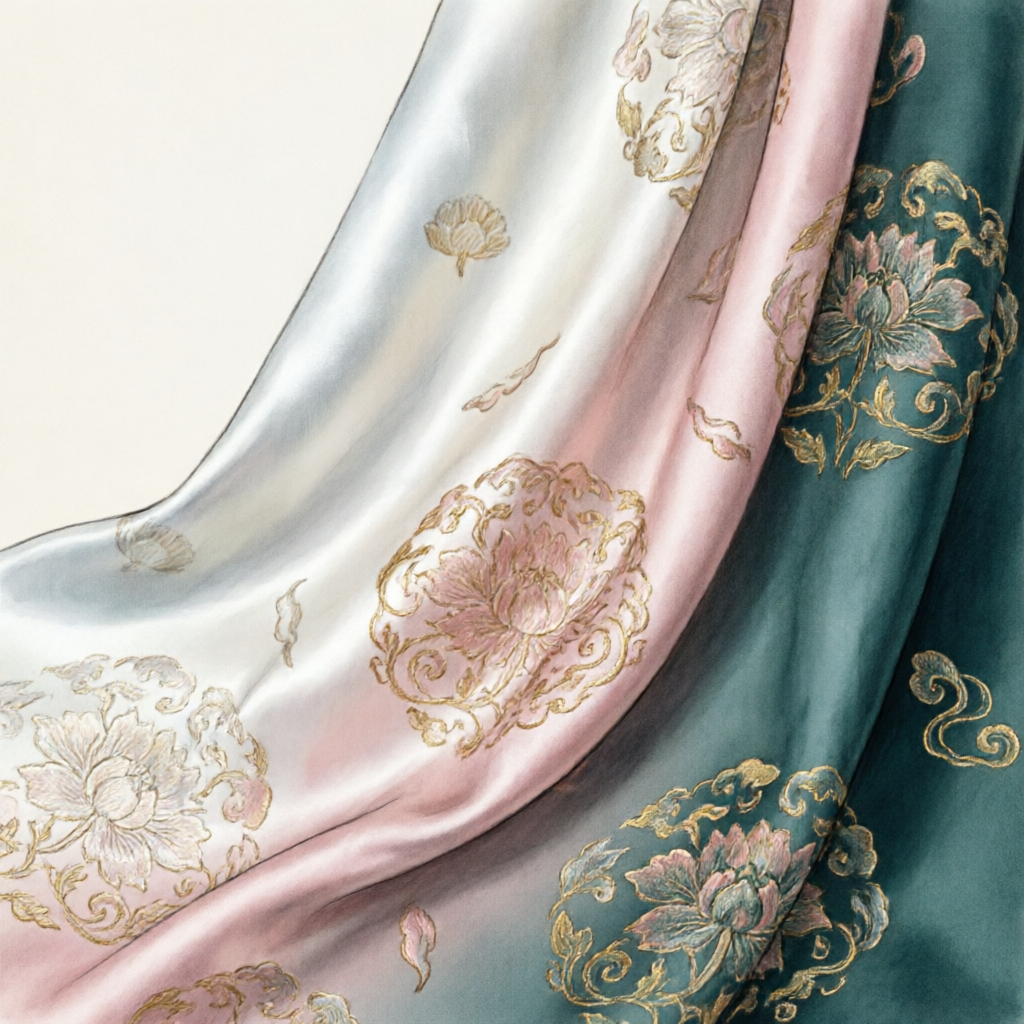
Silk is a natural protein fiber, some forms of which can be woven into textiles. The protein fiber of silk is composed mainly of fibroin and is produced by certain insect larvae to form cocoons. The best-known type of silk is obtained from the cocoons of the larvae of the mulberry silkworm Bombyx mori reared in captivity (sericulture). The shimmering appearance of silk is due to the triangular prism-like structure of the silk fiber, which allows silk cloth to refract incoming light at different angles, thus producing different colors.
History
Early Development
According to ancient Chinese legend, Leizu, the wife of the Yellow Emperor, is credited with discovering sericulture (the rearing of silkworms for silk production) around 2700 BCE. Archaeological evidence suggests that silk production in China dates back to the Neolithic period, with findings of silk fragments dating to approximately 5600-6000 years ago.
In 1926, archaeologists discovered a half cocoon at Xiyin Village in Xia County, Shanxi Province, which was identified as a mulberry silkworm cocoon. This discovery provided tangible evidence of early silk production in China during the Yangshao culture period (approximately 5600-6000 years ago). Further excavations at the Shicun site in the same area uncovered four stone-carved silkworm pupae dating back to approximately 6000 years ago, predating the Xiyin cocoon by about 500 years.
The earliest physical evidence of silk fabric was discovered at the Qingtai and Wanggou sites in Xingyang, Henan Province, dating back to about 5000 years ago. These findings indicate that silk production was already well-established in the Zhengzhou area during that period.
Shang and Zhou Dynasties
During the Shang Dynasty (1600-1046 BCE), sericulture had developed to a significant scale, with evidence of patterned silk textiles discovered. The oracle bone script of this period already contained characters related to silkworms, mulberry trees, and silk, indicating the importance of silk in Shang society.
The Western Zhou Dynasty (1046-771 BCE) saw more organized management of handicraft production, with silk production techniques advancing from those of the Shang Dynasty. During the Spring and Autumn and Warring States periods (770-221 BCE), sericulture became an important national policy for enriching and strengthening states. The appearance of "jin" (brocade) during this period marked a significant milestone in Chinese silk history, combining the excellent properties of silk with artistic elements.
Qin and Han Dynasties
The Qin (221-206 BCE) and Han (206 BCE-220 CE) dynasties witnessed significant development in the silk industry. The establishment of a centralized government and the implementation of policies promoting economic growth led to the expansion of both state-run and private silk production.
During Emperor Wu's reign (141-87 BCE), the Silk Road was established as a network of trade routes connecting the East and West. This facilitated the export of Chinese silk to Central Asia, West Asia, and eventually Europe. The discovery of numerous Han Dynasty silk fabrics along the Silk Road provides material evidence of the prosperity of this trade during that period.
Wei, Jin, and Northern and Southern Dynasties
The period of Wei, Jin, and Northern and Southern Dynasties (220-589 CE) was marked by continuous warfare, political division, and frequent changes of regime. Despite these challenges, silk production continued to develop, with diverse styles and rich cultural connotations. During this period, the center of China's sericulture industry gradually shifted from the Yellow River basin to the Yangtze River basin.
Sui and Tang Dynasties
The Sui (581-618 CE) and Tang (618-907 CE) dynasties represented a peak in feudal Chinese society, characterized by national strength, economic prosperity, and cultural openness. The silk industry flourished during this period, with three major production areas: the Yellow River basin, the Sichuan region, and the southeast region below the Yangtze River.
The Tang Dynasty was the golden age of silk production, with unprecedented levels in terms of output, quality, and variety. The production of silk was organized into three sectors: imperial handicrafts, rural sidelines, and independent handicrafts, with scales much larger than previous dynasties. The foreign trade of silk also developed tremendously, with three Silk Road routes and the emergence of the Maritime Silk Road.
Song Dynasty
During the Song Dynasty (960-1279 CE), sericulture technology advanced further, leading to a brief period of glory for Chinese silk. New varieties such as Song brocade, silk gauze, and gold-threaded fabrics emerged. The production center shifted to the Jiangnan region (south of the Yangtze River), with Zhejiang becoming known as the "capital of silk."
The state-run silk production workshops were considerable in scale, with institutions like the Brocade Institute, Dyeing Institute, and Embroidery Institute established in the capital. Private silk weaving also flourished, with numerous workshops appearing in cities. Due to the obstruction of the overland Silk Road, maritime silk trade developed significantly during this period.
Key Information
| Property | Description |
|---|---|
| Chemical Composition | Primarily fibroin protein (70-80%), containing 18 amino acids including glycine, alanine, and serine |
| Fiber Structure | Triangular cross-section with irregular shape and area; consists of fibroin core surrounded by sericin |
| Production Process | Sericulture, reeling, weaving, dyeing, and finishing |
| Main Varieties | Mulberry silk, tussah silk, wild silks from various sources |
| Historical Origin | China, dating back to approximately 5600-6000 years ago |
| Major Uses | Textiles, clothing, upholstery, industrial applications, medical sutures |
Cultural Significance
Silk has held profound cultural significance in China and beyond for millennia. In ancient China, silk was initially reserved for emperors and nobility, symbolizing status and power. The development of sericulture and silk weaving became integral to Chinese cultural identity and technological achievement.
The Silk Road, named after the lucrative trade of Chinese silk, facilitated not only commerce but also the exchange of ideas, cultures, and technologies between East and West. Silk fabrics were highly valued in foreign markets, and the technology of sericulture was closely guarded as a state secret in China for centuries.
In Chinese culture, silk is associated with prosperity, good fortune, and refinement. Traditional Chinese clothing often incorporated silk fabrics, and silk embroidery became a highly developed art form. The Chinese character for silk (丝, sī) is composed of two parts representing a silkworm and its thread, reflecting the material's importance in Chinese language and culture.
Modern Status
Today, silk remains a valuable textile with unique properties that continue to make it desirable for various applications. Modern silk production combines traditional sericulture with advanced technologies in reeling, weaving, and finishing.
While pure silk products are less common in modern industrial applications due to their high cost and delicate nature, silk is often blended with other fibers to enhance durability and reduce wrinkles. The global silk industry continues to evolve, with research focusing on improving silk production efficiency, developing new varieties, and expanding applications in fields such as biomedicine and cosmetics.
Environmental concerns have also led to renewed interest in sustainable silk production and the development of eco-friendly processing methods. As petroleum-based synthetic fibers face increasing scrutiny, natural fibers like silk are experiencing a resurgence in popularity among environmentally conscious consumers.
References
- Kuhn, D. (2012). Silk Technology and Innovation in Early China. Cambridge University Press.
- Goodrich, C. S. (2009). A Silk Road Encyclopedia. ABC-CLIO.
- Wang, S. (2015). The History of Silk in China. Zhejiang University Press.
- Fraser, C. (2013). Chinese Silk: A Cultural History. British Museum Press.
- Gansu Provincial Museum & Institute of Archaeology, CASS. (2017). Silk Road Archaeology. Science Press.