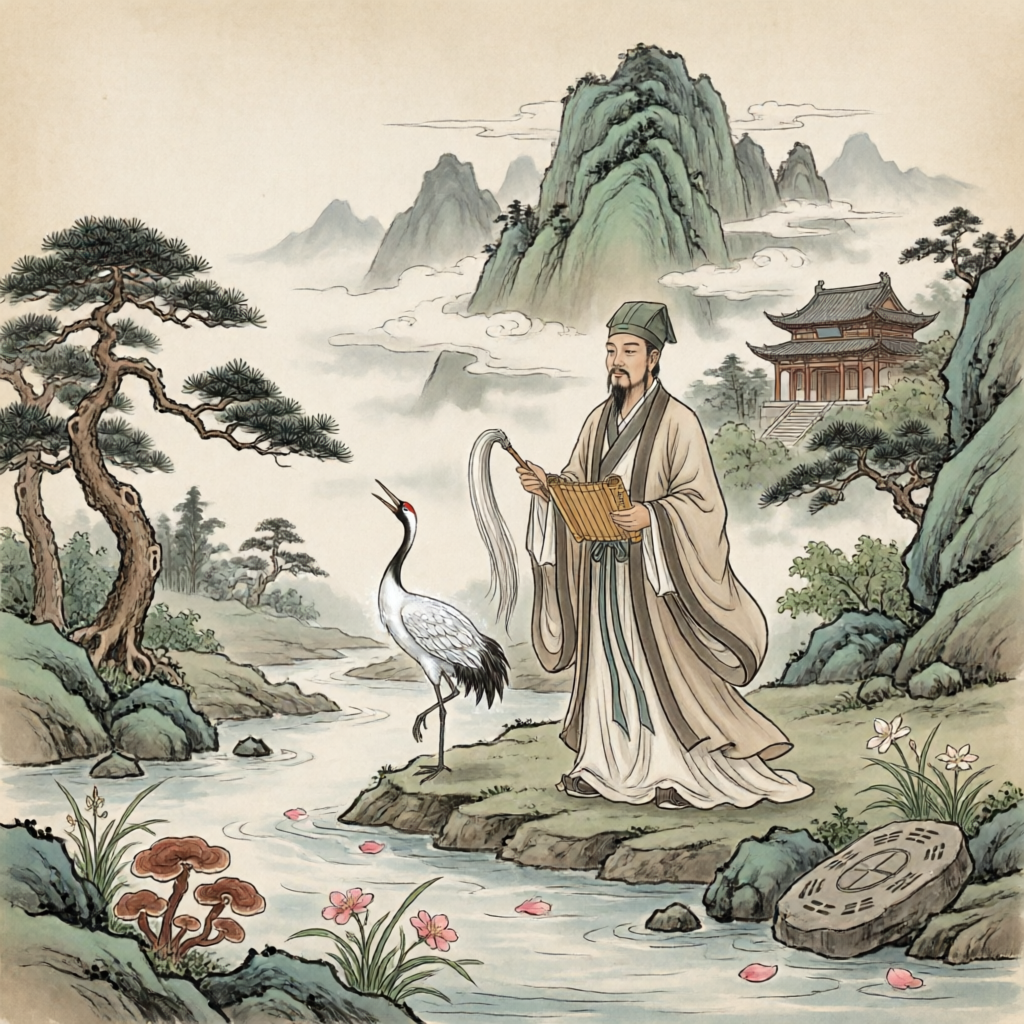
Taoism
Overview
Taoism (道教) is an indigenous Chinese philosophical and religious tradition that has profoundly influenced Chinese culture for over two millennia. At its core, Taoism centers on the concept of 'Dao' (道), often translated as 'the Way,' which represents the fundamental principle underlying the universe and all existence. As both a school of philosophical thought and an organized religion, Taoism encompasses a wide range of beliefs, practices, and institutions that have evolved throughout Chinese history.
History
Origins and Development
Modern Chinese scholars generally distinguish between two related but distinct concepts: Daojia (道家, the philosophical school) and Daojiao (道教, the religious tradition). The term 'Daojia' first appeared in Sima Tan's "Discussion of the Essentials of the Six Schools" during the Western Han Dynasty, referring to the school represented by the thought of Laozi and Zhuangzi, or the Huang-Lao (黄老) learning prevalent during the Warring States and Qin-Han periods. These philosophical schools all took 'Dao' as their highest category, advocating respect for the Dao and virtue, following the principles of nature, governing the country and cultivating oneself through the rules of purity and non-action, and handling relationships between humans and nature.
The religious tradition of 'Daojiao,' in contrast, represents a religious entity. As the name suggests, 'Daojiao' means the 'teaching or transformation of the Dao' – a religion that worships the 'Dao' and seeks to 'become immortals and attain the Dao' through spiritual and physical cultivation. As a religious entity, Taoism not only has its unique scriptures, doctrines, divine beliefs, and ritual activities, but also religious lineages, organizational structures, disciplinary systems, and places of worship.
Formation and Establishment
The Eastern Han to Wei-Jin-Northern-Southern Dynasties period (25-589 CE) marked the formation and establishment of Taoism. During the late Eastern Han, Huanglao Dao (黄老道) took shape as an organized entity, followed by the emergence of folk primitive religious groups like Taiping Dao (太平道) and Tianshi Dao (天师道). After several centuries of transformation and development during the Wei-Jin-Northern-Southern Dynasties, Taoism's scriptures, doctrines, cultivation methods, rituals, and disciplinary codes gradually became more complete. New Taoist schools proliferated, and with recognition from ruling authorities, Taoism evolved into a mature orthodox religion.
Golden Age and Transformation
From the Sui and Tang dynasties through the Northern Song period (581-1127 CE), Taoism experienced great prosperity due to the patronage of the ruling class. Its philosophy, health preservation techniques, talismanic arts, and ritual regulations became more sophisticated. After the late Tang and Northern Song, new developments emerged within Taoism, primarily characterized by the integration of Confucian, Buddhist, and Taoist thought and the rise of the Golden Elixir (Jindan) schools that emphasized internal alchemy cultivation.
During the Southern Song, Jin, and Yuan dynasties (1127-1368 CE), Taoism underwent significant transformation. In northern China, new schools such as Quanzhen Dao (全真道), Taiyi Dao (太一道), and Zhendadao (真大道) emerged. In the south, the Southern School of Golden Elixir (Jindanpai Nanzong), Tianxin (天心), Shenshou (神霄), Qingwei (清微), and Jingming (净明) schools appeared. Early schools like Tianshi Dao, Shangqing Pai (上清派), and Lingbao Pai (灵宝派) also underwent reforms in their doctrines and practices. The integration of the Three Teachings (三教合一) and emphasis on internal alchemy cultivation were the main characteristics of this period.
Modern Developments
During the Ming and Qing dynasties (1368-1911 CE), as Chinese feudal society entered its late period, Taoism's development stagnated. After the founding of the People's Republic of China in 1949, Taoism underwent reforms to eliminate unreasonable systems and practices from the old society. The establishment of the Chinese Taoist Association achieved the great unity of Taoists nationwide. However, Taoism was affected by various political movements during the anti-rightist struggle, the Great Leap Forward, and the people's commune campaigns.
Since the reform and opening-up period began in 1978, Taoism has experienced significant revitalization. Under the guidance of the Party and government's religious policies, Taoist educational activities have developed, talent cultivation has achieved remarkable results, Taoist research has flourished, and active participation in social welfare and friendly foreign exchanges has created an unprecedented new situation.
Key Information
| Aspect | Details |
|---|---|
| Founder(s) | Laozi (traditionally), Zhang Daoling (institutional founder) |
| Major Texts | Daodejing (道德经), Zhuangzi (庄子), Taipingjing (太平经) |
| Main Schools | Quanzhen (全真), Zhengyi (正一) |
| Core Concept | Dao (道) - the Way or fundamental principle |
| Goal | Immortality (长生) through spiritual cultivation |
| Sacred Sites | Mount Qingcheng (青城山), Longhu Mountain (龙虎山), Wudang Mountains (武当山) |
| Major Festivals | Laozi's Birthday, Ghost Festival (中元节) |
Cultural Significance
Taoism has profoundly influenced Chinese culture in numerous ways. Its philosophy of wuwei (无为, non-action) and harmony with nature has shaped Chinese political thought, medicine, art, literature, and martial arts. The concept of yin and yang (阴阳) and the Five Elements (五行) originated in Taoist cosmology and became fundamental to traditional Chinese medicine and feng shui (风水).
Taoist ethics emphasize simplicity, humility, compassion, and harmony with both human society and the natural world. The ideal of 'heaven and man unite as one' (天人合一) has influenced Chinese environmental ethics and continues to resonate in contemporary discussions of sustainability.
Taoist arts, including calligraphy, painting, poetry, music, and architecture, reflect its aesthetic principles of naturalness, spontaneity, and harmony with the environment. Taoist temples, with their distinctive architectural styles, often situated in scenic natural settings, serve as both religious centers and cultural landmarks.
Modern Status
Today, Taoism exists as both an organized religion and a philosophical tradition. The Chinese Taoist Association, established in 1957, serves as the national organization for Taoists, with its headquarters at Baiyun Guan (White Cloud Temple) in Beijing. Taoism currently has approximately 8,200 registered places of worship and nearly 30,000 ordained clergy nationwide.
Contemporary Taoism has made significant efforts to adapt to modern society while preserving its traditions. Taoist education has been systematized with the establishment of specialized institutions like the China Taoist College, which offers programs at various levels from vocational training to postgraduate studies.
Taoism has also become increasingly engaged in social welfare and environmental protection. The Taoist community has participated in disaster relief, medical assistance, and ecological conservation projects. In 2003, Taoists from China and abroad established the 'China Taoist Ecological Forest Base' in Minqin County, Gansu Province, to combat desertification. The Taoist emphasis on harmony between humans and nature has found expression in these contemporary environmental initiatives.
Internationally, Taoism has gained greater recognition through academic exchanges, cultural festivals, and publications. The China Taoist Association has organized the International Taoist Forum four times (2007, 2011, 2014, 2017), bringing together Taoist representatives from over 30 countries and regions. Efforts to establish a World Taoist Federation aim to further promote Taoist culture globally.
References
-
Kohn, Livia. The Daoist Experience. State University of New York Press, 1998.
-
Robinet, Isabelle. Taoism: Growth of a Religion. Translated by Phyllis Brooks. Stanford University Press, 1997.
-
Kirkby, Joan. The Tao of the Yurt: Nomadic Cosmology and Domestic Space in Inner Mongolia. University of Hawaii Press, 2014.
-
Lagerwey, John. Taoism: A Historical Introduction. Blackwell Publishing, 2000.
-
Miller, James. Daoism: A Short Introduction. Oxford University Press, 2003.