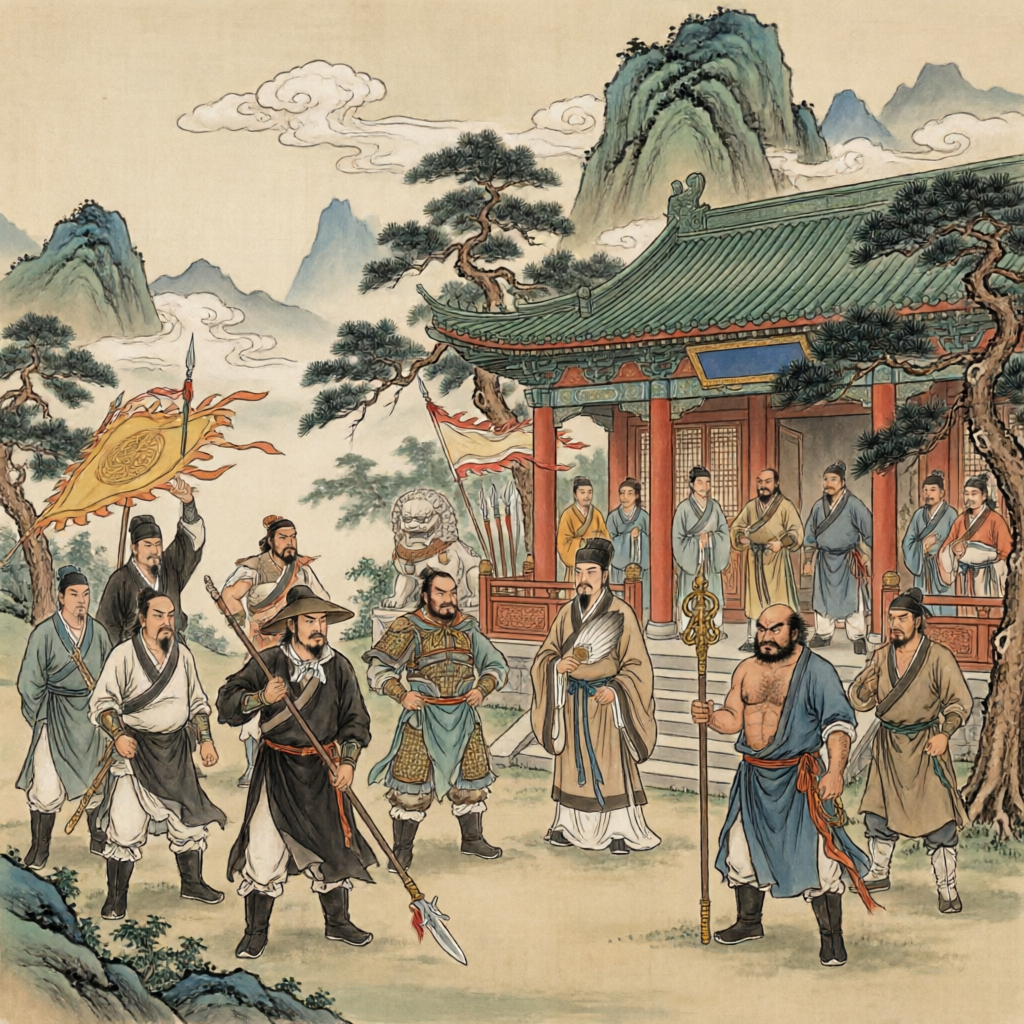
Water Margin
Overview
Water Margin, also known by its literal translation Outlaws of the Marsh, is one of the Four Great Classical Novels of Chinese literature. The novel, traditionally attributed to Shi Nai'an, tells the story of 108 outlaws who gather at Mount Liang (also known as Liangshan Marsh) to oppose a corrupt government during the Song dynasty. The novel combines elements of history, folklore, and popular storytelling to create a complex narrative that explores themes of justice, loyalty, rebellion, and redemption.
History
Historical Background
The novel is based on historical events from the Northern Song Dynasty, specifically the Song Jiang rebellion that took place between 1119 and 1121. Historical records such as the Dongdu Shilie and the History of Song document the exploits of Song Jiang and his thirty-six followers, who "roamed freely across Heshuo (modern Hebei) with tens of thousands of government troops unable to resist them." These historical accounts indicate that while the rebel force was relatively small, they were formidable fighters who posed a significant threat to the Song Dynasty.
During the Song Dynasty, the art of storytelling flourished, and tales of Song Jiang and his thirty-six followers quickly became popular material for storytellers. The earliest written records of these stories appear in Southern Song Dynasty texts like Zuiweng Tanlu, which mentions story titles such as "Blue-Faced Beast," "Flower Monk," and "Wu Xingzhe," believed to refer to characters Yang Zhi, Lu Zhishen, and Wu Song respectively. The earliest extant work containing these stories is The Great Song Dynasty Chronicle of Xuanhe, which may have originated during the Yuan Dynasty or been an earlier Song Dynasty text with Yuan Dynasty additions.
Title Origin
During its transmission, the novel acquired various alternative titles, including Loyal and Righteous Water Margin, Water Margin Loyal and Righteous Biography, The Fifth Talent Book, and Water Margin Romance. The title "Water Margin" is derived from a line in the Book of Songs (Shijing): "Ancient Duke Danfu, came to court at dawn, led west to the water margin, and arrived at Qi." The exact meaning of "Water Margin" has been subject to scholarly debate, with interpretations ranging from representing "loyalty and righteousness" to symbolizing the "water margin of Liangshan Mountain" or metaphorically representing "in the wild" (in opposition to the court).
Authorship Controversy
The actual authorship of Water Margin spans several centuries from the Song and Yuan to the late Ming Dynasty, involving numerous storytellers, writers, and publishers. The novel represents a type of "accumulative long literary work" passed down through generations. During the Ming and Qing Dynasties, three different attribution forms appeared in published versions of the novel: one attributing the work solely to Luo Guanzhong, another to a collaboration between Shi Nai'an and Luo Guanzhong, and a third attributing it solely to Shi Nai'an. By the late Ming Dynasty, Jin Shengtan's abridged edition attributed the work solely to Shi Nai'an, and this attribution has persisted in most modern editions.
Content Plot
The novel begins during the reign of Emperor Renzong of the Song Dynasty, when a devastating plague spreads throughout the land. The emperor dispatches Grand Marshal Hong Xin and the Celestial Master of Longhu Mountain to perform rituals to appease the gods. At Longhu Mountain, Hong Xin orders the excavation of a sealed cave in the Demon Subduing Temple, accidentally releasing 108 demonic stars who descend to earth as 108 heroic outlaws.
The first hero introduced is "Nine-Tattooed Dragon" Shi Jin, who encounters Wang Jin, a former military instructor framed by Gao Qiu. Shi Jin loses a duel to Wang Jin and becomes his disciple. Subsequently, Shi Jin becomes involved in a conflict with the leaders of Shaohua Mountain and is forced to flee. His journey leads him to Weizhou City, where he meets Lu Da, a military instructor, and reunites with his former master Li Zhong. The three learn of how singer Jin Cui-lian is being extorted by the local bully "Guankey" Zheng Tu. Lu Da confronts and kills Zheng Tu the next day, then flees to Daizhou, where he eventually becomes a monk at Wutai Mountain under the name "Zhishen."
At the monastery, Lu Da twice violates his vows by drinking alcohol and creates disturbances, leading the abbot to recommend him to Daxiangguo Temple in the Eastern Capital. On his journey, Lu defeats "Little Overlord" Zhou Tong, who was attempting to forcibly marry a local woman. Later, at Wansi Temple, he joins forces with Shi Jin to kill the evil monks "Iron Buddha" Cui Daocheng and "Flying Yaksha" Qiu Xiaoyi and burns down the dilapidated temple. Upon reaching the Eastern Capital, Lu Da befriends Lin Chong, a military instructor. Lin Chong's wife is harassed by Gao Qiu's adopted son on their first meeting. Later, Gao Qiu, his son, and Lu Qian conspire to frame Lin Chong, who is exiled to Cangzhou. Lu Da secretly follows Lin Chong to protect him during his journey. In Cangzhou, Lin Chong encounters "Little Whirlwind" Chai Jin, who provides him with money to bribe officials. However, due to pressure from Gao Qiu, Lin Chong is assigned to work at a fodder depot where he is set up for assassination. Lin Chong kills his attackers, flees to Chai Jin's estate, and is eventually recommended to join the outlaws at Liangshan Marsh under Wang Lun. Wang伦 insists that Lin Chong kill someone to prove his loyalty, but instead Lin Chong encounters "Blue-Faced Beast" Yang Zhi.
Wang Lun prevents their fight and attempts to recruit Yang Zhi, who declines. Yang Zhi returns to the Eastern Capital after being stripped of his position for losing a shipment of exotic flowers and stones (huashi gang). To make money, he sells his ancestral sword but is accosted by the ruffian Niu Er. In a fit of anger, Yang Zhi kills Niu Er and is sentenced to exile in Daming Prefecture. The prefect Liang Shijie recognizes Yang Zhi's abilities and keeps him in his service. Yang Zhi defeats Zhou Jin in a competition and draws with "Vanguard" Suo Chao, earning his position.
Meanwhile, Prime Minister Cai Jing's birthday approaches, and Liang Shijie orders Yang Zhi to escort the birthday gifts (the "birthday tribute") to the Eastern Capital. This mission is discovered by "Red-Haired Ghost" Liu Tang, who plans to steal it with Chao Gai, the village head of Dongxi Village. "Wise Star" Wu Liang learns of this and collaborates with the three Ruan brothers from Shijie Village. They are later joined by "Dragon in the Clouds" Gongsun Sheng and "Daytime Rat" Bai Sheng. When the convoy passes through Huangni Ridge, Chao Gai's group uses a scheme to drug the guards and steal the birthday tribute. After recovering, Yang Zhi, having nowhere to go, encounters Lin Chong's disciple "Butcher" Cao Zheng and "Flower Monk" Lu Zhishen at the foot of Erlong Mountain. They kill the Erlong Mountain leader Deng Long and take over the Baozhu Temple.
The theft of the birthday tribute reaches the capital, and the court dispatches He Tao to investigate in Yuncheng County. The county clerk "Timely Rain" Song Jiang learns of this and warns Chao Gai. Chao Gai and his men defeat He Tao's forces at Shijie Village and flee to Liangshan Marsh. The Liangshan leader Wang Lun, fearing Chao Gai's presence, refuses to let them stay long. Wu Liang conspires with Lin Chong, who had been marginalized by Wang伦, and they kill Wang伦 in a coup.
Under Chao Gai's leadership, Liangshan Marsh prospers. Chao Gai sends Liu Tang with gold and a letter to thank Song Jiang for his help, but the letter is discovered by Song Jiang's concubine Yan Baoxi, who blackmails him. Song Jiang kills Yan Baoxi in anger and flees with his younger brother "Iron Fan" Song Qing to Chai Jin's estate in Cangzhou.
At Chai Jin's estate, Song Jiang meets Wu Song, who is resting there while returning home. Wu Song travels separately and encounters a tiger at Jingyang Ridge, which he kills with his bare hands. He is appointed as a constable in Yanggu County and reunites with his elder brother Wu Dalang and his sister-in-law Pan Jinlian. Pan attempts to seduce Wu Song, forcing him to move to the county office. While away on business, Pan Jinlian has an affair with the wealthy Ximen Qing and they poison Wu Dalang. Upon returning, Wu Song kills them both and is exiled to Mengzhou. On the way, he meets the Butcher Zhang Qing and "Female Yaksha" Sun Erniang, who run a restaurant. In the prison camp, he befriends Shi En, son of the camp commander, and helps him reclaim the Happy Forest area from "God of War" Jiang Zhong. However, Wu Song is framed by the local military inspector Zhang Mengfang. After killing assassins at Feiyunpu, Wu Song massacres Zhang Mengfang's family and flees to Erlong Mountain. On his journey, he kills the Taoist "Flying Centipede" and is captured at Kong Family Village after fighting "Mars" Kong Liang, but reunites with Song Jiang, who is teaching martial arts there.
Song Jiang accompanies Wu Song away from Kong Family Village and goes to join "Little Li Guang" Hua Rong at Qingfeng Fortress. However, he is nearly killed by the leaders of Qingfeng Mountain and later framed and captured by the civil official Liu Gao. Yan Shun and others from Qingfeng Mountain rescue Song Jiang and Hua Rong and kill Liu Gao. Song Jiang defeats the Qingzhou forces and subdues the fierce generals "Thunder Fire" Qin Ming and "Suppressor of the Three Mountains" Huang Xin. As they head to Liangshan, Song Jiang is tricked by his father into returning home and captured by government troops. He is exiled to Jiangzhou, where he befriends several local bullies and meets "Magic Traveler" Dai Zong and "Black Whirlwind" Li Kui. One day, while drunk at Xunyang Tower, Song Jiang writes a poem that is misinterpreted by the vice prefect Huang Wenbing as treasonous. Song Jiang is sentenced to death but rescued by Liangshan heroes at the execution ground. Under Song Jiang's plan, they attack Wumei Army (across the river from Jiangzhou), kill Huang Wenbing, and bring Song Jiang and the others to Liangshan. Song Jiang attempts to return home to bring his family to the mountain but is surrounded by government troops and forced to hide at Huandao Village. There, he encounters the Nine Heavens Mysterious Lady, who saves him from pursuers and grants him three volumes of heavenly scriptures.
Li Kui returns home to bring his mother to the mountain but encounters tigers that kill her. In a rage, Li Kui kills four tigers and is hailed as a local hero but is recognized as a Liangshan outlaw and captured. Fortunately, Zhu Fu, brother of "Dry Land Crocodile" Zhu Gui, helps rescue Li Kui and also brings "Blue-Eyed Tiger" Li Yun to the mountain. Song Jiang and the others miss Gongsun Sheng and send Dai Zong to find him. Dai Zong returns with four heroes from Yinma River and befriends "Sick Knot" Yang Xiong and "Desperate Third" Shi Xiu. Later, Yang Xiong's wife has an affair, and Shi Xiu kills her. They decide to go to Liangshan but encounter conflict with Zhu Family Village. After seeking help unsuccessfully, they go to Liangshan for reinforcements, beginning the three battles of Zhu Family Village and recruiting heroes such as Jie Zhen, Jie Bao, and "Sick Yuchi" Sun Li.
After the three battles of Zhu Family Village and rescuing Chai Jin, Liangshan's influence grows significantly. They repel three major campaigns by Grand Marshal Gao, and the three mountains of Taohua Mountain, Erlong Mountain, and Liangshan unite. However, Chao Gai is fatally wounded by a poisoned arrow while attacking Zengtou City. To expand their forces, Wu Liang devises a plan to recruit the famous "Jade Qilin" Lu Junyi. After many twists and turns, Lu Junyi joins Liangshan. The Liangshan army defeats Zengtou City and repels several imperial offensives, with many military commanders joining their cause. The 108 heroes gather at Liangshan. After the grand gathering, facing the increasingly powerful Liangshan army, the imperial court twice offers amnesty but fails due to obstruction by corrupt officials. The court sends Gao Qiu and Tong Guan to suppress Liangshan five times, but all attempts are defeated. Gao Qiu is even captured alive. Only after three imperial edicts does the court finally succeed in offering amnesty.
After accepting amnesty, the Liangshan heroes hold a "Great Market of Gold Distribution," distributing their wealth and houses to local residents. The Liangshan army is then dispatched to the north to attack the Liao Kingdom. They conquer four cities—Tan, Ji, Ba, and You—and defeat the elite Liao forces. With guidance from the Nine Heavens Mysterious Lady, they break the Grand Cosmic Formation Array commanded by Wuyan Guang of Liao and kill him. The offensive is so successful that the Liao emperor is forced to surrender to the Northern Song.
However, after the campaign against Liao, the court returns all the recovered Yan territory to Liao and does not grant official positions to the Liangshan heroes, rendering their efforts futile. The court also does not allow the Liangshan soldiers to enter the city. During the Lantern Festival, Li Kui and Yan Qing sneak into the city and learn that Fang La in the south has rebelled. Song Jiang volunteers to lead the campaign as the southern vanguard.
Due to climate, epidemics, and the court's recall of the army physician "Divine Doctor" An Dao'an, the Liangshan army suffers heavy casualties. They eventually achieve a costly victory against Fang La, with only 32 commanders surviving. After victories in both northern and southern campaigns, the court rewards the surviving commanders. Song Jiang, ranked first as "Heavenly Leader" and nicknamed "Protector of Righteousness," is appointed Commander-in-Chief of the Army and Pacification Commissioner of Chuzhou. Six months after taking office, he is poisoned by corrupt officials. Lu Junyi, ranked second, is poisoned with mercury and falls into a river. Wu Liang, ranked third, eventually hangs himself with Hua Rong at Song Jiang's tomb.
One night after their deaths, Emperor Huizong dreams of Dai Zong leading him to Liangshan Marsh, where he meets the heroes. Song Jiang reveals in the dream that they were poisoned by corrupt officials. Upon waking, Emperor Huizong investigates, confirms their deaths, and builds a temple for them at Liangshan Marsh to protect the region and receive the people's worship.
Key Information
| Aspect | Details |
|---|---|
| Original Title | 水浒传 (Shuǐ Hǔ Zhuàn) |
| Alternative Titles | Outlaws of the Marsh, All Men Are Brothers, The Water Margin |
| Authorship | Traditionally attributed to Shi Nai'an, with possible contributions from Luo Guanzhong |
| Approximate Completion Date | Late 14th century (Ming Dynasty) |
| Literary Form | Novel |
| Language | Classical Chinese |
| Number of Chapters | 100 (original), 120 (extended version) |
| Main Setting | Northern Song Dynasty (960-1127) |
| Key Themes | Justice, loyalty, rebellion, redemption, corruption, brotherhood |
| Cultural Significance | One of the Four Great Classical Novels of Chinese literature, profoundly influencing Chinese literature, theater, and popular culture |
Cultural Significance
Water Margin holds a significant place in Chinese cultural heritage as one of the Four Great Classical Novels. The novel's exploration of justice, loyalty, and rebellion against corruption has resonated with Chinese readers for centuries. Its characters, with their distinct personalities and moral complexities, have become archetypes in Chinese literature and popular culture.
The novel's influence extends beyond literature into various art forms. It has been adapted into numerous operas, films, television series, and video games. The story of the 108 heroes has become a cultural touchstone, referenced in countless works of Chinese popular culture. The novel's themes of righteous rebellion against corrupt authority continue to resonate in modern Chinese society.
The novel's portrayal of brotherhood and loyalty among the outlaws has made it particularly popular among common people, who often identify with the heroes' struggles against oppressive social structures. The characters' code of honor, despite their outlaw status, has been interpreted as a critique of official corruption and a celebration of popular justice.
Modern Status
Today, Water Margin remains widely read and studied in China and throughout the world. It has been translated into numerous languages and is considered a masterpiece of world literature. Modern scholars continue to analyze the novel from various perspectives, including its historical context, literary techniques, philosophical themes, and social commentary.
The novel's characters and stories continue to inspire contemporary adaptations in various media. Recent years have seen new film and television productions, as well as innovative reinterpretations in literature and digital media. The novel's themes of justice, corruption, and resistance to authority remain relevant in modern discussions of social and political issues.
Academic interest in the novel has grown significantly, with scholars examining its historical sources, textual variations, cultural impact, and enduring relevance. The novel's complex portrayal of rebellion and its ambiguous moral stance continue to provide fertile ground for scholarly debate and interpretation.
References
-
Hsia, C.T. The Classic Chinese Novel: A Critical Introduction. Yale University Press, 1968.
-
Shapiro, Harold R. Water Margin: A Novel of Loyalty and Righteousness. University of Hawaii Press, 1987.
-
Plaks, Andrew H. The Four Masterworks of the Ming Novel. Princeton University Press, 1987.
-
Wang, David Der-wei. Fictional Realism in Twentieth-Century China: Mao Dun, Lao She, Shen Congwen. Columbia University Press, 1992.
-
Doleželová-Velingerová, Milena, ed. The Chinese Novel: From Myth to Modernity. Wiesbaden: Harrassowitz Verlag, 1993.