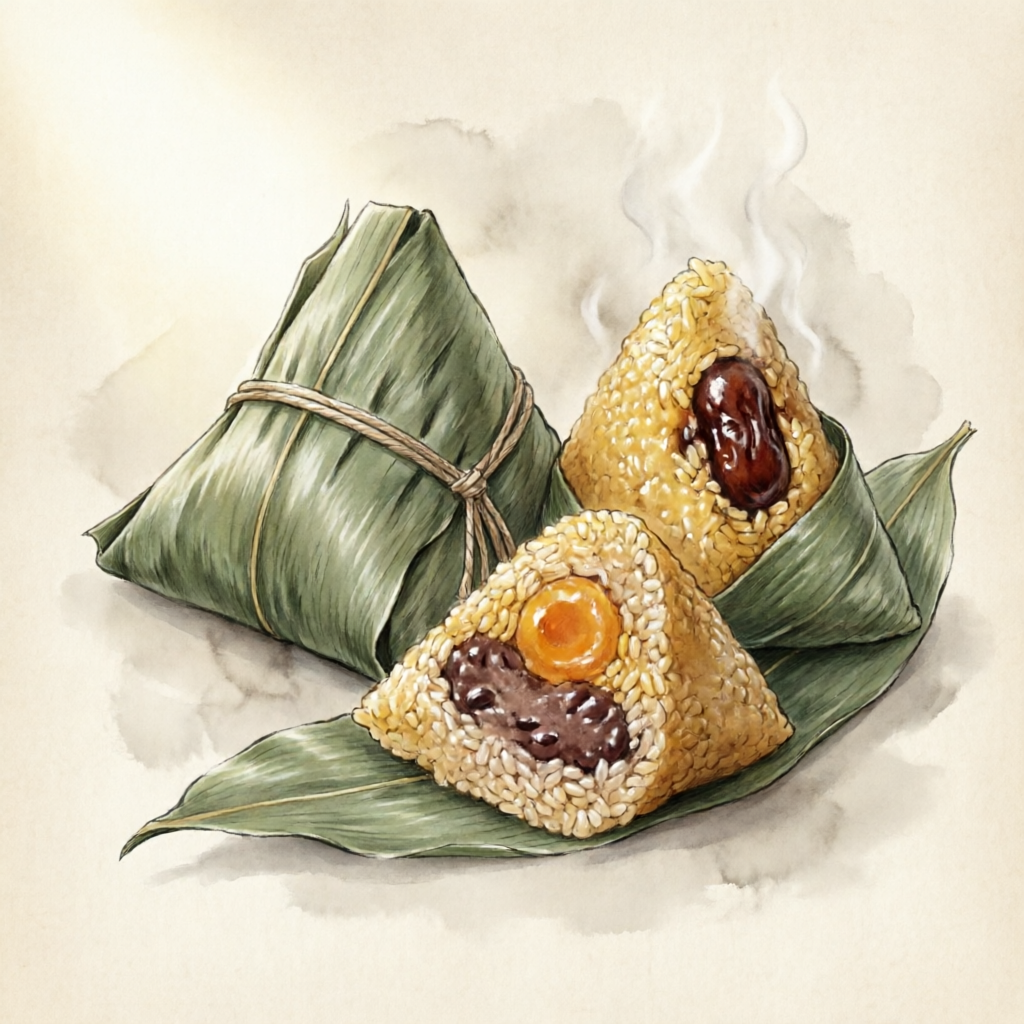
Zongzi: Traditional Chinese Rice Dumplings
Overview
Zongzi (粽子) are traditional Chinese rice dumplings wrapped in bamboo or reed leaves, most commonly associated with the Dragon Boat Festival (Duanwu Festival). These pyramid-shaped or conical parcels contain glutinous rice and various fillings, which can range from sweet to savory depending on regional preferences. With a history spanning over 2,000 years, zongzi represent not only a culinary tradition but also cultural practices across China and other East Asian countries.
History
The precursor to modern zongzi was known as "jiao shu" (角黍), named for its angular shape and millet filling. Initially, people created "jiao shu" in the shape of ox horns as substitutes for actual ox horns used in ancestral worship ceremonies. The Book of Odes (《诗经·周颂·良耜》) describes ancient Zhou dynasty rituals where ox horns were used for sacrifices. When common people couldn't afford actual oxen for ceremonies, they began wrapping grain in plant leaves to form ox horn shapes as substitutes.
The Book of Rites (《礼记·月令》) mentions that during the midsummer month, the emperor would taste newly harvested millet (黍) along with cherries (含桃) as sacrificial offerings. Millet, considered the "fire grain" representing the southern element, was wrapped in water-growing wild rice leaves (菰叶), symbolizing the containment of yang (fire) within yin (water). This practice aligned with ancient Chinese understanding of natural cycles and the summer solstice, when yin and yang energies are believed to exchange.
Archaeological evidence suggests zongzi originated in China over 2,000 years ago. The earliest discovered zongzi were found in 2023 at the Chengyangcheng site in Xinyang, Henan province, dating back to ancient times. These were wrapped in oak leaves, a tradition still preserved in some mountainous regions of Shaanxi, Henan, and Shandong.
During the Han Dynasty, zongzi became increasingly associated with the Dragon Boat Festival and merged with the legend of commemorating the poet Qu Yuan. Since then, zongzi have evolved from mere food items into cultural symbols carrying deep significance during the Dragon Boat Festival.
The term "jiao shu" was explicitly recorded in the Fengtu Ji (《风土记》) written by Zhou Chu during the Western Jin Dynasty, indicating that zongzi had already appeared before the Spring and Autumn Period and were initially used for ancestral worship. By the Jin Dynasty, zongzi had become a festival food specifically associated with the Dragon Boat Festival.
Key Information
| Aspect | Description |
|---|---|
| Chinese Name | 粽子 (zòngzi) |
| Category | Traditional snack, Dragon Boat Festival food |
| Taste | Sweet, salty, and various other flavors |
| Main Ingredients | Glutinous rice, bamboo/reed leaves, various fillings |
| Associated Festival | Dragon Boat Festival (Duanwu Festival) |
| Cultural Significance | Ancestral worship, commemoration of Qu Yuan, symbol of good fortune |
Cultural Significance
Zong belong to the category of "he" (籺), which are ceremonial food items used for worshiping deities and ancestors during festivals. Making he for ancestral worship is an ancient tradition in China. Different festivals feature different types of he, with zong he specifically used during the Dragon Boat Festival for worshiping deities and ancestors.
The tradition of eating zongzi during the Dragon Boat Festival became widespread after the Han Dynasty, eventually merging with the legend of Qu Yuan, a patriotic poet who drowned himself in the Miluo River. According to legend, locals threw rice dumplings into the river to prevent fish from eating his body, establishing the practice of eating zongzi during the festival.
Zongzi also carry symbolic meanings in Chinese culture. During the Ming and Qing dynasties, zongzi became considered auspicious food. Scholars preparing for imperial examinations would eat "bizong" (笔粽, literally "brush zongzi") before their exams, as the elongated shape resembled a writing brush and the name sounded like "bi zhong" (必中), meaning "sure to pass." This practice reflected the cultural value placed on education and scholarly achievement.
Regional Varieties
Zongzi vary significantly across different regions of China, with distinct shapes, fillings, and preparation methods:
Northern Varieties
Northern zongzi are typically simpler, often consisting of glutinous rice with red dates or bean paste fillings, served with sugar:
- Beijing Zongzi: Generally larger, in a slanted quadrilateral or triangular shape. Most are made with glutinous rice, though rural areas still prefer yellow millet zongzi. Fillings include red dates and bean paste.
- Xi'an Honey Zongzi: A specialty of Xi'an and Guanzhong regions, these diamond-shaped zongzi are served cold with honey or rose syrup, making them a popular summer treat.
- Henan Oak Leaf Zongzi: In mountainous areas of Henan, locals still use oak leaves to wrap millet or glutinous rice, preserving an ancient tradition.
Southern Varieties
Southern zongzi are generally more diverse in fillings and preparation methods:
-
Guangdong Zongzi: Considered representative of southern zongzi, they come in pyramid shapes, strips, or triangular cones. Popular varieties include salted meat zongzi, alkaline water zongzi, and bean paste zongzi. The salted meat zongzi, made with glutinous rice, pork belly, and mung beans, often with additional ingredients like salted egg yolks, mushrooms, and chestnuts, is particularly favored.
-
Jiaxing Zongzi: From Jiaxing in Zhejiang province, these are renowned for their variety and quality. Jiaxing zongzi come in quadrilateral shapes with fillings including fresh meat, bean paste, and "eight treasures." The fresh meat zongzi features lean meat with a piece of fatty meat that renders its oil into the rice during cooking, creating a rich yet not greasy texture.
-
Huzhou "Pillow Zongzi": Characterized by their long, pillow-like shape, these zongzi from Huzhou are also called "beauty zongzi" for their elegant appearance. They are typically handmade with various fillings including soy sauce, fresh meat, bean paste, and egg yolks.
Regional Specialties
| Region | Specialty Zongzi | Characteristics |
|---|---|---|
| Shanghai | Cantonese-style | Soft texture, intense flavors, pyramid shape with flat bottom |
| Nanjing | Small-foot zongzi | Various shapes including small-foot, pillow, triangular, and quadrilateral |
| Suzhou | Long and thin quadrilateral | Fine craftsmanship with fillings like fresh meat, red date paste, bean paste |
| Hangzhou | Tangqi zongzi | Features pork belly, Shaoxing wine, specific glutinous rice, and bamboo leaves |
| Fuzhou | Salted zongzi | Tied in uniform strings of ten, used as ancestral offerings |
| Chaozhou | Double-flavor zongzi | Unique with both sweet and savory elements |
| Sichuan | Spicy zongzi | Incorporates Sichuan's characteristic spicy flavors |
| Yunnan | Bamboo tube zongzi | Cooked in bamboo tubes, imparting a unique fragrance |
Modern Status
Today, zongzi remain an integral part of Chinese cultural heritage, particularly during the Dragon Boat Festival. The tradition of preparing zongzi is passed down through generations, with families gathering to wrap zongzi together before the festival. In recent years, there has been growing international recognition of zongzi as a cultural symbol.
In September 2019, a proposal for "international standards for zongzi" submitted by the China Chamber of Commerce was approved by the 21st Session of the Codex Committee for Asia (CCASIA21). This development aims to help promote the traditional technique of zongzi wrapping as an intangible cultural heritage and facilitate the global spread of this traditional Chinese food.
Modern variations of zongzi continue to emerge, with chefs experimenting with new fillings and presentation styles while maintaining traditional elements. Despite these innovations, the fundamental practice of wrapping glutinous rice in leaves and steaming or boiling it remains unchanged, preserving centuries of culinary tradition.
References
-
Wang, L. (2018). Food and Culture in China: The History and Traditions of Chinese Cuisine. Cambridge University Press.
-
Chen, J. (2020). Dragon Boat Festival: Traditions and Customs Across China. Beijing: China Intercontinental Press.
-
Li, Y., & Zhang, H. (2019). "The Archaeological Discovery of Ancient Zongzi in Henan Province." Journal of Chinese Culinary History, 15(2), 45-62.
-
Liu, M. (2021). Regional Cuisines of China: A Culinary Journey Through China's Diverse Food Cultures. New York: Routledge.
-
Zhao, R. (2017). "Intangible Cultural Heritage and the Preservation of Traditional Food Crafts: The Case of Zongzi." Food, Culture and Society, 20(3), 421-438.