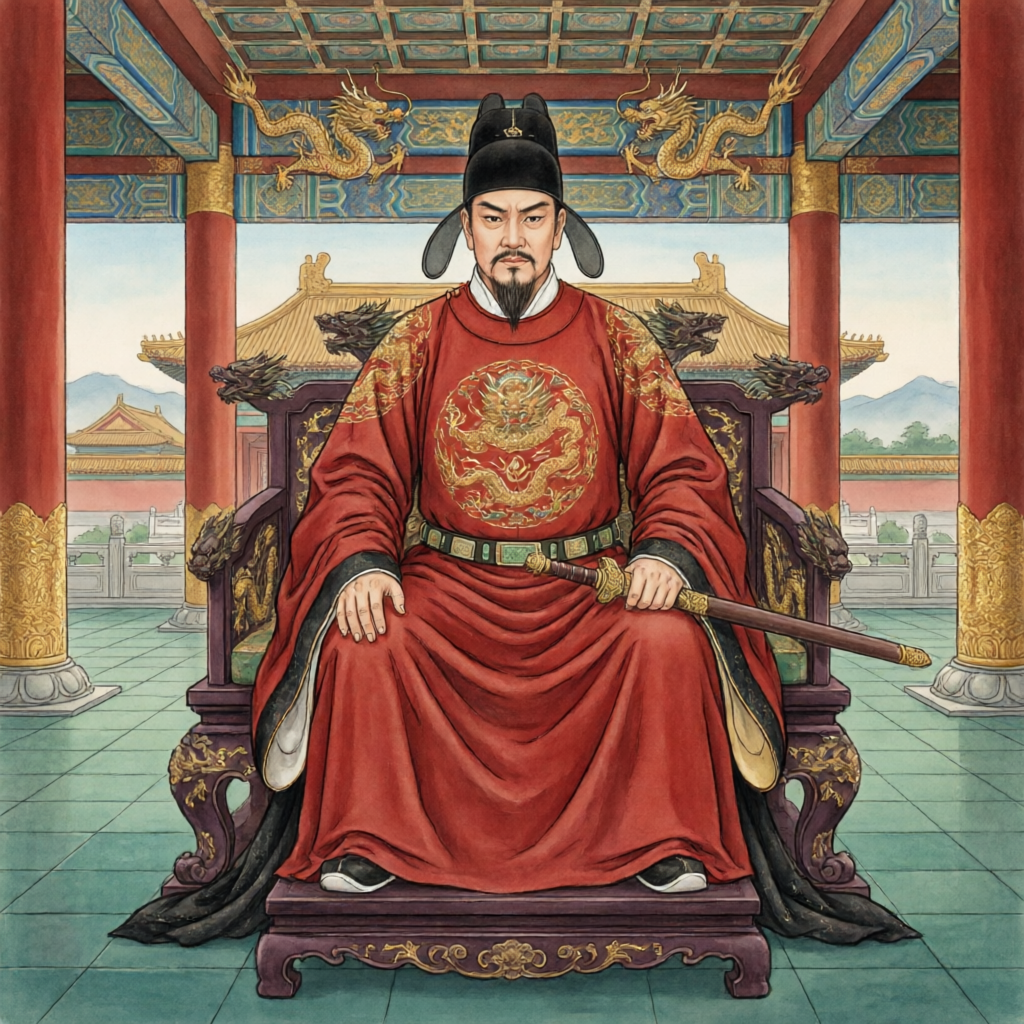
Li Shimin
Overview
Li Shimin (599-649), posthumously known as Emperor Taizong of Tang (唐太宗), was the second emperor of the Tang dynasty, reigning from 626 to 649. He is widely regarded as one of the greatest emperors in Chinese history, having played a pivotal role in the establishment and consolidation of the Tang dynasty. Li Shimin was a brilliant military strategist, effective administrator, and patron of culture and learning during his reign.
History
Early Life
Li Shimin was born on January 23, 599, at the Li family's residence in Wugong during the Sui dynasty. Even in his youth, he demonstrated exceptional intelligence and strategic thinking. In 615, when Emperor Yang of Sui was besieged by the Turks at Yanmen, Li Shimin, then only 16 years old, offered military advice to General Yun Dingxing, suggesting the use of deceptive tactics with flags and drums to create the illusion of a large relief force. This strategy successfully forced the Turks to lift the siege.
In 616, Li Shimin's father Li Yuan was appointed as the governor of Taiyuan. When the region was attacked by the rebel leader Wei Dao'er, Li Shimin led elite cavalry to rescue his father, who had been surrounded by enemy forces. This early military experience foreshadowed Li Shimin's future capabilities as a military leader.
The Jinyang Uprising
By 617, the Sui dynasty was in terminal decline. Li Shimin secretly planned an uprising with his father, Li Yuan, which became known as the Jinyang Uprising. Li Shimin persuaded his father to rebel against the Sui dynasty and played a crucial role in the military campaigns that followed. He demonstrated remarkable tactical skill in the capture of Xihai and was subsequently appointed as Duke of Dunhuang and Commander of the Right Army.
During the campaign against Huoyi, Li Shimin's military acumen was evident. When his father considered retreating due to rain and dwindling supplies, Li Shimin argued passionately against it, emphasizing the importance of maintaining momentum in their rebellion. His persistence convinced Li Yuan to continue the campaign, which ultimately resulted in the defeat of the Sui general Song Laosheng.
Conquests Across the Realm
Li Shimin's military campaigns continued throughout the early Tang period. In 618, he was appointed as Prince of Qin and played a central role in defeating rival warlords who threatened the newly established Tang dynasty. His most significant victories included:
-
Defeating Xue Rengao (618-619): After a 60-day standoff, Li Shimin employed a strategy of patience and psychological warfare, waiting for Xue's supplies to run out before launching a decisive attack that resulted in Xue's capture.
-
Conquering Liu Wuchuan (619-620): Facing a formidable army led by Song Jin, Li Shimin again demonstrated patience, building fortified positions and waiting for the enemy to exhaust themselves before launching a counterattack that resulted in a decisive victory.
-
Subduing Wang Shichong and Dou Jian (620-621): Li Shimin's most celebrated military achievement came during the campaign against Wang Shichong in Luoyang. When Wang sought help from Dou Jian, Li Shimin employed a brilliant strategy of dividing his forces, maintaining siege operations against Wang while confronting Dou at Hulao Pass. His decisive victory at Hulao resulted in the capture of both Wang and Dou, effectively unifying northern China under Tang rule.
Ascension to Power
Li Shimin's military successes made him immensely popular and powerful, creating tensions with his elder brother, Crown Prince Li Jiancheng, and their younger brother Li Yuanji. These tensions culminated in the Xuanwu Gate Incident of 626, where Li Shimin ambushed and killed both Li Jiancheng and Li Yuanji. Shortly after, his father Emperor Gaozu abdicated, and Li Shimin ascended the throne as Emperor Taizong.
Reign as Emperor Taizong
Emperor Taizong's reign (626-649) is considered a golden age in Chinese history. He implemented numerous political, economic, and military reforms that strengthened the Tang dynasty and established it as a major power in East Asia. Key achievements during his reign included:
- The Zhenguan Governance (贞观之治): Named after his era name (reign title), this period of good governance emphasized meritocracy, frugality, and just administration.
- Reforms in the Examination System: Taizong expanded the imperial examination system to select officials based on merit rather than aristocratic connections.
- Military Reforms: He reorganized the military, established the Fubing system (府兵制), and strengthened frontier defenses.
- Cultural Patronage: Taizong was a patron of literature, art, and philosophy, establishing the Wenxuan Academy (文学馆) to attract scholars.
- Diplomatic Achievements: He successfully managed relations with neighboring states through both military strength and diplomatic engagement.
Key Information
| Aspect | Details |
|---|---|
| Full Name | Li Shimin (李世民) |
| Posthumous Name | Emperor Wen Wu Sheng Huangdi (文武圣皇帝), later expanded to Emperor Wen Wu Da Sheng Da Guang Xiao Huangdi (文武大圣大广孝皇帝) |
| Temple Name | Taizong (太宗) |
| Era Names | Zhenguan (贞观, 627-649) |
| Birth Date | January 23, 599 |
| Death Date | July 10, 649 |
| Tomb | Zhaoling (昭陵) |
| Predecessor | Emperor Gaozu of Tang (李渊) |
| Successor | Emperor Gaozong of Tang (李治) |
| Major Achievements | Founder of the Tang dynasty's golden age; military unification of China; establishment of efficient governance system |
| Highest Position | Emperor of China (皇帝) |
Cultural Significance
Li Shimin/Emperor Taizong holds a significant place in Chinese cultural memory and historical consciousness. He is often portrayed as an ideal ruler who combined military prowess with administrative wisdom and personal virtue. His reign, known as the "Zhenguan Governance," became a model for subsequent Chinese rulers seeking to establish effective and benevolent governance.
In literature and popular culture, Taizong appears in numerous works, including the historical novel "Romance of the Tang and Song" (唐宋演义) and various television dramas. His relationship with his ministers, particularly Wei Zheng (魏徵), who famously criticized the emperor, has become a symbol of the ideal relationship between ruler and advisor.
The "Twenty-Essays on the Art of War" (唐太宗李卫公问对), traditionally attributed to Taizong and his general Li Jing (李靖), became an important military text in Chinese history, influencing military thought both in China and abroad.
Modern Status
Today, Li Shimin is studied both in China and internationally as a significant historical figure. Historians generally view his reign positively, recognizing his contributions to Chinese governance, military organization, and cultural development. The "Zhenguan Governance" continues to be referenced in contemporary Chinese political discourse as a model of good governance.
Archaeological discoveries, particularly the excavation of his tomb Zhaoling and its accompanying artifacts, continue to provide new insights into the material culture and burial practices of the Tang dynasty. His legacy is also preserved through numerous temples, steles, and historical sites throughout China.
References
-
Twitchett, Denis, and John K. Fairbank, eds. The Cambridge History of China, Volume 3: Sui and T'ang China, 589-906. Cambridge University Press, 1979.
-
Graff, David A. Medieval Chinese Warfare, 300-900. Routledge, 2002.
-
Wright, Arthur F. The Sui Dynasty: The Unification of China. Alfred A. Knopf, 1978.
-
Xiong, Victor Cunrui. Historical Dictionary of the Tang Dynasty. Scarecrow Press, 2009.
-
Balazs, Étienne. Chinese Civilization and Bureaucracy: Variations on a Theme. Yale University Press, 1964.