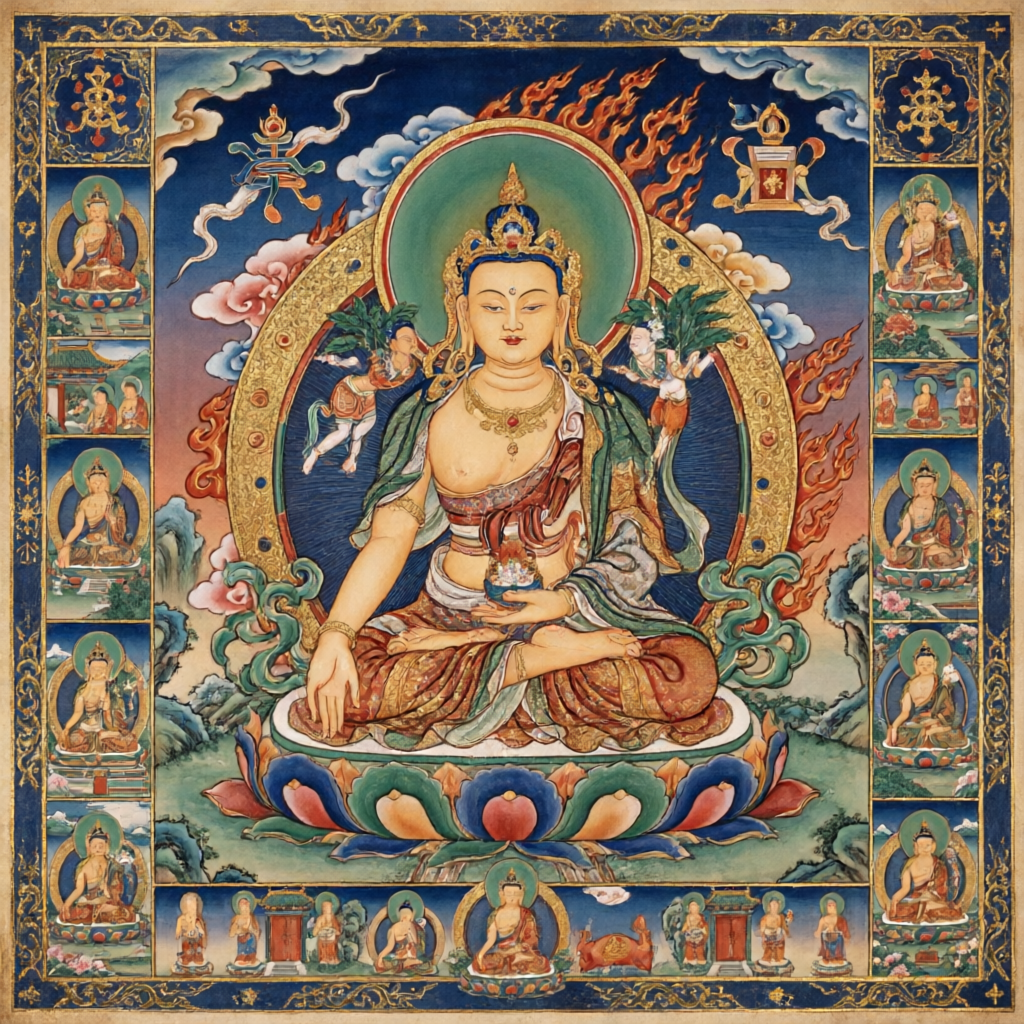
Thangka
Overview
Thangka, also spelled Thang-ga, is a type of Tibetan Buddhist painting on cotton or silk appliqué, usually depicting a Buddhist deity, scene, or mandala. These intricate artworks are created in a meticulous process that can take months or even years to complete. Thangkas serve as important religious devotional objects in Tibetan Buddhism and are also valued for their artistic and cultural significance. In 2006, Thangka painting was inscribed on the list of National Intangible Cultural Heritage of China.
History
The origins of Thangka are subject to various scholarly interpretations. Four main theories exist regarding its development:
-
Indian Influence: According to Italian scholar Giuseppe Tucci, Thangka originated from Indian religious paintings called "pata," which were introduced to Tibet along with Buddhism. Proponents of this theory note similarities in canvas materials and proportions between Thangkas and Indian patas.
-
Chinese Influence: Chinese scholar Jie Sheng Xie proposed that Thangka developed under the influence of Chinese scroll painting. In his work "The Origin of Thangka," he suggests that Thangka evolved alongside the development of Chinese scroll painting from the Han to Yuan dynasties.
-
Royal Origin: Tibetan tradition attributes the first Thangka to King Songtsen Gampo of Tibet, who allegedly painted a goddess image with his own nasal blood, as recorded in the "Siddhartha Mirror of Crystal" by the Fifth Dalai Lama.
-
Bön Tradition: Some scholars believe Thangka evolved from portable religious paintings used by practitioners of Bön, the indigenous Tibetan religion, which were later adopted and adapted by Buddhism.
Key Information
| Category | Details |
|---|---|
| Chinese Name | 唐卡 (Tángkǎ) |
| Alternative Names | 唐嘎 (Tánggā), 唐喀 (Tángkā) |
| Definition | Religious scroll painting mounted with colored silk |
| Region | Tibet Autonomous Region |
| Intangible Heritage Status | National (since 2006) |
| Heritage Category | Folk Art |
| Heritage Number | Ⅶ—14 |
Artistic Styles
Several distinct artistic schools of Thangka painting have emerged throughout history:
Nepalese Style
Popular from the 11th to 13th centuries, this style was influenced by artists accompanying Princess Bhrikuti of Nepal when she married Songtsen Gampo. Characterized by warm tones, prominent central figures, and simple but stiff figures with heavy ornaments.
Khyenri Style
Developed in the 13th century in the Ü-Tsang region, this style incorporated elements from both Tibetan and Nepalese traditions. It featured more balanced compositions and more detailed depictions of figures and backgrounds.
Menri Style
Founded by Menla Döndrub in the 15th century, this school emphasized strict iconographic measurements and refined line work. It became dominant during the Gelugpa period and influenced later developments in Tibetan art.
Karma Gadri Style
Originating in the 16th century in eastern Tibet (Kham), this style incorporated Chinese landscape painting techniques. It was influenced by the Karma Kagyu school of Tibetan Buddhism and developed distinct regional characteristics.
New Menri Style
Emerging in the 17th century during the time of the Fifth Dalai Lama, this style synthesized elements from Menri, Karma Gadri, and other traditions. It established standardized iconographic measurements that became influential throughout Tibet.
Subjects and Themes
Thangkas are often called the "encyclopedia of Tibetan culture" due to their diverse subject matter:
Religious Subjects
- Mandala diagrams
- Buddha figures and bodhisattvas
- Tibetan deities and protectors
- Scenes from Buddhist scriptures
- Wheel of life (Bhavacakra)
- Western Paradise
Secular Subjects
- Historical events
- Tibetan medicine and anatomy
- Astronomy and astrology
- Folk tales and legends
- Architectural scenes
Materials and Techniques
Thangkas can be created using various methods:
Painting
- Traditional mineral and vegetable pigments
- Applied to cotton or silk canvas
- Often includes gold leaf accents
Appliqué
- Embroidered Thangkas
- Brocade Thangkas
- Appliquéd Thangkas with cut fabric pieces
Special Types
- Pearl Thangkas (extremely rare)
- Printed Thangkas
Creation Process
The creation of a Thangka is a ritualistic process:
1. Canvas preparation and stretching
2. Application of gesso and polishing
3. Drawing the outline
4. Applying colors layer by layer
5. Detail work and gold application
6. "Opening the eyes" (final ritual)
7. Consecration and blessing
Cultural Significance
Thangkas serve multiple functions in Tibetan culture:
Religious Value
- As meditation aids
- For teaching Buddhist concepts
- As objects of veneration and merit accumulation
- As portable altars for nomadic practitioners
Historical Value
- Documenting historical events and figures
- Preserving cultural knowledge
- Recording religious lineage and teachings
Artistic Value
- Representing the pinnacle of Tibetan artistic achievement
- Influencing other art forms in the region
- Demonstrating sophisticated techniques and symbolism
Modern Status
While traditional Thangka creation continues, the art form faces challenges:
Preservation Efforts
- Recognition as national intangible cultural heritage
- Establishment of training programs
- Documentation of techniques and styles
- Museum exhibitions and academic study
Market Development
- Growing international interest
- Rising market values
- Concerns about authenticity and mass production
- Balancing tradition with commercialization
References
-
Tucci, Giuseppe. Tibetan Painted Scrolls. Rome: La Libreria dello Stato, 1949.
-
Jackson, David P. A History of Tibetan Painting. Vienna: Verlag der Österreichischen Akademie der Wissenschaften, 1996.
-
Gray, Theodore. Tibetan Thangka Painting: Methods and Materials. London: Thames & Hudson, 1977.
-
Gutschow, Niels. The Creation of Religious Art in Tibet. New York: Oxford University Press, 2004.
-
Beckwith, Christopher. The Tibetan Empire in Central Asia. Princeton: Princeton University Press, 1987.