Overview
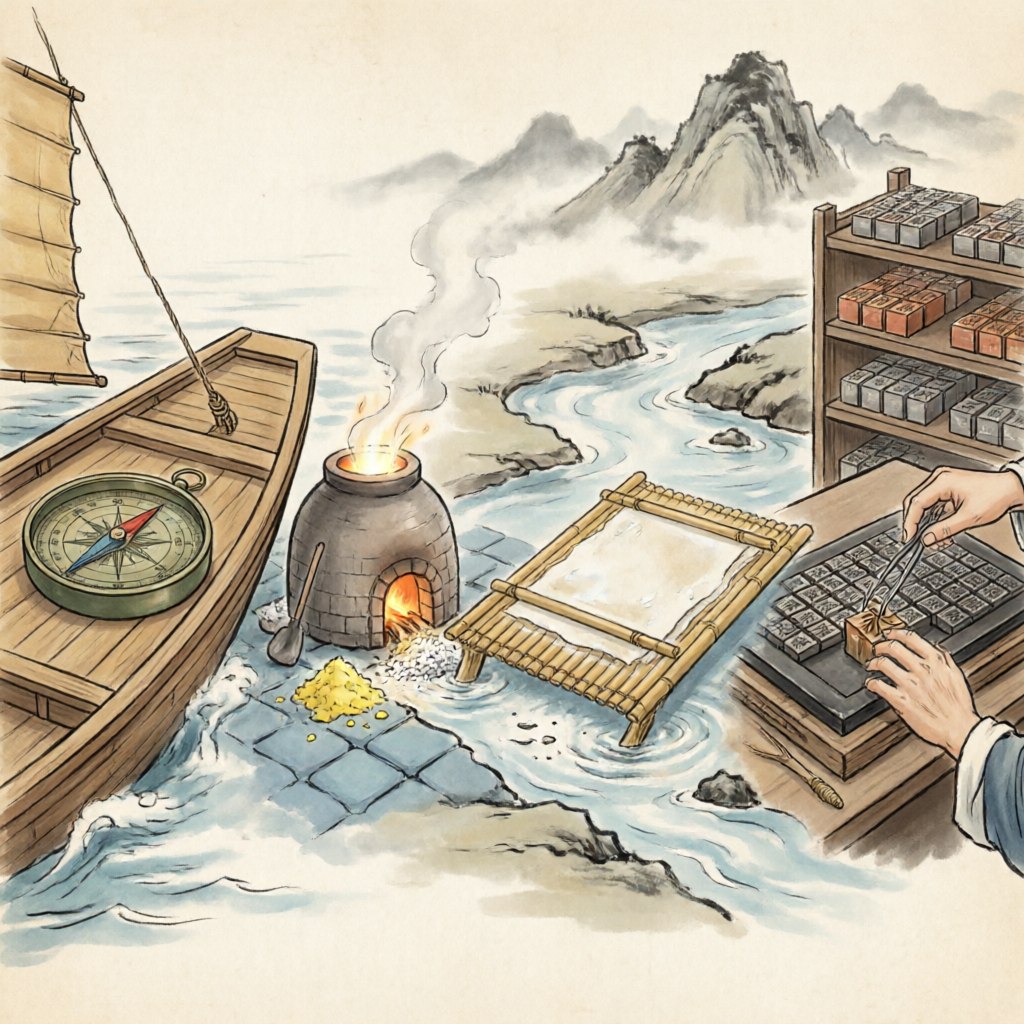
The Four Great Inventions of ancient China—papermaking, printing, the compass, and gunpowder—represent significant technological achievements that profoundly influenced the development of human civilization. While Chinese civilization has many achievements named in groups of "four," "five," and so on, the concept of the "Four Great Inventions" originated from Western scholars before being adopted by Chinese intellectuals. These inventions revolutionized communication, navigation, warfare, and scientific development, spreading from China to other parts of the world and accelerating global progress.
History
Origins of the Concept
The concept of China's "Four Great Inventions" was first articulated by Western scholars. Italian mathematician Girolamo Cardano, as early as 1550, identified China's "three great inventions": the south-pointing spoon (compass), printing, and gunpowder, considering them "unequalled in antiquity." In 1621, English philosopher Francis Bacon mentioned in his book "Novum Organum" that printing, gunpowder, and the compass "have changed the whole face and state of things throughout the world."
Between 1861-1863, Karl Marx and Friedrich Engels elevated the significance of these inventions. Marx wrote in "Machinery, Natural Science, and the Science of Technology": "Gunpowder, the compass, and printing—these were the three inventions that foretold the coming of bourgeois society. Gunpowder blew up the knightly class, the compass opened up world markets and founded colonies, and printing became the tool of Protestantism and in general the most powerful lever for the intellectual development of the masses."
Papermaking
Papermaking represents one of humanity's most remarkable inventions. China was the first country in the world to cultivate silkworms and produce silk. Ancient Chinese people used high-quality silkworm cocoons for weaving silk, while inferior cocoons were processed into silk floss through a method called "piao xu" (漂絮). After repeated processing, fiber薄片 (fiber flakes) accumulated on bamboo mats, which could be dried and used for writing. This byproduct, known as "he ti" or "fang xu" in ancient texts, reveals the connection between papermaking and silk processing.
Research suggests that papermaking likely originated in southern China, closely related to the tree bark cloth culture that emerged around the Pearl River Delta 6,000 years ago. Archaeological discoveries in the region, including stone beaters dating back 6,800 years, indicate that southern China was the birthplace of tree bark cloth culture, which could be processed into paper-like materials.
While ancient Egypt had papyrus and Europe used parchment, China developed silk floss paper and "jian bo" paper. However, it was Cai Lun's paper, made from plant fibers, that had a profound impact on global papermaking. Cai Lun, during the Eastern Han Dynasty (25-220 AD), expanded the range of raw materials to include rags, fishnets, tree bark, and hemp heads, developing papermaking into an independent craft rather than a byproduct of textile production.
Papermaking spread to Japan via Korea in the 7th century, reached the Arab world in the mid-8th century, and was adopted in Europe by the 12th century.
The Compass
The compass is a simple instrument for determining direction, evolving from earlier "si nan" (司南). Its main component is a magnetic needle mounted on an axis that can rotate freely. Under the Earth's magnetic field, the needle aligns with the magnetic meridian.
China is universally recognized as the inventor of the compass. The invention resulted from ancient Chinese people's understanding of magnetism through production activities. Initially, people discovered that lodestone could attract iron, and later recognized its directional properties.
During the Warring States period (475-221 BC), Chinese people created "si nan" based on the magnetic properties of lodestone. The earliest description appears in "Han Feizi": "The ancient kings established si nan to determine directions." By the Northern Song Dynasty (960-1127 AD), people invented the method of artificially magnetizing iron needles, creating the compass that began to be used in navigation. During the Southern Song Dynasty (1127-1279 AD), the compass was widely used in navigation and spread to the Arab world, reaching Europe in the early 13th century.
The application of the compass in navigation facilitated voyages such as Christopher Columbus's discovery of America and Ferdinand Magellan's circumnavigation, significantly accelerating global economic development.
Gunpowder
Gunpowder, a black or brown explosive composed of potassium nitrate, charcoal, and sulfur, was invented by ancient Chinese alchemists during the Sui and Tang dynasties (581-907 AD). The research began in ancient Taoist alchemy, where practitioners sought elixirs of immortality.
Alchemists developed methods to neutralize the toxicity of minerals like sulfur and arsenic through a process called "fu huo" (伏火, "fire subduing"). During the mid-Tang Dynasty, alchemist Chuan Xuanqi proposed a formula in "Fu Fan Fa" containing sulfur, saltpeter, and Aristolochia, which could combust when ignited. This mixture, containing carbon, sulfur, and saltpeter, constituted an easily combustible substance later known as gunpowder.
Initially used as a medicinal substance, gunpowder's formula was eventually transferred to military applications. In early forms, gunpowder was wrapped around arrows and launched with bows to burn enemies. During the Song Dynasty, gunpowder was packed into bamboo tubes with small "directional sticks," creating the world's first gunpowder rockets. Later developments included primitive firearms like the "fire lance" and "fire gun," which were the ancestors of modern firearms.
Europeans only understood the properties of black powder in the 13th century. After several centuries of development and improvement, black powder weapons gradually replaced cold weapons, revolutionizing land warfare tactics, siege techniques, and naval warfare. Black powder remained the primary explosive and propellant until the mid-19th century when it was gradually replaced by newer inventions like smokeless powder, TNT, and other high explosives.
Key Information
| Invention | Period of Origin | Key Innovator(s) | Global Impact |
|---|---|---|---|
| Papermaking | Eastern Han Dynasty (25-220 AD) | Cai Lun | Revolutionized record-keeping, spread knowledge globally, replaced expensive parchment and papyrus |
| Printing | Tang Dynasty (618-907 AD), perfected in Song Dynasty | Bi Sheng (movable type) | Enabled mass production of texts, facilitated spread of knowledge, fueled Renaissance and Reformation |
| Compass | Warring States period (475-221 BC), developed into compass in Song Dynasty | Various inventors | Revolutionized navigation, enabled global exploration, shaped trade routes and colonization |
| Gunpowder | Tang Dynasty (618-907 AD) | Alchemists | Transformed warfare, led to development of firearms, changed military tactics and siege warfare |
Cultural Significance
The Four Great Inventions hold immense cultural significance in China and worldwide. They represent the innovative spirit of ancient Chinese civilization and demonstrate how technological advancements can shape human history. In China, these inventions are celebrated as symbols of national pride and intellectual achievement.
The inventions also exemplify the process of cultural diffusion and technological transmission across civilizations. Each invention spread from China to other parts of the world through various channels including trade routes, diplomatic missions, and cultural exchanges, where they were adapted and further developed.
Philosophically, the inventions reflect ancient Chinese approaches to understanding and utilizing natural phenomena. The compass, for example, was initially explained through阴阳五行学说 (Yin-Yang Five Elements theory) before modern scientific understanding of magnetism developed.
Modern Status
Today, the Four Great Inventions are recognized globally as cornerstones of human technological development. While their original forms have been superseded by modern technologies, their fundamental principles continue to influence contemporary innovations.
In China, the Four Great Inventions are prominently featured in educational curricula and cultural exhibitions, serving as symbols of China's historical contributions to world civilization. The inventions have also inspired modern Chinese technological ambitions, with initiatives like "Made in China 2025" aiming to achieve similar breakthroughs in contemporary fields.
Internationally, these inventions are studied as examples of how technological innovations can transform societies and drive global progress. They continue to be referenced in discussions about innovation, technology transfer, and cultural exchange between civilizations.
References
-
Needham, Joseph. (1986). Science and Civilisation in China, Volume 5: Chemistry and Chemical Technology, Part 7: Military Technology: The Gunpowder Epic. Cambridge University Press.
-
Temple, Robert. (1986). The Genius of China: 3,000 Years of Science Discovery and Invention. Prion Books.
-
Dutton, Yves H. (2012). "The Invention of the Compass." In Encyclopedia of the History of Science, Technology, and Medicine in Non-Western Cultures. Springer.
-
Fang, Chaoying. (2000). "Gunpowder." In Encyclopedia of China (Chinese History Edition). Encyclopedia of China Publishing House.
-
Tsien, Tsuen-Hsuin. (1985). Paper and Printing. In Science and Civilisation in China, Volume 5: Chemistry and Chemical Technology, Part 1. Cambridge University Press.