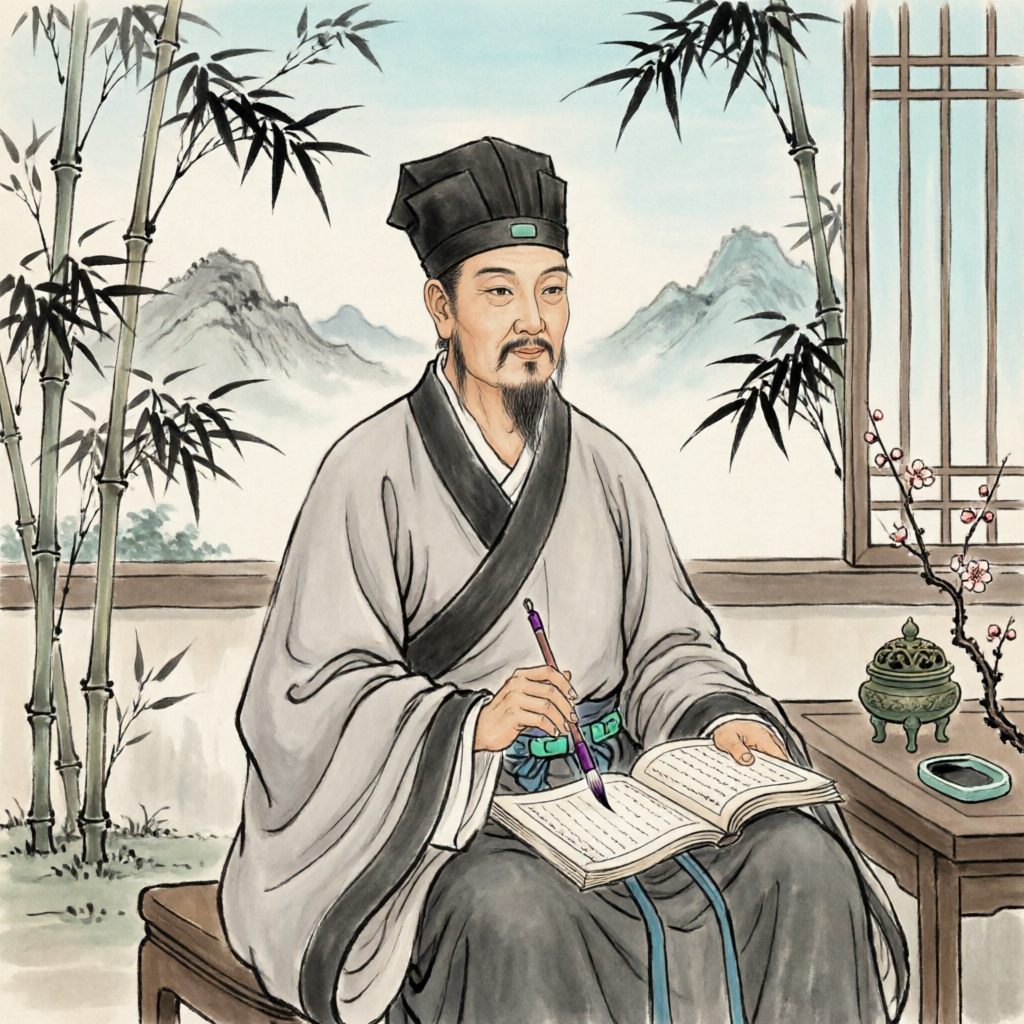
Cheng Hao
Overview
Cheng Hao (1032-1085), courtesy name Bochun, was a renowned philosopher, educator, and official during the Northern Song Dynasty (北宋). He is celebrated as one of the principal founders of Neo-Confucianism (理学), often referred to as "Master Mingdao" (明道先生). Along with his younger brother Cheng Yi, Cheng Hao established the "Luo School" (洛学) of philosophy, which laid the theoretical foundation for Song Confucianism. Their collective works and philosophical insights have profoundly influenced East Asian thought for nearly a millennium.
History
Cheng Hao was born on February 28, 1032, in Huangpi County (modern-day Huangpi District, Wuhan), Hubei Province. His ancestors had a long tradition of serving as officials, with his great-grandfather Cheng Yu moving from Bianjing (modern Kaifeng, Henan) to Henan Prefecture (modern Luoyang, Henan). Cheng Hao's father, Cheng Xiang, held various official positions, including that of a county magistrate.
From an early age, Cheng Hao and his brother Cheng Yi were deeply influenced by their family's scholarly traditions, particularly their father's political thought, which was characterized by opposition to Wang Anshi's New Policies. Cheng Hao demonstrated exceptional intellectual abilities and was known for his composed demeanor, with contemporaries noting they never saw him display anger or agitation despite decades of association.
Cheng Hao passed the imperial examination in 1057 and subsequently held various official positions, including county secretary, magistrate of Jincheng (modern Jincheng, Shanxi), and Censor. During the reign of Emperor Shenzong (1068-1085), he served as a Censor but, due to his political disagreements with Wang Anshi, was not entrusted with significant responsibilities. Consequently, he devoted himself to academic pursuits, establishing schools in places such as Songyang and Fugou, and developing his educational philosophy.
Cheng Hao passed away on July 9, 1085, at the age of 54, before he could assume his new position as Palace Aide to the Censor-in-Chief. His posthumous honors included the title "Pure Duke" (纯公) in 1220, elevation to "Earl of Henan" (河南伯) in 1241, and "Duke of Yu State" (豫国公) in 1330.
Key Information
| Aspect | Details |
|---|---|
| Personal Name | Cheng Hao (程颢) |
| Courtesy Name | Bochun (伯淳) |
| Posthumous Title | "Pure Duke" (纯公) |
| Era | Northern Song Dynasty (北宋) |
| Birth Date | February 28, 1032 |
| Death Date | July 9, 1085 |
| Birthplace | Huangpi County, Huangzhou (modern Wuhan) |
| Native Place | Huizhou (modern Huangshan, Anhui) |
| Main Accomplishments | Co-founder of Neo-Confucianism (理学), establishment of the "Luo School" (洛学) |
| Major Works | "Discourse on Kingly and Hegemonic Rule" (论王霸札子), "Memorial on Ten Matters" (论十事札子), "On Settling the Nature" (定性书), "Understanding Benevolence" (识仁篇) |
| Educational Philosophy | Emphasized cultivation of sagehood through understanding the "Principle of Heaven" (天理), prioritized classical Confucian texts, and advocated "investigating things to extend knowledge" (格物致知) |
Cultural Significance
Cheng Hao's philosophical contributions represent a significant transformation in Chinese intellectual history. He and his brother Cheng Yi established the concept of "Li" (理, Principle) as the ultimate cosmic and moral order, which became the cornerstone of Neo-Confucianism. Their proposition that "all things are but one Principle" (万物皆只是一个天理) fundamentally reinterpreted Confucian thought by integrating cosmological speculation with ethical principles.
Cheng Hao's educational philosophy emphasized that the purpose of learning was to cultivate sagehood, stating that "the scholar's pursuit must continue until he becomes a sage; stopping short of this is to abandon the path." He stressed that education must be based on Confucian classics and ethical principles, while warning against excessive focus on textual interpretation without understanding deeper principles.
The cultural impact of Cheng Hao's work extends beyond philosophy into Chinese social and political thought. His integration of ethical principles with cosmic order provided intellectual justification for the existing social hierarchy, stating that "the distinction between superior and inferior, the propriety of respect and humility, are what is correct according to the Principle and the foundation of ritual." This perspective influenced Chinese governance and social organization for centuries.
Modern Status
Today, Cheng Hao is recognized as one of the most significant philosophers in Chinese history. His works, collectively compiled in the "Cheng Family Writings" (二程集), remain essential texts in the study of Chinese philosophy. The "Henan Cheng Clan's Recorded Sayings" (河南程氏遗书), compiled by his disciples and later edited by Zhu Xi, preserves many of his teachings.
Modern scholarship continues to explore Cheng Hao's contributions to philosophy, education, and political thought. His distinction between "innate nature" (天命之性) and "material nature" (气质之性) remains influential in discussions of human psychology and ethics. His emphasis on "investigating things to extend knowledge" (格物致知) anticipated modern empirical approaches, though his metaphysical framework differs significantly from contemporary scientific thought.
The places associated with Cheng Hao, including the former sites of his schools and ancestral home in Huangpi, have become cultural landmarks. The "Two Chengs Ancestral Hall" (二程祠) in Henan and the Songyang Academy, where he taught, continue to attract scholars and tourists interested in Chinese philosophical traditions.
References
-
Chan, Wing-tsit. A Source Book in Chinese Philosophy. Princeton University Press, 1963.
-
de Bary, William Theodore, and Irene Bloom. Sources of Chinese Tradition. Columbia University Press, 1999.
-
Tu, Weiming. Neo-Confucianism in History. Harvard University Press, 2001.
-
Gardner, Daniel K. Learning to Be a Sage: Selections from the Conversations of Cheng Yi. University of California Press, 1990.
-
Bol, Peter K. "This Culture of Ours: Intellectual Transitions in Tang and Sung China." Stanford University Press, 1992.