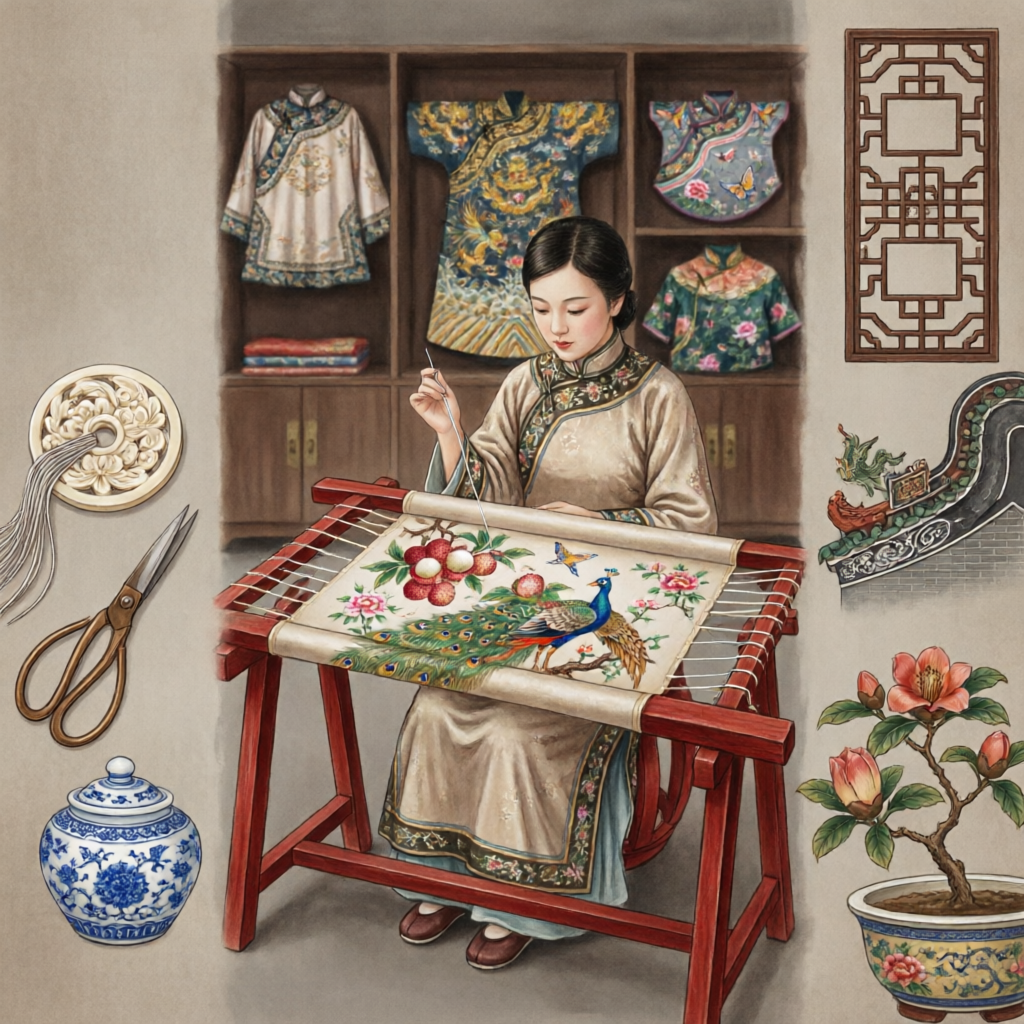
Overview
Cantonese Embroidery (Yue Xiu), also known as Guang Embroidery, is a traditional Chinese embroidery style originating from the Guangdong province. It is one of China's Four Great Embroideries, alongside Suzhou, Hunan, and Sichuan embroidery. Cantonese Embroidery is renowned for its vibrant colors, elaborate patterns, and distinctive techniques that create three-dimensional effects. The art form encompasses two major schools: Guang Embroidery from the Guangzhou region and Chaozhou Embroidery from the Chaozhou area, each with its own unique characteristics and artistic expressions.
History
The origins of Cantonese Embroidery can be traced back to the Tang Dynasty (618-907 CE), when embroidery techniques were brought to the Lingnan region by immigrants from the Central Plains. Lu Meiniang, a 14-year-old girl from Nanhai (present-day Guangzhou), is regarded as the founder of Cantonese Embroidery. According to historical records in the Duyang Zabian, Lu embroidered seven volumes of the Lotus Sutra on a piece of silk cloth just one foot square, with characters as small as millet grains yet clearly defined and as fine as hairs. Emperor Shunzong of Tang was so impressed by her skill that he called her "Divine Lady," and Emperor Xianzong rewarded her with a golden phoenix ring for her wisdom and ingenuity.
During the Ming Dynasty (1368-1644), Cantonese Embroidery began to gain international recognition. In 1514, a Portuguese merchant purchased an embroidered dragon robe fragment in Guangzhou and presented it to his king, receiving a substantial reward. By 1600, Queen Elizabeth I of England had developed such a fondness for Cantonese gold and silver thread embroidery that she established the English Embroiderers' Guild, importing Chinese silk and threads to create noble garments. King Charles I further promoted the cultivation of mulberry trees and silkworm rearing in Britain, helping to develop the country's silk industry. Cantonese Embroidery became known in the West as "China's gift to the West," and examples were collected in museums across England, France, Germany, and the United States.
In the Qing Dynasty (1644-1912), Cantonese Embroidery flourished, particularly after 1757 when the Qianlong Emperor restricted foreign trade to Canton (Guangzhou), stimulating local embroidery production. In 1793, the "Jinxiu Hang" (Embroidery Guild) and specialized export firms were established in Guangzhou, setting standards for production time, materials, patterns, colors, specifications, and pricing. During this period, "Pi Jin Xiu" (leather gold embroidery) became popular, using sheepskin gold as a backing for a shimmering effect. Embroidery artists innovatively used peacock feathers and horsehair threads to create unique textures and effects.
Key Information
| Aspect | Description |
|---|---|
| Chinese Name | 粤绣 (Yue Xiu) |
| English Name | Cantonese Embroidery |
| Heritage Status | National Intangible Cultural Heritage (China) |
| Heritage Number | Ⅶ—20 |
| Application Region | Guangdong Province |
| Category | Guangzhou City |
| Recognition Date | Listed as National Intangible Cultural Heritage |
| Major Schools | Guang Embroidery (Guangzhou), Chaozhou Embroidery |
| Key Materials | Silk, gold/silver threads, peacock feathers, horsehair |
| Distinctive Techniques | "Shui Lu" (water paths), "Ding Jin Xiu" (gold thread embroidery), "Jinrong Hunhe Xiu" (gold and silk mixed embroidery) |
Cultural Significance
Cantonese Embroidery holds significant cultural value as both an art form and a craft deeply embedded in the social and cultural life of Guangdong. The embroidery reflects the region's history, aesthetics, and values through its motifs and techniques. Traditional themes include dragons, phoenixes, peacocks, peonies, "hundred birds paying homage to the phoenix," and southern Chinese fruits like lychees, all symbolizing prosperity, beauty, and good fortune.
The art form also represents the cultural exchange between China and the West. From the Ming Dynasty onward, Cantonese Embroidery was exported to Europe and influenced Western fashion and decorative arts. Western nobility highly valued embroidered garments from Guangzhou, and the techniques and designs were adapted in European textile production.
Cantonese Embroidery is also significant in the development of Cantonese opera. The elaborate embroidery used in opera costumes became a specialized branch of the craft, with costumes from "Zhuangyuan Fang" (Scholar's Lane) in Guangzhou becoming famous nationwide. These costumes were so renowned that even imperial troupes commissioned them.
Modern Status
Today, Cantonese Embroidery continues to be practiced and preserved as an important cultural heritage. In 2012, Chen Shaofang was recognized as a national intangible cultural heritage inheritor for her contributions to Guang Embroidery. The art form has evolved to incorporate contemporary designs while maintaining traditional techniques.
Modern Cantonese Embroidery encompasses various categories including wall hangings, screens, clothing, accessories, and religious artifacts. The craft is divided into several types based on technique: silk thread embroidery, gold and silver thread embroidery, double-sided embroidery, and padded embroidery. Chaozhou Embroidery is particularly famous for its "Ding Jin Xiu" (gold thread embroidery), which creates a three-dimensional relief effect by padding the embroidery surface.
Educational institutions like the Guangzhou Arts and Crafts Research Institute and the Chaozhou Embroidery Research Institute work to document and preserve traditional techniques. In recent years, Cantonese Embroidery has been featured in international exhibitions and cultural exchanges, demonstrating its enduring appeal and artistic value.
The craft continues to adapt to contemporary contexts, with artists creating works that blend traditional techniques with modern aesthetics. In 2025, Cantonese Embroidery techniques were incorporated into costumes for the closing ceremony of the 15th National Games, showcasing the art form's relevance in contemporary cultural expression.
References
-
Gao, J. (2008). Chinese Embroidery: Traditional Techniques. Yale University Press.
-
Wang, X. (2012). The Art of Cantonese Embroidery: History, Techniques, and Cultural Significance. Guangdong People's Publishing House.
-
Li, Y., & Chen, S. (2015). Intangible Cultural Heritage of China: Cantonese Embroidery. Cultural Relics Publishing House.
-
Jiang, Z. (2010). Traditional Chinese Handicrafts: Embroidery. Shanghai Publishing House.
-
Brown, R. (2018). Silk and Silver: The History of Chinese Embroidery in Europe. Oxford University Press.