Overview
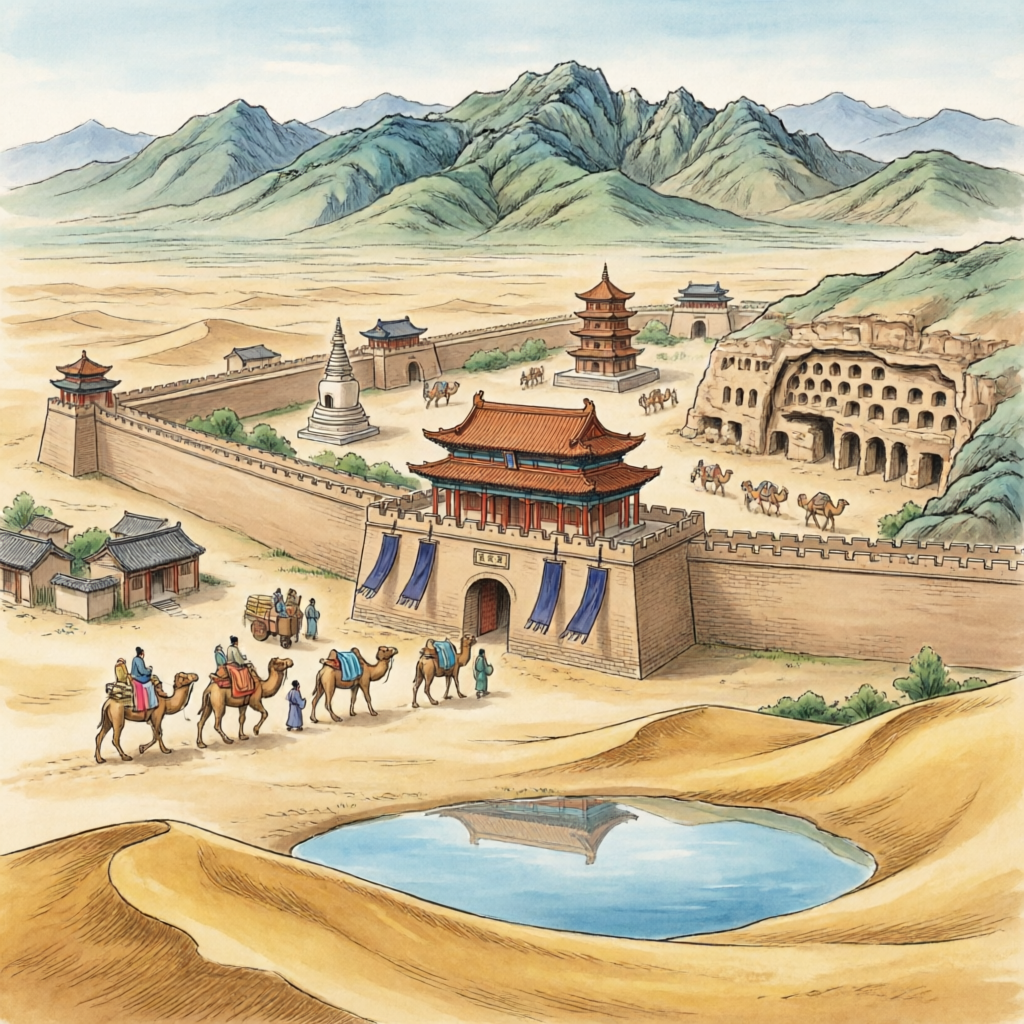
Dunhuang City is located in the northwestern part of Gansu Province, China, at the convergence of Gansu, Qinghai, and Xinjiang provinces. It is situated at the westernmost end of the Hexi Corridor and covers an area of 26,700 square kilometers, with an oasis area of 1,991 square kilometers. The city has a population of approximately 182,000 people as of the end of 2024, with a significant portion living in urban areas. Dunhuang is internationally famous for its historical role as a major stop on the ancient Silk Road and for being home to the Mogao Caves, a UNESCO World Heritage Site.
History
The history of Dunhuang dates back approximately 4,000 years to the Shun and Yu periods of ancient China. According to historical records, Shun exiled the Sanmiao people to Sanwei, who became the earliest known inhabitants of the Dunhuang region. During the Xia and Shang dynasties, the Qiang and Rong peoples of the Yumen Huoshagou culture inhabited the area. During the Spring and Autumn Period, the Yuezhi and Wusun nomadic tribes grazed their livestock in the region.
During the Qin and Han dynasties, the Xiongnu rose to power and conquered the Yuezhi, occupying Dunhuang. During the reign of Emperor Wu of the Western Han, after a series of wars against the Xiongnu, the Hexi region was incorporated into the Han Dynasty's territory. Zhang Qian's diplomatic missions to the Western Regions opened the Silk Road. In 111 BCE, the Dunhuang Commandery was established.
During the Three Kingdoms period, the Dunhuang Commandery was maintained by the Cao Wei regime. When the Jin Dynasty moved south, Dunhuang came under separate administration from the central plains. During the Sixteen Kingdoms period, the Former Liang combined Dunhuang, Jinchang, and Gaochang commanderies with the Western Regions Protectorate, Wujin Colonel, and Yumen Grand Protectorate to establish Shazhou.
In 400 CE, Li Gao declared himself "Duke of Liang" in Dunhuang Commandery, establishing the Western Liang kingdom with its initial capital in Dunhuang. In 439 CE, at the beginning of the Northern Wei Dynasty, Dunhuang Garrison was established. By the late Yanchang period (512-515 CE), Guazhou was established, with Dunhuang serving as its administrative center.
During the Sui Dynasty, the Dunhuang Commandery was reestablished in 607 CE, and Mingsha County was renamed Dunhuang County. In 622 CE, during the Tang Dynasty, it was renamed Xisha Zhou, and in 633 CE, it was renamed Shazhou again. In 640 CE, Emperor Taizong of Tang eliminated the Western Turks' obstacles along the eastern and western routes, ensuring the畅通 (smooth passage) of the Silk Road and ushering in a period of prosperity for Dunhuang.
In 727 CE, the Tang-Tibetan wars began in the Hexi Corridor, and Guazhou City was temporarily captured by the Tibetans. After the An Lushan Rebellion, the Tang Dynasty transferred troops from the Hexi region to suppress the rebellion, allowing the Tibetans to invade. Around 781 CE, Shazhou fell to Tibetan forces after being besieged for ten years. Tibetan rule over Dunhuang lasted for 67 years, during which the economy and culture flourished, and magnificent Tibetan Buddhist art emerged in the Mogao Caves.
In 848 CE, Zhang Yichao of Shazhou led an uprising that overthrew Tibetan aristocratic rule and established the Guiyi Army regime, returning the Hexi region to Tang Dynasty control. This period in Dunhuang's history is known as the Guiyi Army period, which lasted until 1036 CE when the Western Xia occupied the region.
During the Western Xia's rule, Dunhuang was occupied for 191 years. After the Yuan Dynasty conquered the Western Xia, Shazhou was reestablished in 1277 CE. In 1280 CE, it was upgraded to Shazhou Route Prefecture, administered by the Gansu Provincial Administration Commission. In 1405 CE, during the Ming Dynasty, it was changed to Shazhou Guard, later with the addition of Handong Left Guard. In 1528 CE, the Ming government closed Jiayu Pass, and Guazhou and Shazhou were abandoned for 200 years, leading to the decline of Dunhuang.
In 1715 CE, Qing troops recaptured the entire Hexi region and advanced into the Western Regions. In 1723 CE, the Qing Dynasty established Shazhou Division in Dunhuang, which was upgraded to Shazhou Guard two years later. In 1726 CE, over 2,400 households from 56 prefectures and counties in Gansu were resettled in Shazhou for reclamation. In 1760 CE, it was renamed Dunhuang County. In 1913 CE, during the Republic of China period, Anxi Prefecture was changed to Anxi County, and Dunhuang County came under the direct administration of Gansu Province. On September 28, 1949, Dunhuang was liberated.
Key Information
| Category | Information |
|---|---|
| Chinese Name | 敦煌市 (Dunhuang City) |
| Alternative Name | 沙州 (Shazhou) |
| Administrative Code | 620982 |
| Administrative Status | County-level city |
| Affiliated Region | Jiuquan City, Gansu Province |
| Geographic Location | Northwestern Gansu Province |
| Area | 26,700 km² |
| Jurisdiction | 9 towns |
| Government Seat | No. 888 Yangguan Middle Road, Shazhou Town, Dunhuang City |
| Telephone Area Code | 0937 |
| Postal Code | 736200 |
| Climate | Warm temperate arid climate |
| Population | 182,000 (end of 2024) |
| Famous Attractions | Mogao Caves, Mingsha Mountain and Crescent Lake |
| Airport | Dunhuang Airport (near Mogao Caves) |
| Railway Station | Dunhuang Railway Station |
| Vehicle License Code | 甘J (Gan J) |
| Regional GDP | 10.09 billion yuan (2024) |
Cultural Significance
Dunhuang holds immense cultural significance as a crucial hub along the ancient Silk Road. The city's strategic location at the junction of Eastern and Western civilizations facilitated the exchange of goods, ideas, and cultural practices for centuries. The Mogao Caves, with their extensive collection of Buddhist art spanning a millennium, represent one of the most important cultural treasures of ancient China and Central Asia.
The caves contain over 2,000 painted murals and more than 45,000 manuscripts, creating a comprehensive record of Buddhist art, religious practice, and daily life along the Silk Road. The diverse artistic styles and influences found in the caves demonstrate the cultural fusion between Chinese, Indian, Persian, and Central Asian traditions.
During the Tibetan occupation period (781-848 CE), Dunhuang experienced a cultural renaissance with the emergence of distinctive Tibetan Buddhist art. The city's position as a melting pot of cultures is further evidenced by the discovery of the Dunhuang manuscripts, which include texts in various languages including Chinese, Tibetan, Sanskrit, Sogdian, and Uyghur.
Modern Status
Today, Dunhuang is a thriving tourist destination and cultural center. The city's economy is primarily driven by tourism, with visitors from around the world coming to explore the Mogao Caves, Mingsha Mountain, and Crescent Lake. In recent years, Dunhuang has also developed renewable energy resources, becoming China's first base for one million kilowatts of solar photovoltaic power generation in 2010.
The city has made significant investments in infrastructure and flood control measures, particularly along the Dang River, which is crucial for agricultural irrigation. Dunhuang's administrative structure includes nine towns, with Shazhou Town serving as the government seat. The city continues to balance preservation of its rich cultural heritage with modern development, implementing sustainable practices to protect its fragile desert environment while promoting economic growth.
References
-
Whitfield, R. (1990). The Art of Central Asia: The Stein Collection in the British Museum. Tokyo: Kodansha International.
-
Hansen, V. (2009). The Silk Road: A New History. Oxford: Oxford University Press.
-
Su, B. & Zhang, J. (2017). Dunhuang: A Concise History. Dunhuang: Dunhuang Research Academy Publishing House.