Terracotta Warriors
Overview
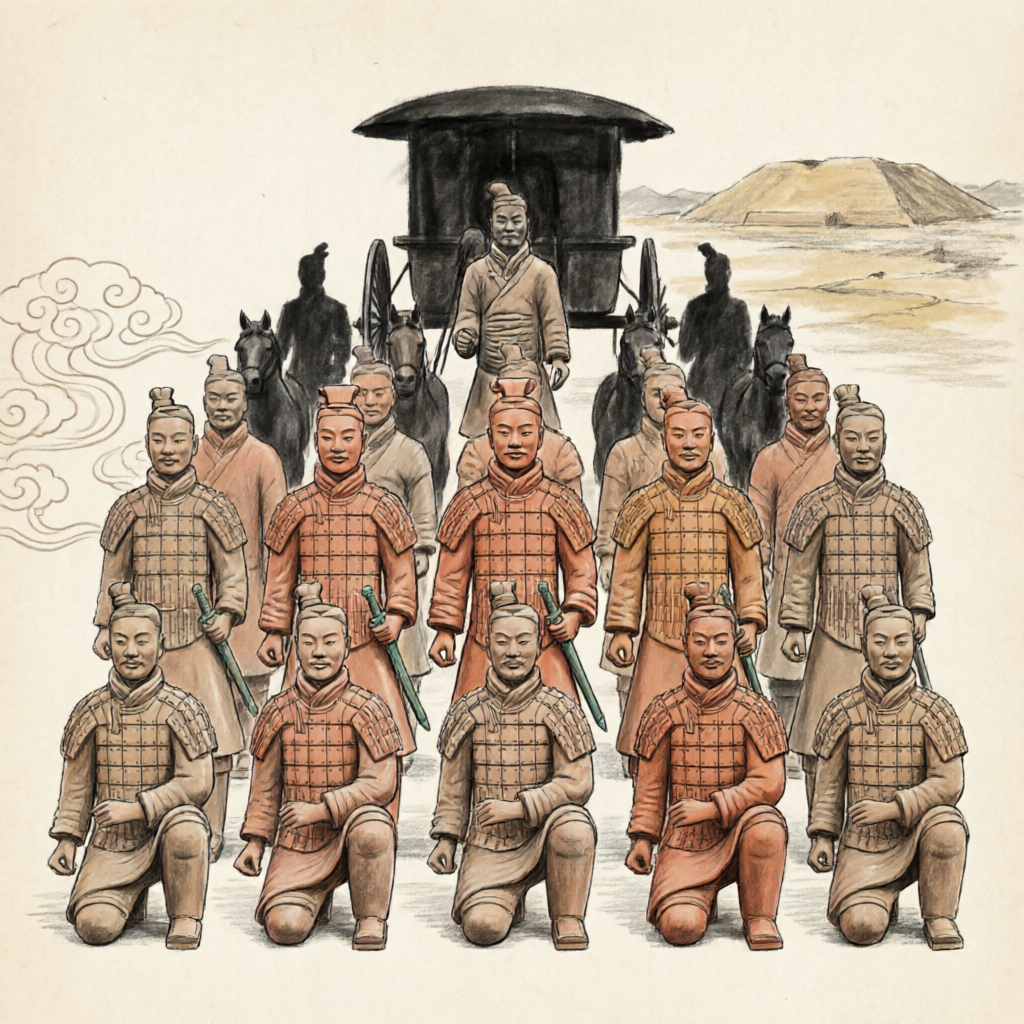
The Terracotta Warriors, also known as the Terracotta Army or Terracotta Figures, are a collection of terracotta sculptures depicting the armies of Qin Shi Huang, the first Emperor of China. These sculptures were buried with the emperor in 210-209 BCE with the purpose of protecting him in the afterlife. The figures vary in height, uniform, and hairstyle in accordance with rank. The collection includes 8,000 soldiers, 130 chariots with 520 horses, and 150 cavalry horses, the majority of which remained buried in the pits adjacent to the emperor's mausoleum. The Terracotta Army is a form of funerary art buried with the emperor and was both a demonstration of emperor's power and a safeguard for the journey to the afterlife.
History
The practice of human sacrifice accompanied the disintegration of primitive public ownership and flourished with the establishment of slavery [7]. Human sacrifice reached its zenith during the Shang Dynasty, where noble tombs contained numerous sacrificial victims. At the Anyang Yin Ruins royal cemetery, more than 5,000 people were found to have been sacrificed in the dozen large tombs excavated [8]. The Zhou Dynasty learned from the tyranny of the Shang and emphasized "virtue and protection of the people." The birth and implementation of the Rites of Zhou significantly suppressed but did not eradicate human sacrifice. During the Spring and Autumn period, as various states vied for power and social turmoil ensued, human sacrifice resurfaced. During the Warring States period, the feudal states successively abolished the human sacrifice system. In the first year of Duke Xian of Qin (381 BCE), "the practice of burying living persons was stopped" [9], formally abolishing human sacrifice in the state of Qin.
The social changes during the Spring and Autumn and Warring States periods led to changes in burial customs, resulting in the use of figurines for burial instead of humans. The original meaning of "俑" (yong) was human sacrifice, but as human sacrifice gradually faded from view, "俑" became the specific term for clay sculptures, stone carvings, and figurines in tombs. The Terracotta Warriors are a typical example of using figurines to replace human sacrifice, representing the pinnacle of this practice. The reason the Qin figurines reached such heights in scale and realism, in addition to the wisdom of the craftsmen, is inseparable from the will of Qin Shi Huang, the first feudal emperor in history [7].
According to historical records, Qin Shi Huang's mausoleum was designed by Chancellor Li Si according to convention, supervised by General Zhang Han, and took 39 years to build. The Terracotta Warriors were made and buried in the accompanying pits during the construction of the mausoleum.
In the first year of Qin Ziying (206 BCE), Qin Shi Huang's mausoleum suffered its first and possibly greatest disaster. According to historical records such as "Records of the Grand Historian - Annals of Emperor Gao" and "Book of Han - Volume 1 - First Part of the Annals of Emperor Gao" and "Book of Han - Volume 36 - Biography of King Yuan of Chu", after Xiang Yu entered the Guanzhong region, he extensively destroyed Qin Shi Huang's mausoleum, causing severe damage to the above-ground buildings. Archaeological excavations have shown that black charcoal remains were found in Pits 1 and 2, indicating that the collapse of these pits was caused by being burned [42].
In March 1974, farmers from Xiyang Village, Lintang County, discovered several broken, life-sized clay figurines while digging a well 1.5 kilometers east of the mausoleum. After exploration and trial excavation by the Shaanxi Provincial Archaeological Team, the Terracotta Warriors were brought back to light [39].
From 1974 to 1977, Shaanxi archaeologists excavated three Qin figurine pits in southwest Xiyang Village, Lintang County, covering an area of 20,780 square meters and unearthing more than 42,000 terracotta soldiers, chariots, weapons, and other artifacts.
In 1987, the Mausoleum of the First Qin Emperor and the Terracotta Warrior pits were approved by UNESCO for inclusion in the World Heritage List and hailed as the "Eighth Wonder of the World" [40].
On June 13, 2009, the third large-scale excavation of Pit 1 of the Terracotta Army of the Mausoleum of the First Qin Emperor began [42].
In March 2023, the results of the third excavation of Pit 1 were announced, with more than 220 terracotta figurines, 16 horses, 4 chariots, 2 drums, 1 drumstick, 1 lacquered shield, and 3 quivers discovered, along with more than 1,000 sets of chariot fittings, weapons, and tools [41].
On July 22, 2025, the Museum of the Terracotta Army of the First Qin Emperor announced new breakthroughs in research. Archaeologists captured clear fingerprints from over 2,000 years ago using ultra-depth-of-field microscopy, discovering that some of the makers of the terracotta warriors were "minors" [46]. As of July 2025, archaeologists at the Museum of the Terracotta Army of the First Qin Emperor in Xi'an, Shaanxi Province, had discovered more than 100 new fingerprint impressions on the unearthed terracotta warriors using technological means [47].
Key Information
| Feature | Details |
|---|---|
| Chinese Name | 兵马俑 (Bīngmǎyǒng) |
| Location | Lintong District, Xi'an, Shaanxi Province, China |
| Discovery Date | March 1974 |
| Era | Qin Dynasty (221-206 BCE) |
| UNESCO Status | World Heritage Site (since 1987) |
| Nicknames | "Eighth Wonder of the World" |
| Number of Figures | Approximately 8,000 soldiers, 130 chariots, 520 horses |
| Pit Dimensions | Pit 1: 230m × 62m; Pit 2: 124m × 98m; Pit 3: 520m² |
| Open to Public | March 16-November 15: 08:30-17:00; November 16-March 15: 08:30-16:30 |
| Ticket Price | 120 RMB |
| Recommended Visit Duration | 3-4 hours |
Cultural Significance
The Terracotta Warriors represent significant advancements in Chinese art and technology during the Qin Dynasty. Each warrior has unique facial features, expressions, and hairstyles, suggesting they were modeled after real individuals. The detailed craftsmanship extends to the warriors' armor, weapons, and even the soles of their shoes, which show intricate stitching patterns [14].
The discovery of the Terracotta Warriors has profoundly impacted our understanding of ancient Chinese military organization, weaponry, and artistic traditions. The different types of warriors—infantry, archers, charioteers, cavalry, and officers—provide valuable insights into Qin Dynasty military structure and tactics. The presence of different ranks and specialized units demonstrates the sophisticated military organization of the Qin Empire.
The abandonment of human sacrifice in favor of terracotta figurines represents a significant cultural shift in Chinese burial practices. This transition reflects the changing philosophical and religious beliefs during the Zhou and Qin periods, moving away from the earlier Shang Dynasty practices of mass human sacrifice [7].
Modern Status
Today, the Terracotta Army is one of China's most significant archaeological treasures and a major tourist attraction. The Museum of the Terracotta Army of the First Qin Emperor was established on the site, and ongoing archaeological work continues to reveal new discoveries. Recent excavations have focused on Pit 1, where researchers have identified different types of officers and clarified the arrangement patterns of the Qin army formations [34].
Conservation efforts have been a major focus, as many of the warriors were damaged when the wooden structures supporting them collapsed over time. Advanced techniques are now used to preserve the terracotta figures and their remaining pigments. The site also features modern exhibition halls that protect the warriors while allowing visitors to view them.
International exhibitions featuring selected Terracotta Warriors have toured various countries, introducing these cultural treasures to global audiences. These exhibitions have contributed significantly to cultural exchange and increased international awareness of Chinese history and art.
References
- Yuan, Zhongyi. "The Terracotta Army of the First Emperor of China." Cambridge University Press, 2003.
- Li, Xueqin. "The First Emperor: China's Terracotta Army." British Museum Press, 2007.
- Rawson, Jessica. "The Chinese Bronzes of the Eastern Zhou Dynasty." British Museum Press, 1990.
- Qin, Shi Huang. "Records of the Grand Historian: Qin Dynasty." Translated by Burton Watson, Columbia University Press, 1993.
- Shaanxi Provincial Cultural Relics Bureau. "The Terracotta Army of the First Qin Emperor: Archaeological Discoveries and Research." Cultural Relics Publishing House, 2019.